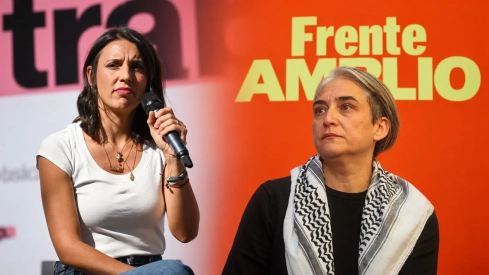
Frente Amplio and Podemos reach the final stretch of negotiations for the general elections on November 29 with the possibility of an agreement open and Madrid among the main obstacles. At the doorstep of the last 48 hours to register coalitions, Ada Colau offers to discuss her candidacy and the electoral brand, while Podemos maintains its commitment to Irene Montero and collaboration with Gabriel Rufián. Among the proposals is still the number two for Montero for Madrid that 'ElConstitucional.es' exclusively advanced this Tuesday.
Internal sources of the Frente Amplio now convey to this newspaper discomfort with primaries that have a single aspirant to the Presidency of the Government, although they maintain confidence in reaching an understanding. Their interlocutors consider that the vote promoted by Podemos should allow continued negotiation between organizations. Meanwhile, the possibility of territorial agreements coexisting with separate candidacies in Madrid is contemplated, a scenario still pending the decisions of the parties.
Madrid remains open with Delgado at the helm and a proposal for Montero
Izquierda Unida, Movimiento Sumar, Más Madrid and Comuns confirmed this Tuesday to Emilio Delgado as head of the list for Madrid. The agreement sets the first position of the Frente Amplio candidacy, but leaves pending the distribution that would result from an eventual incorporation of Podemos. The regional deputy of Más Madrid thus obtains the support of the four organizations to head a decisive constituency both for the deputies it distributes and for the visibility of its candidate.
As this newspaper published based on sources close to the negotiations, the proposal to reserve the second place for Montero would modify the distribution presented by Más Madrid, which had placed the Minister of Health, Mónica García, there. The offer described by these interlocutors has yet to be translated into an official announcement by the organizations. Opening that position would allow recognition of the weight of Podemos and its electoral reference, although the entire list and state leadership would still have to be agreed upon.
Podemos maintains a distinct position. Its general secretary, Ione Belarra, defended this Wednesday on 'Mañaneros 360', on TVE, the Montero-Rufián tandem as the best option for the left, while offering dialogue to the parties of the Broad Front and to territorial forces. The Organization Secretary, Pablo Fernández, also claimed this afternoon on 'Malas Lenguas' that collaboration as a basis for expanding alliances. Both parties seek broader candidacies, but propose to build them around different projects and procedures.
Within the Broad Front, the hypothesis circulates that Podemos will end up presenting its own candidacy in Madrid with Rufián participating in its campaign. Sources place it as a possibility, without considering it closed. The agreement with ERC already contemplates cooperation in the campaign and Podemos' support for republican candidacies in Catalonia. Rufián asked this Tuesday that ERC and Comuns talk to unblock the Catalan fit. The scope of that cooperation remains relevant for any state understanding.
Colau offers to yield while primaries strain the negotiation
Colau defended this Wednesday on 'La Hora de La 1', on TVE, that her candidacy can also be discussed if another person gathers more consensus. The former mayor of Barcelona, proposed by the four parties of the Broad Front for the Presidency of the Government, is also open to changing the name of the coalition. "There can be no crossed vetoes or red lines," she demanded. Her call expressly includes the Podemos leader. "I cannot conceive that we build a single candidacy where Irene Montero is not present," she stated.
The federal coordinator of IU, Antonio Maíllo, has supported that offer as an expression of willingness to build a broad alliance, while maintaining Colau as the ideal person to lead it and ruling out Rufián as the Broad Front candidate. From the Comuns, the Minister of Culture, Ernest Urtasun, has also called for unity and electoral strength to bring measures such as those included in the housing decrees to the Government and Congress. Programmatic coincidence continues to be one of the arguments for seeking an agreement.
Montero, MEP, political secretary of Podemos and former Minister of Equality, insisted this afternoon, before participating in the demonstration for public education in Madrid, that she will respect the result of the primaries. "I will do what the majority says and that is why I have presented myself for primaries," she said. She also defended working intensely to reach territorial agreements following the collaboration with ERC. Voting ends this Thursday at 11:59 p.m. and the results will be published on Friday starting at noon.
The disagreement over that procedure continues to weigh. The primaries admit citizen participation outside of Podemos, but Montero is the only candidate for the Presidency, after the parties of the Broad Front refused to participate and demanded to negotiate the election method beforehand. Sources from this space interpret that the process will end up validating the leadership that Podemos already proposes and question that it becomes a condition for agreement. Even with that discomfort, they maintain their expectation that the formation will sit down to negotiate and an agreement can be reached.
Territorial pacts can decide how many deputies the left retains
Negotiation also continues in the Valencian Community, Aragon, the Balearic Islands and the Canary Islands. Compromís seeks a broad Valencian candidacy, with its own leadership and open to other forces, while Chunta Aragonesista tries to articulate an alliance from Aragon. Belarra has pointed to these contacts as part of the pending work, beyond the focus on Madrid and Barcelona. The margin for sharing ballots will depend on the conditions agreed upon by the organizations of each territory and how they fit in with the state negotiation.
In the Balearic Islands, the clash over the distribution persists. According to information published by 'Última Hora', Podemos proposes that Ara Més head the list and Lucía Muñoz occupy the second position, with a two-year rotation for each formation if they obtain a deputy. Ara Més defends its leadership and maintains reservations about that alternation. Més has called an assembly of its bases for this Thursday, while conversations continue to expand the candidacy to Congress and explore an alliance to the Senate with the Balearic socialists.
The translation of agreements into seats will be decisive. The CIS published this Wednesday attributes 6.1% to Sumar/Frente Amplio and 3.1% to Podemos; furthermore, Rufián reaches 8.1% among preferences to preside over the Government, a different measure from the estimated vote for parties. The fieldwork was carried out from October 1 to 6, before the officialization of the ERC-Podemos agreement. Representation will also depend on the provincial distribution of support, especially in small constituencies, where two candidacies can compete for the same last seat.
While negotiating, Frente Amplio has presented its image in intense orange and yellowish green, the slogan "It's time", a website and profiles on X, Instagram, TikTok and Bluesky. Its public presentation is scheduled for Saturday 17, at noon, in the Auditorium of the Manzanares Linear Park in Madrid. Before that, the registration of alliances must be resolved. The deadline ends this Friday 16 at 11:59 p.m.; candidacies with names and their order will be presented between October 21 and 26.
