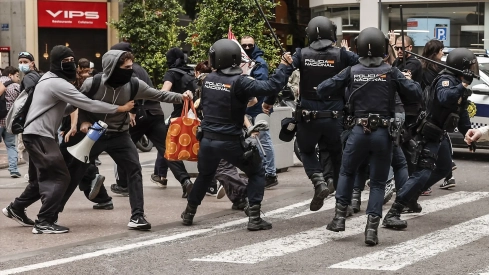
The decision of the Minister of the Interior, Fernando Grande-Marlaska, to prohibit the use of tear gas against demonstrators, after the controversy over police charges during the general strike of 11N, has angered several unions of the National Police, who consider that the measure places agents "under suspicion" and leaves them, in their words, "sold out and defenseless."
Sources from the Ministry of the Interior confirmed this Thursday that an investigation has been ordered and that the department has given instructions that, "henceforth, tear gas should not be used in demonstrator control devices."
The SUP defends police action and demands institutional support
The Unified Police Union (SUP), the majority among commanders, has stated in declarations sent to Europa Press that it does not question the investigation of possible irregularities, but it does reject that any use of force is presented as police abuse. "Enough of presenting any use of force as police abuse. Agents are obliged to act in situations of violence and cannot do so with fewer and fewer tools and less institutional support," the organization said.
The SUP has described as "unacceptable" that, after a day marked by public order disturbances and injured police officers, the minister's response is, in their opinion, to put agents under suspicion and restrict their means of intervention. "Police officers cannot always be the first to assume risks and the first to be questioned by their own Ministry. We demand protection, respect, and institutional support," it added.
The SPP speaks of public disauthorization and demands respect
The Professional Police Union (SPP), the majority among police commanders, has joined the criticism and stated that it is "deeply indignant, tired, and fed up" with the National Police being used, in its opinion, as "political bargaining chip."
The organization has warned that withdrawing operational tools such as tear gas from riot control devices "is not modernizing, nor is it progressive: it is leaving agents sold out, defenseless, and exposed to direct aggressions without an effective intermediate alternative." Furthermore, it has asked the Government and the Ministry of the Interior to stop singling them out when it is the police who "risk their lives" and has demanded "legal support" and "an immediate cessation of public disauthorization."
Jupol calls for Marlaska's resignation and criticizes the internal investigation
For its part, Jupol has reacted to the prohibition of tear gas and the opening of the internal investigation by demanding the immediate resignation of Fernando Grande-Marlaska, whom it reproaches for investigating police officers "while being unable to offer condolences for the murder of a colleague in Oviedo."
This union has recalled that the coercive means available to the National Police are regulatory work tools, provided by the Administration itself, and that their use must respond to criteria of necessity, proportionality, and congruence. In this sense, it has defended that tear gas "constitutes a coercive means of intervention that allows, in certain circumstances, to act while maintaining distance and avoiding direct physical contact with violent individuals."
Jupol, like other unions, has criticized that agents are investigated but without any "condemnation of violence against police officers" from the Interior.
Balance of arrests and criticism for the Ministry's response
The protests during the 11N strike left police officers injured and 47 people arrested for disturbances in interventions by the National Police and the Civil Guard, to which were added other actions by Mossos d'Esquadra and Ertzaintza, which raised the number of arrests to over a hundred, according to data mentioned by police organizations.
The associations have insisted that the Ministry of the Interior's decision comes just days after the death of an agent and his dog in the line of duty in Oviedo, after a shooting and a backpack explosion, an episode for which the unions had again demanded recognition of the profession as high-risk.
Contact