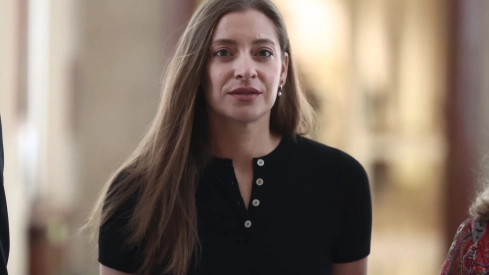
Ester Muñoz has set a limit on one of the main promises with which the Popular Party intends to present itself as an alternative to Pedro Sánchez. The PP spokesperson in Congress has acknowledged that a party with hundreds of mayors, thousands of councilors, and numerous public officials can never guarantee that no case of corruption will appear.
"When you govern such a large party with so much territorial power, it is impossible to guarantee zero corruption. That is the reality," she stated in an interview published this Monday by 'El Mundo'. Muñoz believes that corruption "is part of human nature" and shifts the true test of each party to the response it offers when irregularities appear.
Her words come after months of popular offensive against the Government due to investigations affecting the PSOE and Sánchez's inner circle. Alberto Núñez Feijóo has gone so far as to proclaim that "corruption will leave when Sánchez leaves" and has promised an Institutional Clean-up Plan if he manages to reach La Moncloa. His parliamentary spokesperson now lowers the scope of that promise and admits that no party with such a broad territorial structure can ensure that all its members will always comply with the law.
Muñoz also acknowledges that the scandals related to the Government facilitate "a lot" her work in Congress, although she assures that she would have preferred them never to occur. The popular leader maintains that the open cases harm the country's image and fuel the weariness of citizens who end up viewing all politicians as part of the same problem.
Muñoz shields Feijóo
The spokesperson defends that the guarantee offered by Feijóo lies in his career at the head of different administrations. She recalls his time at Insalud, Correos, and the Xunta de Galicia and assures that no person belonging to his direct teams has been convicted or charged with corruption during his three decades of public career.
"A person with that background, who in 30 years has not appointed anyone who steals, no longer has to prove anything," she concluded. Muñoz thus uses Feijóo's personal history to answer for the future behavior of a much broader party with power in city councils, provincial councils, and autonomous communities throughout Spain.
His statement is expressly limited to the direct collaborators chosen by the popular leader and leaves out the judicial history of the PP itself. The Supreme Court confirmed in 2020 the civil liability for profit of the party in the first period of the 'Gürtel case' for electoral acts paid for by companies of Francisco Correa in Majadahonda and Pozuelo de Alarcón. That legal figure did not entail a criminal conviction for the PP and presupposes that the beneficiary was unaware of the commission of the crimes. The party had to return, however, more than 245,000 euros for the illicit enrichment obtained through electoral expenses assumed by the plot.
Muñoz believes that the reaction to each case separates some parties from others. The PP may encounter episodes of corruption if it returns to government, according to its own reasoning, but the spokesperson promises a forceful action when they appear. That is the guarantee it offers against an impossible total absence of criminal behavior.
Pacts with the far-right Vox and a future Government
The popular leader has also defended territorial agreements with the far-right Vox. Muñoz rejects that the positions of Santiago Abascal's party can be compared with those of EH Bildu and maintains that Vox, as an organization, does not defend Francoism. She does acknowledge that some of its representatives have starred in "unfortunate interventions."
Muñoz cites the situation of LGTBI rights as an example to deny that coalitions between PP and Vox have caused setbacks. She also downplays the incorporation of the so-called 'national priority' into the agreement reached in Andalusia and presents this measure as a way to carry out a "rational management of immigration".
The clause goes beyond migratory management. The 'national priority' is the formula with which Vox intends to give preference to Spaniards over foreigners in access to certain aid, benefits, and public housing. Its application must respect the constitutional and European principles of equality and non-discrimination, limits on which Muñoz has not commented during the interview.
The spokesperson did reserve some praise for leaders at her ideological antipodes. She believes that Félix Bolaños and Gabriel Rufián have "flexibility and intelligence" and values their ability to respond during debates. Her opinion of Carlos Cuerpo is much harsher. "He is a robotic, repetitive person incapable of confronting what I tell him. He brings his prepared speech and that's it," she said about the first vice-president.
Muñoz assures that she maintains mutual respect with Rufián despite their confrontations in Congress. The ERC spokesperson has promised to work to prevent her from becoming a minister, while the popular leader acknowledges that she will do the same to prevent the republican from being part of a government. Her only personal red line is EH Bildu, whose representatives, for her, do not deserve "not even a greeting."
The possibility of becoming a minister appears several times in the conversation. Muñoz begins by rejecting it with a "No!" and assures that the elections are still far off. She also anticipates that Feijóo will carefully study each appointment because his future Executive will have to "reconstruct many things" that, in her opinion, have been destroyed during the years of socialist government.
Her refusal loses force when asked if she is ruled out among those possible ministers. "I don't know. Maybe not," replies the spokesperson, who leaves the decision in Feijóo's hands. "At the moment, I only see myself as a spokesperson. I am on the front line of battle and here the goal is that, sooner or later, the PP reaches the Government," she concludes.
