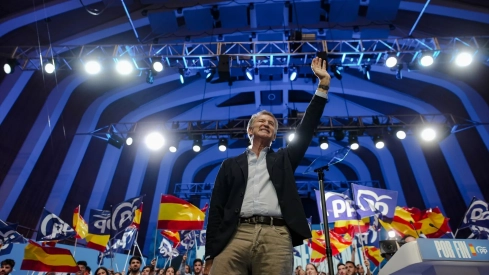
Alberto Núñez Feijóo is preparing a renewal of around 60% of his list leaders for Congress for the elections on November 29. Mayors, regional councilors, and health management officials are leading the replacements, which the president of the PP will present this Sunday, October 25, in Salamanca, accompanied by Alfonso Fernández Mañueco, one day before the deadline to register candidacies.
The change fully affects Catalonia and the Canary Islands and is particularly intense in Andalusia and Castilla-La Mancha. In the positions of Feijóo's closest team, continuity predominates. Miguel Tellado, Ester Muñoz, Cuca Gamarra, Elías Bendodo, Juan Bravo, and Carmen Fúnez repeat for A Coruña, León, La Rioja, Málaga, Seville, and Ciudad Real, respectively. The popular leader thus retains the main leaders who have guided his parliamentary and party strategy.
In Madrid, the main promotion is that of Cayetana Álvarez de Toledo, who moves up from sixth to second place, while Borja Sémper maintains the third. Feijóo places two figures with different political profiles alongside him, a combination with which he seeks to unite the different sensibilities of the PP in his own candidacy.
Women head approximately half of the known lists, including the three from the Valencian Community and the two from Extremadura. In addition, these general elections incorporate the requirement to alternate women and men in the candidacies, introduced by the 2024 parity law, which also conditions the distribution of the starting positions.
Mayors will make the leap to Madrid without letting go of their city councils
Xavier García Albiol and María José Catalá are two of the bets with the greatest public exposure. The mayors of Badalona and Valencia will head the lists for Barcelona and Valencia and have announced that they will maintain their municipal responsibilities. Pilar Miranda, for Huelva, and María José García-Pelayo, for Cádiz, also want to combine both positions. Carlos Velázquez, mayor of Toledo and head of the list for that province, joins them.
That accumulation raises a question within the party itself. Article 12 of the PP's statutes declares it incompatible to be a deputy and mayor of a municipality with more than 20,000 inhabitants, although it allows extraordinary exceptions approved by the National Executive Committee. The internal rule requires resolving this compatibility for those who intend to retain both positions; electoral legislation does not establish an equivalent general prohibition.
Catalá's election adds a contradiction to the discourse of the Valencian popular party members. The party had criticized that Pilar Bernabé headed the PSOE list for Congress and was also a candidate for Mayor. The popular spokesperson in Les Corts, Nando Pastor, even stated that Bernabé "doesn't care a fig about Valencia". Now both will compete for the same constituency months before facing each other again in the municipal elections of May 2027.
Andalusia concentrates six changes in eight provinces. In addition to García-Pelayo and Miranda, Carmen Crespo enters in Almería, Lorena Guerra in Córdoba, Jorge Saavedra in Granada, and Luis Mariano Camacho in Jaén. Crespo comes from the European Parliament and was Minister of Agriculture; Guerra is a senator and agricultural technical engineer; Saavedra is deputy mayor of Granada, and Camacho, mayor of Bailén. Bravo and Bendodo retain the two remaining head positions.
The candidacies will force the barons to reorganize their governments
Feijóo also resorts to officials from regional executives. María Pardo, Minister of Education of Castilla y León, will head Valladolid; Isabel Urrutia, head of the Presidency of Cantabria, will lead that constituency; and Elena Albalat, Minister of Social Services, will go for Castellón. In Galicia, Fabiola García, head of Social Policy, will be Miguel Tellado's number two for A Coruña. Their departures will force a reorganization of the respective governments.
In Pontevedra, Julio García Comesaña replaces Ana Pastor, already removed from the political front line. Feijóo brings back the person he appointed Minister of Health in September 2020, during the pandemic, and who left Alfonso Rueda's Government in 2024. The Galician continuity includes Francisco Conde for Lugo and Ana Vázquez for Ourense, who will repeat after the pepper spray incident in Congress. Her case was dismissed because the dissolution of the Chamber prevented voting on the proposed sanction.
One of the most unique additions is Montse Chimeno, health manager of Zamora and president of the Spanish Society of Internal Medicine, who will head the provincial list with Fernando Martínez-Maíllo as number two. Elvira Velasco moves to the Senate. In Asturias, the PP is betting on Ángela Pumariega, deputy mayor of Gijón and Olympic sailing champion in London 2012, while Miriam Guardiola rises to the first position for Murcia after serving as a deputy and deputy spokesperson.
Canarias renews its two headliners with Sergio Ramos for Las Palmas and Gustavo González de Vega for Santa Cruz de Tenerife. The first is a former senator and former councilman of Telde and returns after having left politics in 2024; the second comes from the Vice-Ministry of Economy of the Canarian Government. In Castilla-La Mancha, along with Velázquez and Fúnez, Francisco Navarro for Albacete, Raquel Oliver for Cuenca, and Itziar Asenjo for Guadalajara will run, with municipal and regional trajectories.
Catalonia changes all its headliners and Navarra reunites old rivals
Albiol's candidacy displaces Nacho Martín Blanco from the first position for Barcelona. The other three Catalan replacements are Diana Moya in Girona, Roger Melero in Lleida, and Mónica Landete in Tarragona. Moya is a jurist, political scientist, and local administration official; Melero is a councilman and head of Immigration for Nuevas Generaciones; and Landete is a lawyer specializing in insurance, consumer, and transport. The PP combines the electoral pull of the mayor of Badalona with profiles of less national projection in the other provinces.
The Basque Country also changes its references. Iñaki Oyarzabal will head Álava and Jon Echeverría, Gipuzkoa, while the substitute for Beatriz Fanjul in Bizkaia is still pending. The former president of Nuevas Generaciones has explained that she is leaving politics by her own decision, despite the party offering her to repeat. "I am 35 years old and I want to do other things," she declared when announcing her departure.
In Navarra, the pact with UPN places Leticia San Martín as head of the list and Sergio Sayas in second place. The coalition will once again bring together Sayas and Javier Esparza in the campaign, who will head the Senate and presided over UPN when he and Carlos García Adanero disobeyed the order to support the labor reform in 2022. Both were expelled and ended up joining the PP. The electoral agreement now reconstructs a collaboration broken by that crisis.
The province chosen for Sunday's presentation provides another change. Carmen Seguín heads the PP's proposal for Salamanca and José Antonio Bermúdez de Castro moves to second place. The Councilor for Institutional Relations, Festivities and Traditions comes from the institutional communication of the City Council. The candidacy approved by the provincial committee, with Pilar Sánchez in third position, must be ratified by the National Electoral Committee.
