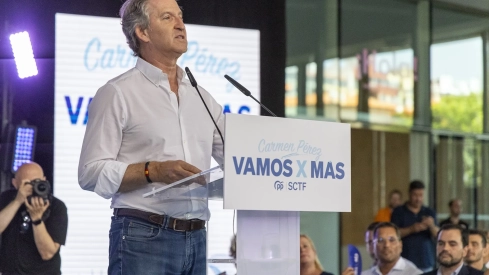
Alberto Núñez Feijóo has taken advantage of the warnings from the European Commission about corruption in Spain to launch a new offensive against Pedro Sánchez. The president of the Popular Party has accused the head of the Executive of deteriorating the country's image and has promised an "Institutional Clean-up Plan" if he manages to reach La Moncloa.
"Corruption will leave when Sánchez leaves," Feijóo declared during an event held this Friday in Santa Cruz de Tenerife. The popular leader has taken his accusations directly to the President of the Government, whom he has defined as the political responsible for the scandals known in recent months.
"If Sánchez's entire environment is corrupted, the rotten apple is him," he stated before the officials and sympathizers gathered for the presentation of Carmen Pérez as the PP's candidate for mayor of the capital of Tenerife.
The speech comes after the European Commission published its 2026 Rule of Law report. Brussels recognizes the legislative projects promoted by the Government, but considers that their practical application remains limited in matters such as conflicts of interest, asset declarations of high-ranking officials, and the regulation of lobbies.
The PP presents the report as a general failure
The popular leadership has described the document as "the most complete and worrying diagnosis" prepared so far about Spain. Génova maintains that the European Commission fails the country on corruption, judicial independence, and public media.
The community report lacks grades or failures and uses a scale to measure the progress made on each recommendation. The Commission appreciates significant progress in the status of the attorney general and in access to information, some progress in the functioning of the CGPJ and in speeding up major cases, and limited progress in the control of high-ranking officials and pressure groups.
The PP has focused its reaction on the most severe warnings and has relegated the favorable sections to the background. Brussels confirms that the effective application of the State Anti-Corruption Plan has not yet improved existing rules, although it recognizes its approval and the processing of the future Public Integrity Law.
The Commission also demands a truly independent supervisor, with sufficient means and capacity to detect and sanction irregularities. It also calls for accelerating major corruption investigations, completing the regulation of lobbies, and reducing weaknesses in public procurement.
"He is the rotten apple"
Feijóo has stated that the corruption linked to the PSOE is "systemic" and is "at the heart of the State." The popular leader has mixed the conclusions of the European report with the judicial proceedings affecting former socialist leaders and people close to the president.
He has also brought back one of his most repeated phrases in recent weeks, according to which "Sanchismo has more defendants than deputies." The expression has become one of the main slogans of the PP to try to concentrate different judicial cases under the same label.
Feijóo has accused the president of being unable to detect what was happening around him. "If Sánchez was not able to smell the corruption in the seat next to his car, in the Council of Ministers, in the Federal Committee of the PSOE, or in his house, he is not capable of eradicating it," he declared.
The popular leader has also placed the Canary Islands as "ground zero of Sanchista corruption" due to the trips of former minister José Luis Ábalos, the mask plot, and the Mediador case. The reference allowed Feijóo to connect his national discourse with the chosen setting to present the PP's municipal candidate.
A plan still without a known text
Feijóo has announced that his Institutional Clean-up Plan will include a reform of the suplicatorio to facilitate the judicial appearance of government members. The alleged parliamentary blockade mentioned by the popular leader has not occurred during the current legislature, although the PP assures that it wants to prevent it through a legal modification.
The opposition leader has also committed to regulating the activity of lobbies, one of the repeated demands by Brussels. The Government approved its project in January 2025, but the norm is still pending completion of its processing in Congress.
Another of Feijóo's promises consists of prohibiting pardons for those convicted of corruption. The current Government has not granted any individual pardon to a leader convicted of corruption during this period, while José María Aznar's Executive did grant a partial pardon in 1998 to José Barrionuevo and Rafael Vera, convicted for the kidnapping and embezzlement in the GAL case.
Feijóo has also promised to review public appointments to guarantee the independence of institutions. His intention, he explained, is to place "the best servants and not those most subservient to the master."
"If someone puts their hand in the till, they're out on the street in a minute and a half," he assured. The PP will now have to specify the legal content, deadlines, and organisms affected by a plan announced so far in general terms.
The report also points to judges
The Popular Party has especially highlighted the section dedicated to criticisms by political representatives against judges and judicial rulings. Brussels notes the concern expressed by the Supreme Court, the CGPJ, judicial associations, and the Constitutional Court regarding statements directed against certain magistrates.
The Commission asks the Executive and Legislative powers to avoid interventions capable of weakening judicial independence or public trust in the courts. The PP believes that this warning confirms its complaints against ministers and socialist leaders for speaking of "lawfare" or questioning procedures affecting Sánchez's circle.
The European document also incorporates the other side of this institutional tension. Some judges have made public statements against political officials, and several of these actions are being studied by the Disciplinary Commission of the CGPJ.
Brussels calls for mutual respect from the Government, Parliament, and the Judiciary. This second call has occupied considerably less space in the reaction disseminated by Génova.
The battle for RTVE
The PP has also used the section on public media to accuse the Government of interfering in RTVE. The report includes concerns expressed by the News Councils of TVE and RNE about professional standards and the risk of political bias in some content.
The Commission attributes these warnings to the consulted parties and also includes the Government's position, which defends the normal functioning of the corporation after the latest reforms. The document calls for sufficient guarantees for the editorial independence of national and regional public broadcasters.
Génova has turned this section into another of its arguments to maintain that Spain is experiencing a generalized democratic deterioration. The European report maintains a more measured tone and presents the contradictory assessments provided during its preparation.
Bolaños claims the advances recognized by Europe
The Government has responded to the PP by focusing on the favorable sections. Félix Bolaños has defended that Brussels positively values the reform of Justice and notes that some of the measures "are already bearing fruit."
The Minister of the Presidency and Justice highlighted the creation of 500 judicial positions and 200 for prosecutors, the largest joint expansion carried out to date. He also pointed out the reduction of civil litigation linked to the Efficiency Law and Spain's position among the most advanced European countries in judicial digitalization.
Bolaños also stressed that the Commission appreciates significant progress in the reform of the prosecutor general's statute. The project would extend his mandate to five years to temporarily separate it from the political cycle of the Government that proposes his appointment.
The Executive acknowledges that several norms are still pending in Congress. These include the Public Integrity Law, the regulation of interest groups, the criminal procedural reform, and the Open Administration Law.
Feijóo returns to corruption after the setback of the amnesty
The new discourse comes a day after the Court of Justice of the European Union endorsed the main aspects of the amnesty law examined so far. Feijóo has assured that he respects judicial decisions, although he maintains his political and moral rejection of the norm.
The PP is now trying to shift its strategy towards corruption, a terrain it considers more favorable after the latest known procedures and convictions. The Brussels report offers new warnings on which to build this offensive, although its conclusions are broader and more nuanced than the portrait disseminated by Génova.
The presentation took place during Carmen Pérez's official launch as a candidate for the Mayoralty of Santa Cruz de Tenerife. Feijóo ended his speech by calling for the party's mobilization for the upcoming elections and promising that he will explain to citizens what he finds in the Administration if he reaches the Government.
