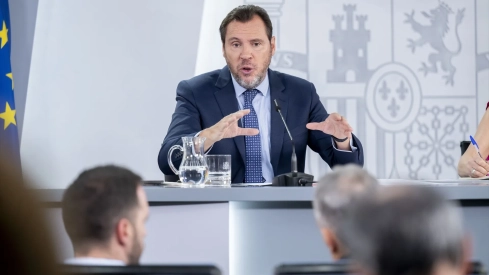
Óscar Puente has fully entered the political debate opened by the large fires that are punishing Madrid, Castilla y León, and Castilla-La Mancha. The Minister of Transport published an extensive video on X this Monday to reject the PP's requests to set aside responsibilities while extinction efforts continue. "Some of us refuse to remain silent any longer," he warned.
Puente argues that behind the increase in large fires are climate change, the precariousness of regional extinction services, and years of political decisions that have reduced resources allocated to prevention. His message points directly to the Popular governments of Isabel Díaz Ayuso and Alfonso Fernández Mañueco, the two communities most affected by the flames in recent days.
The video extends the confrontation that began on Friday, when Puente accused the PP's autonomous communities of resorting to the Military Emergency Unit while reducing taxes and weakening their public services. Ayuso responded by calling him a "buffoon" and demanded a lowering of the tone, while the minister returned the insult a few hours later.
Una reflexiones sobre el tema de los incendios, sobre lo de ir todos a una y sobre cuándo tocan o no según qué debates políticos. pic.twitter.com/xdsxqs8bgh
— Óscar Puente (@oscar_puente_) July 27, 2026
Puente holds PP autonomous communities responsible
"Behind this drama we experience every summer are their policies," Puente stated. The minister accuses the PP and the far-right Vox of denying the relationship between climate change and the growing virulence of fires, while signing government agreements in which the expression "climate fanaticism" is used.
Puente has placed much of the political responsibility on prevention. "Cleaning the countryside and preparing it to better resist fire is an autonomous competence. And they do not exercise it," he denounced. He also reproached the Popular executives for keeping extinction personnel "in the most absolute precariousness" while applying tax cuts to large fortunes.
The legislation supports the distribution of powers indicated by the minister. Article 48 of the Forest Law entrusts the autonomous communities with the approval of annual prevention, surveillance, and extinction plans for their entire territory. These documents must include silvicultural treatments, firebreaks, access roads, water points, professional staffing, and funding.
The declaration of a national interest emergency has placed the Ministry of Interior at the forefront of the operational response in Madrid, Ávila, and Toledo, where state, regional, and local resources are already working together. This common command now coordinates extinction efforts, while the ordinary powers of prevention and land preparation continue to correspond to each autonomous community.
Puente has also defended his right to intervene due to the consequences that fire causes on the railway network. According to the data presented in his video, 30% of railway incidents recorded last summer were related to fires near the tracks. The minister also recalled that circulation between Madrid and Galicia remained interrupted for 15 days due to the fires.
"I have a loudspeaker and I am not willing to silence it," he warned. Puente compared the situation to the reconstruction of infrastructures damaged by the DANA in Valencia, where Transportes did undertake direct work. The minister assures that he then fulfilled his responsibilities without offloading them onto other administrations.
The UME's archives and the PP's initial rejection
The toughest part of the video came when addressing the use of the Military Emergency Unit. Puente believes that the UME has become the service that PP communities resort to as soon as their devices are overwhelmed and attributes this dependence to the lack of their own personnel.
The unit was created by the Government of José Luis Rodríguez Zapatero through a Council of Ministers agreement on October 7, 2005. The PP then questioned its fit, its cost, and the use of the Armed Forces in civil emergencies. Popular deputy Beatriz Rodríguez-Salmones asked in Congress that military personnel not be turned into firefighters and accused the Executive of using soldiers as "fire extinguishers".
Puente has assured that the popular party even appealed the creation of the UME before the Supreme Court. That point requires a clarification. The appeal that ended with the annulment of the first Intervention Protocol was filed by the Basque Government, and the Supreme Court upheld it in 2008 because the mandatory reports from Civil Protection and the Council of State were missing. The ruling affected the procedure followed to approve the protocol, which was replaced in 2011, and did not eliminate the unit.
The minister has used that opposition to criticize the current request for military resources. "Those who asked that the military not be turned into firefighters today demand the intervention of the UME at the first sign of trouble," he reproached before accusing the PP of later appropriating advances that it rejected in its origins.
Puente has also questioned why the popular party now appeals to unity after years attacking the legitimacy of the Government and Pedro Sánchez's family. He cited disputes over Spanish sovereignty, tariff threats, wars, and the destruction of Gaza to ask why the PP demands unity during fires while breaking that common position on other State matters.
"Why on some occasions do we all have to go as one and on others do we like the fruit?" he launched in a direct reference to the expression popularized by Ayuso. The minister believes that the request to lower the tone seeks to protect regional governments from an uncomfortable debate about their decisions.
Puente ended by taking the discussion to the polls. Against the slogan "let Txapote vote for you," he asked citizens to assess who guarantees healthcare, education, fire-fighting devices, and the response to climate change. "It is time to put them in front of their contradictions and their shortcomings. Let the debate open in all its rawness," he concluded.
Add ElConstitucional.es as a preferred Google source for free.
Stay informed about all the latest breaking news with the best information. Against disinformation, for democracy and social rights.
