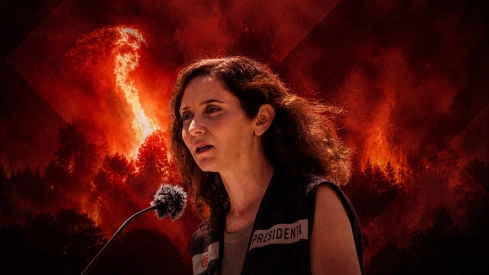
Isabel Díaz Ayuso has taken advantage of her visit to the command post of the Sierra Oeste fire to question the Government's climate response and revive one of the arguments that are repeated most often every summer. The president of Madrid has asked to listen to those who live in rural areas and find, in her words, "many difficulties to clean the forests and to work their own lands".
Ayuso has also stated that "the vast majority" of fires are intentional and has accused Pedro Sánchez of proposing "broad-brush" solutions by defending a state pact against the climate emergency. The two statements mix different issues and convey an image that the available official data do not support.
State legislation allows for brush clearing, vegetation removal, and silvicultural treatments. Furthermore, it obliges autonomous communities to plan prevention and to require owners to carry out work when necessary. The plan approved this year by the Community of Madrid itself schedules preventive actions on 5,652 hectares.
It is also worth clarifying what "cleaning the mountain" means. This expression encompasses very different activities, from removing fallen branches to felling trees, opening firebreaks, burning plant remains, or using machinery capable of producing sparks. Each job has specific conditions, and most of the most severe limitations appear when the risk of fire is very high or extreme.
The Forest Law mandates prevention throughout the year
The main regulation is Law 43/2003, on Forests. Its article 43 establishes that the competent public administrations must coordinate the prevention, surveillance, and extinction of fires, regardless of who owns the land.
The distribution of responsibilities is clearer in article 48. Autonomous communities must approve a plan for their entire territory each year, keep it active for twelve months, and detail the available resources. This plan must include silvicultural treatments, firebreaks, access roads, and water points, in addition to setting out the work corresponding to public and private owners.
The same provision allows these actions to be carried out through agreements, public aid, or subsidiary intervention by the administration. The state law therefore facilitates prevention and entrusts each autonomous community with ordering how it should be carried out.
The restrictions included in section six of article 48 mainly affect periods in which AEMET declares a very high or extreme danger. In these cases, communities must suspend burning and limit the use of machinery that can generate deflagrations or sparks within the forest and in a 400-meter strip. These are temporary measures aimed at preventing new ignitions during the most dangerous days.
Logging and timber harvesting also have regulations. Article 37 allows them to be carried out through a responsible declaration when the land has an approved management instrument. In unmanaged forests, prior authorization is usually required. The objective is to maintain sustainable exploitation and avoid damage to protected areas, riverbeds, fragile soils, or cataloged species.
Madrid grants its own permits and schedules the work
The authorizations affecting Madrid's forests depend on the Community of Madrid. Its own electronic headquarters explains that work on arboreal vegetation or forest exploitation can be processed through authorization or responsible declaration, depending on the volume, surface area, and characteristics of the land.
The regional regulation also contemplates actions that can be carried out without authorization. These include the removal of dead or fallen branches and certain clearing of undergrowth less than 1.5 meters, provided they do not affect protected species or exceed 1,000 square meters annually. Larger interventions require control by the General Directorate of Biodiversity and Forest Management of the Community itself.
The Annual Plan for the Prevention, Surveillance, and Extinction of Forest Fires in Madrid for 2026, approved on April 29, expressly reproduces the obligation of public and private owners to carry out the necessary preventive work. The document organizes treatments on vegetation, maintenance of firebreaks, preventive grazing, forest roads, and water points.
The figures are concrete. The Ayuso Government has programmed 1,307.89 hectares of silvicultural treatments, 411.56 hectares of firebreak maintenance, and 3,772.59 hectares of preventive grazing. The total of the actions reaches 5,652.38 hectares this year.
The device includes 37 brigades and 419 workers dedicated to preventive tasks, above the 32 brigades and 258 personnel included in the 2025 balance. The financing and execution of these measures are fundamentally the responsibility of the regional Government, although some projects may receive state or European funds.
That certain owners encounter administrative delays, discrepancies with forest agents, or difficulties in affording the work can reveal specific management problems. These situations must be documented case by case and addressed to the Madrid administration, responsible for authorizing and supervising the actions. No state regulation contains a general prohibition on clearing forests.
The causes of the fires are still under investigation
Ayuso has assured that "the vast majority" of the fires are intentional. There are still no closed statistics that allow attributing a common origin to the large fires active this July. The Civil Guard and specialized brigades keep investigations open, and their conclusions may take weeks or months.
The main national statistic is the EGIF database of the Ministry for Ecological Transition. Communities submit a file with more than 150 fields for each fire, and the ministry must review and consolidate all that information. Reliable balances on causes are published a considerable time after each campaign ends, as explained by the official forest statistics portal itself.
The latest Seprona data released by the ministry correspond to 2023 and do not cover all fires registered in Spain either. Of the 2,944 cases analyzed by the Civil Guard, 225 were classified as intentional, 7.64%. Negligence was observed in 281, 241 had a natural origin, and 220 were accidental. The cause remained unresolved in 1,977 investigations.
The expression "provoked fire" also generates frequent confusion. It can be used for any fire started by human activity, even if it began due to imprudence, a breakdown, a machinery spark, or a controlled burn that got out of control. An intentional fire requires someone to have acted deliberately to set the land on fire. Both categories describe very different realities.
The climate does not light the spark, but it changes the fire
Every fire needs an ignition source. It can be lightning, a cigarette butt, a power line, agricultural machinery, a controlled burn, or an intentional act. Climate warming then affects soil and vegetation moisture, temperature, wind, propagation speed, and the intensity reached by the flames.
AEMET calculates that the average temperature in Spain has increased by 1.75 degrees since 1961. The twelve warmest years in the series have been recorded during the 21st century, and in the last decade alone, the agency counted 221 records of warm days compared to seven records of cold days. The data appears in the 2025 climate report.
AEMET itself uses temperature, relative humidity, wind, previous precipitation, soil moisture, vegetation status, and land uses to calculate its forest fire danger index. The amount of forest fuel matters, but its dryness and meteorological conditions determine how easily it can burn and how far the fire can advance.
A study published in 2025 in the journal NPJ Climate and Atmospheric Science, focused on the Iberian Peninsula, concluded that the increase in fuel dryness associated with climate change has increased the average propagation speed of the analyzed fires by between 2% and 8.3%, with differences depending on the area and type of vegetation.
The European Commission's Joint Research Centre also warns that the probability of experiencing days with high or extreme danger will increase across almost all of Europe as temperatures rise. The impact will be particularly pronounced in southern countries and will extend the seasons in which fires can acquire extreme behavior.
Forest fuel management, maintenance of agricultural mosaics, grazing, and silvicultural treatments are part of prevention. Adaptation to warming is also essential because a treated forest can face heat waves, droughts, and winds capable of overcoming defense lines.
The climate pact was presented in 2025
Ayuso has reproached Sánchez for talking about the pact against the climate emergency "since 2014." The official chronology disproves that date. The president announced the initiative on August 17, 2025, presented its first lines on September 1, and released a document with 80 measures in December of that same year.
The text presented by the Government places active forest management, preventive treatments, the recovery of mosaic landscapes, and support for rural activities among its first proposals. The pact is still awaiting the political agreement necessary for its approval and development.
It also proposes strengthening extinction resources, creating permanent state resources, improving coordination between administrations, and reviewing funding for prevention. Its content addresses both climatic conditions and land management, the two factors that specialists consider essential to reduce the impact of large fires.
Burned land cannot be freely reclassified either
Another message spread on social media claims that forests are burned to build homes, install solar plants, or erect wind farms. Article 50 of the Forest Law establishes a prohibition on changing forest use for at least 30 years and bans any activity incompatible with the regeneration of the vegetation cover.
The norm contemplates very specific exceptions. The new use must have been foreseen before the fire in an already approved planning instrument or be processed through a law for a compelling reason of paramount public interest, with equivalent compensatory reforestation. The exception cannot even be applied to forests included in the Catalog of Public Utility Forests.
Renewable energy projects also do not need the land to burn to begin their processing. They must undergo the corresponding urban, energy, and environmental procedures, regardless of the prior existence of a fire. So far, the investigations opened into the large fires of July have not accredited a scheme aimed at reclassifying the affected land.
The specific cause of each fire must be established by the Civil Guard and the forest investigation brigades. Presenting all fires as intentional already turns a suspicion into a fact that does not yet exist.
