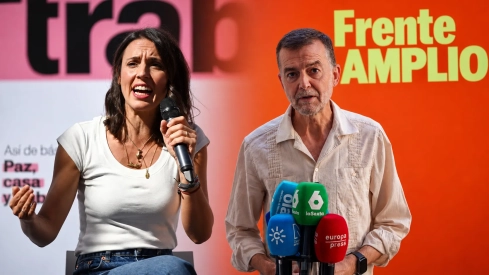
The territorial negotiation of the left reaches its decisive stretch with Podemos and Izquierda Unida clashing over the scope of the agreement. Ione Belarra's party proposes joint candidacies in ten autonomous communities, while Antonio Maíllo refuses to negotiate outside of Frente Amplio and demands a global understanding. The deadline to register coalitions ends this Friday at 11:59 p.m., with federations trying to save agreements they consider crucial for November 29.
From Podemos, they maintain this afternoon that their proposal is still valid. "Our proposal in these ten autonomous communities is that we can reach agreements," sources from the party consulted by 'ElConstitucional.es' convey. They add that in other territories more organizations are involved and there are also open conversations. "Our proposal is still on the table. I hope they can reconsider it," they lament.
The disagreement threatens to extend the division of Madrid and Barcelona to provinces where obtaining representation is much more difficult. The average of DatosRTVE polls published this Thursday attributes nine deputies to Sumar and two to Podemos if they run separately, compared to the 31 obtained by the joint candidacy in 2023. The comparison shows the deterioration of the space, although an eventual coalition cannot automatically assume the votes of both. The provincial distribution and the capacity for mobilization will be decisive to dispute the last seats with the right.
Ten communities pending agreement
Podemos' offer to IU covers Galicia, Asturias, Cantabria, Euskadi, Navarra, Castilla y León, Castilla-La Mancha, Murcia, Extremadura and Andalusia. Belarra presents this path as a way to prevent the disagreement in the large constituencies from impeding shared candidacies in the rest of the country. For the purples, IU's territorial presence allows exploring these agreements without first resolving the dispute over state leadership.
Maíllo has responded on 'La hora de La 1' that "Izquierda Unida is not going to negotiate with Podemos leaving Frente Amplio". The federal coordinator defends that his organization is committed to the project it shares with Movimiento Sumar, Más Madrid and Comuns and rejects separating conversations by communities according to electoral calculations. He maintains the invitation to Podemos to join this alliance and demands a negotiation between the organizations seated at the same table.
The distance is greater in Madrid and Barcelona. Belarra described an agreement in both constituencies as "very difficult" this Thursday on RNE and has once again defended the collaboration between Irene Montero and Gabriel Rufián. The understanding with ERC contemplates that Podemos will not present its own candidacy in Catalonia and that both leaders will campaign together. The general secretary maintains that the larger size of Madrid and Barcelona reduces the cost of competing separately, although greater proportionality does not guarantee that all votes will obtain representation.
That scenario was present in the information published by 'ElConstitucional.es'. This newspaper announced on Tuesday the proposal to reserve the number two position for Montero in Madrid, behind Emilio Delgado, and the margin that the consulted sources placed on territorial agreements. That possibility of fitting in did not become a pact. Belarra's statements this morning now reinforce the prospect of competition in Madrid, while negotiations focus on preventing the rupture from reaching the rest of the constituencies.
The territories try to save unity
The territorial calls have a concrete example in Murcia. The regional deputy for Podemos Víctor Egío appealed on Wednesday night for shared work with IU. "We share a parliamentary group in the Regional Assembly and work in the municipalities. We share struggles and trenches," he wrote on X. The daily collaboration between both organizations is the argument with which he demands that this understanding be transferred to the general elections.
IU's response in Murcia, also expressed by its regional coordinator, Penélope Luna, maintains the framework set by Maíllo. IU of Asturias has also ruled out a negotiation outside of Frente Amplio. The offers from territories such as Murcia, Asturias, Cantabria, and Andalusia thus clash with the demand to first resolve how the agreement with the entire alliance is articulated.
Canarias has opened another focus of tension this Thursday. According to 'Canarias Ahora', Nueva Canarias and Frente Amplio are preparing to register a coalition that, for the moment, does not include Podemos, although they keep its incorporation open. The planned name is Nueva Canarias-Frente Amplio in Las Palmas and Frente Amplio-Nueva Canarias in Santa Cruz de Tenerife. The organization led by Noemí Santana believed that an understanding was close and has publicly reiterated its willingness to agree. "It won't be because of us," she states in a message disseminated on X.
Nuestra voluntad sigue siendo firme https://t.co/HnwDR0RwPe
— Noemí Santana Perera (@noepmp) October 15, 2026
In the Valencian Community, the Balearic Islands, and Aragon, there are conversations with Compromís, Ara Més, and Chunta Aragonesista, respectively, with their own leaderships and territorial demands. These are different negotiations from the bilateral offer directed at IU in the ten communities. Podemos insists to this newspaper that these conversations are continuing. The objective of a shared candidacy remains open, but each territory must specify which organizations participate, under what formula, and with what distribution of responsibilities.
Colau demands to dispute seats from Vox
Ada Colau supported Maíllo's position this Thursday and demanded from Podemos a negotiation on equal terms with all forces of the Broad Front. On 'Mañaneros 360', on TVE, she defended that there is still "time left" and set the goal of "tripling the seats and taking them from Vox". This is the political aspiration she contrasts with partial agreements, whose usefulness she questions in the face of a shared state candidacy.
The former mayor of Barcelona also asked Rufián to use his influence to try for a joint list in Catalonia. On Catalunya Ràdio, she explained that ERC rejected opening that negotiation after contact from Comuns and questioned whether the republican spokesperson's support for Podemos outside Catalonia reinforces the competition among the left. Colau maintains this call after having shown herself willing on Wednesday to discuss both her candidacy and the name of Broad Front to facilitate an agreement, a move reported by this media.
The concern has also reached other members of the space. Mónica García has asked to "get out of the loop", while Pablo Bustinduy has demanded attention to the demands of the left mobilized for housing rather than party interests. The Minister of Youth and Childhood, Sira Rego, has admitted the difficulties with a "we are not doing very well". Emilio Delgado, for his part, has acknowledged the distance between the effort of those protesting in the street and the conversation of the parties, and maintains that an agreement must be reached.
While contacts continue, Podemos closes its primaries this Thursday at 11:59 p.m., with Irene Montero as the sole candidate for the Presidency of the Government. The results are expected for Friday from 12:00 p.m. On the same day, at 11:59 p.m., the deadline for communicating electoral coalitions will end.
