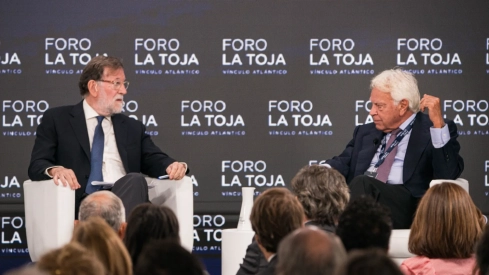
Mariano Rajoy and Felipe González have demanded that Pedro Sánchez call general elections during their meeting this Friday at the La Toja Forum, in O Grove, Pontevedra. The former president of the PP has asked for ballots "now", while the former socialist leader has resorted to irony to express his position. "If I say that elections must be called, they are not called," González said. "I will have more success, that's why I say they have to be called," Rajoy replied.
The conversation, moderated by journalist Lucía Méndez under the title 'Two views on Spain', was held while Congress debated the two housing decrees, before the result of the votes was known. The two former presidents shared much of their diagnosis of the political situation and defended a State pact to address the housing crisis.
Hours later, the Chamber rejected both texts. The first, which included protection measures against evictions and extensions of rentals, fell with 178 votes against and 172 in favor. The second, on the automatic renewal of contracts, received 184 votes against and 166 in favor. PP, Vox, Junts and UPN voted against both; PNV and Coalición Canaria also rejected the second.
The outcome has led Sánchez to open a period of reflection on a possible early election, without an announced call. The president has a weekend of new housing mobilizations ahead of him, after the Tenants' Union confirmed the continuity of the Puerta del Sol encampment.
Rajoy placed the problem on the Executive's ability to develop its program and gather stable support. "It has not been possible to govern for a long time now," he maintained, before stating that it was obligatory "to dissolve the Chamber, call elections and consult the people." González reinforced that criticism from the lack of new Budgets and recalled that, when he lost the necessary majority to approve them, he ended up calling elections. "Can one live without budgets?" he asked himself.
Spain continues to use the 2023 accounts, approved in 2022 and extended. The Constitution contemplates this automatic extension until the approval of new Budgets, so their absence does not in itself oblige to call elections. The former presidents have expressed their reproach in political terms, as a sign of the wear and tear of the Government's support. Rajoy has also questioned the use of budgetary modifications agreed upon in the Council of Ministers.
A pact for housing
The need for a broad agreement on housing has been another of their main coincidences. "The housing crisis is not new, it's always been there. There is no solution if the administrations do not agree," said González. Rajoy has argued that it is a "cross-cutting" problem, affecting citizens across the country, and requiring a state pact.
Both have called for the participation of the autonomous communities. González has added the municipal level to that proposal. "And I would include the city councils, which might have something to say," he pointed out. His approach involves coordinating the different administrations and recovering understanding between the PP and PSOE on an issue that spans the competencies and responsibilities of all of them.
The former socialist president has also reproached Sánchez for the time he has been in power. "When one has been in government for two years, one is an heir to oneself, one can no longer blame others," he stated. Rajoy has focused part of his explanation on the difficulties of building, with references to excessive regulation, its changes, and the lack of workers in the sector.
His proposal for consensus coincided with a day in which the PP voted against the Government's urgent measures and protesters demanded immediate protection against evictions and rent increases. The discussion about a lasting agreement thus coexists with decisions on what to do with expiring contracts and families who may lose their homes.
Before the votes, Sánchez intervened by surprise to ask PP, Vox, and Junts to support the decrees. "History will judge them sooner than they think and with more forcefulness than they imagine," he warned them. The president acknowledged that the measures would not solve all problems on their own, but he argued that they would help mitigate them.
Bipartisanship and Ceuta
Rajoy has linked these major agreements to his defense of the party system. "I am an unconditional supporter of bipartisanship," he declared, arguing that it has worked in Spain and other European countries. He also expressed concern about populisms and about "the extreme right, the extreme left, and extreme stupidity."
González introduced his criticisms of the current PSOE when speaking about social democracy. "An ideology is respectable if it is not a shield that protects one from a lack of ideas," he stated. When asked if he was making an indirect remark, he replied that it was "a direct one." He also questioned the frequent use of decree-laws and called for respect for judicial independence and Parliament.
The former socialist president extended that reproach to the contrast he perceives between the Government's positions inside and outside Spain. "To demand respect for international law, one must have respect for domestic law," he maintained, referring to criticisms of Donald Trump and the defense of international legality.
In relation to the Ceuta crisis, both have asked Sánchez to dialogue with Alberto Núñez Feijóo to agree on a common response. González described it as an "aggression against national sovereignty" and Rajoy as an "invasion," terms with which they expressed their interpretation of what happened. The former socialist leader proposed reinforcing the resources of the Civil Guard and the National Police for border security and the fight against drug trafficking.
Both warned of the risk of conveying weakness in relations with neighboring countries. "When a country is seen as weakened, neighbors try to abuse the situation," González affirmed. Rajoy insisted on the importance of the precedent that, in his opinion, the Ceuta crisis leaves.
The talk maintained the relaxed tone of their usual meetings in La Toja, amidst shared criticisms and jokes. "We are good people even if some don't believe it," Rajoy said goodbye. González added, to laughter from the audience, "and we are both extreme center."
