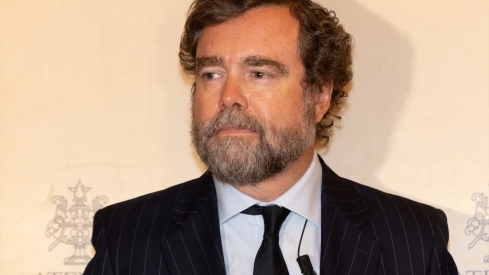
Iván Espinosa de los Monteros has focused on the organic weakness of the far-right Vox and, with it, on the main obstacle he sees for a possible coalition government with the PP: the lack of middle management to cover technical ministries and management structures if the two right-wing parties add up after the general elections.
The president of the 'think tank' Atenea and former leader of the far-right Vox conveyed that warning this Friday, during the presentation of the report Votar con criterio (Voting with criteria), a guide that seeks to organize the vote for the elections and compare the proposals of PP and the far-right Vox in areas such as pensions, housing, taxation, employment, education, or the Rule of Law.
The think tank argues that the far-right Vox has "few managers" and that governing Spain requires covering "hundreds of positions," from ministries and secretariats of state to general directorates and public companies. In this diagnosis, Atenea adds that Santiago Abascal's party "does not currently have a bench of experienced managers" and has lost a good part of its most prepared technical and parliamentary profiles.
Espinosa de los Monteros accepted this reading and took it to the practical level. In his opinion, this deficiency becomes a "handicap" if the far-right Vox enters an executive, especially in portfolios such as Economy or Finance, where —he said— specialized people are needed, and a single visible figure is not enough.
"One person is not enough," summarized the former leader, who insisted that these profiles must also occupy "the top ranks" of the ministries. The warning does not by itself prove that the far-right Vox cannot manage these areas, but it does underscore the lack of structure that Atenea currently detects in the party.
PP with a fundamental advantage and the far-right Vox under more questions
The report does not extend this risk to the Popular Party, to which it attributes "thousands of people with management experience" distributed throughout the territory, including regional councilors, mayors, high-ranking officials, and technicians. Furthermore, it reminds that the Popular Party has already governed Spain twice, an advantage that Espinosa de los Monteros considered valid in terms of executive capacity.
Atenea also examines other points of the far-right Vox: the scarce concreteness of its proposals, the absence of economic memory, calendar or explanation on how they would be applied within the legal framework, and the concentration of power in a reduced circle. The report adds to this the controversy of its European allies, with Viktor Orban among the "much discussed" names.
Against these objections, the 'think tank' highlights as strengths of the far-right Vox the clarity, the ability to place issues in the debate, the pressure that its growth has exerted on the PP and its firmness against separatism. In parallel, it also observes shadows in the PP: unfulfilled previous commitments, corruption cases and a vocation for centrality that, according to the report, should not lead to renouncing principles that its own electorate demands.
The electoral arithmetic narrows the exit and leaves the government formula open
The work incorporates scenarios based on surveys from about 20 institutions and the effect of the electoral system by provinces. With high, medium or low participation, the sum of PP and the far-right Vox would move between 190 and 197 deputies; Atenea's own projection, not counting the CIS, places the total at 198 seats.
The report also analyzes the last seat in play in several provinces to guide the vote in the decisive constituencies. In that review, for example, the last seat in A Coruña is disputed by BNG and PP.
Espinosa de los Monteros defended that Atenea asks for support for the right-wing bloc with the aim of "dislodging" Pedro Sánchez from La Moncloa, but does not ask for a vote for a specific party. He also advised against supporting "recently emerged parties" within that same space and concluded with a clear formula: "Voting for PP and the far-right Vox is the best for Spain".
Looking at the post-election period, the former leader considered it "predictable" that a legislature of the PP and the far-right Vox would not come to an end, because the balances in coalition governments are more difficult to maintain. Along the same lines, he said that stability would depend on the chosen formula and the ability to implement reforms as soon as possible, while the question remains open as to whether the far-right Vox would accept external support for the Executive or a full entry into the cabinet. Asked about a possible formula of external support, Espinosa de los Monteros pointed out that, with the result that the polls predict for them, around 70 deputies, it would be "very difficult" to justify that choice.
Regarding the campaign, Espinosa de los Monteros sees Feijóo and the PP well positioned and reproaches Abascal for not having attended an already scheduled interview with Jordi Wild, whose audience he identifies with the electoral target of the far-right Vox. He also pointed to an "assimilation" of the party's discourse, citing the shift from Article 155 in Catalonia and the warning about pensions in 2023 towards softer messages in this campaign, while mentions of repealing abortion or euthanasia laws are left out of the program. Finally, he left open the possibility of returning to politics because he believes there is a spectrum that is currently "orphaned," and revealed that, according to polls after the early election, he would achieve between eight and ten seats if he ran in these elections with a party. For this November 29, however, he diagnosed that "people vote against something, not in favor of something."
For now, the scenario left by Atenea is twofold: a parliamentary sum still competitive for the right and, at the same time, an open question about who would have enough personnel to execute what was promised if the election result opens the door to a shared government.
Contact
We are listening. Get in touch.
