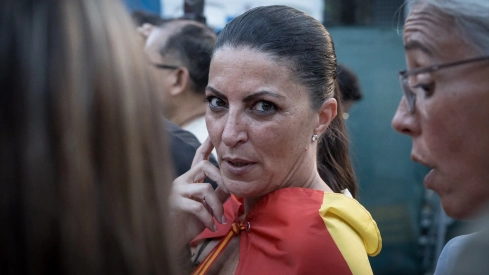
The former leader of the far-right Vox Macarena Olona has asked citizens to turn off their mobile phones and avoid recording the actions of security forces in Ceuta. The former deputy launched her appeal in the midst of a migratory crisis and accompanied it with an expression that links the presence of migrants with dirt in the streets.
“Do not record military actions, nor of the police nor G.C.”, Olona wrote before asking for the message to go viral so that agents “feel safe working”. The far-right finished her publication with a particularly serious phrase given the context in which it was disseminated. “If you want to have clean neighborhoods, those of you who ask for help, help now”.
Olona has not explained what actions would need to be carried out without cameras or why the Police, the Civil Guard, or the Army should be outside citizen control. Her request is limited to demanding that phones be put away and what she calls “the Force” be allowed to act.
The publication exceeded 5,000 likes in a few hours, although it also received numerous critical responses. Some users reminded her that supporting police work is compatible with demanding transparency and rejected the idea that agents should have a “carte blanche without responsibility”. Others warned that asking for the absence of cameras precisely increases the need to document what happens.
Recording police actions is allowed
The recording of police interventions in public places is generally protected by the right to information. Article 36.23 of the Organic Law on the Protection of Citizen Security contemplates sanctions for the use of images when it may generate a concrete danger for agents, their families, protected facilities, or the development of an operation. The norm does not establish the general camera blackout that Olona demands.
The Constitutional Court Ruling 172/2020 also annulled the requirement of prior authorization to use images of police officers, considering it a disproportionate restriction of the right to information. Each possible sanction must respond to an accredited risk and assess the specific circumstances.
Olona's message comes after around 4,000 migrants were forced to leave the makeshift camp on Trampolín beach, where they had been staying since the arrivals on July 30 and 31. Among those who remain in Ceuta are numerous minors who arrived alone and whose future must be resolved individually. The Public Prosecutor for Minors, Teresa Gisbert, has reminded that any return requires a prior assessment of the best interest of each child.
