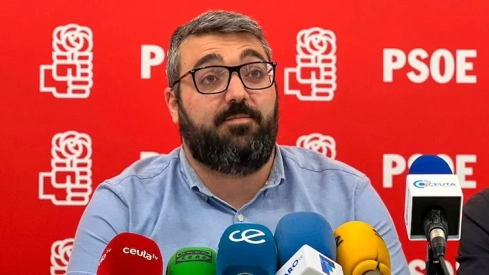
Melchor León has become the first socialist voice to freely express that, in his opinion, Pedro Sánchez's Government is not adequately managing the migration crisis in Ceuta after the massive entry of migrants between July 30 and 31. The PSOE deputy in Ceuta and second vice-president of the Chamber has publicly raised his criticisms against the Executive and has demanded political accountability for the response offered in recent weeks, even demanding the resignation of the Government delegate in the autonomous city, Miguel Ángel Pérez Triano.
León, who has appeared on several television programs to present his position, especially questions the messages conveyed by the Government and the lack of a concrete timetable to restore normality in the city. In this regard, he criticizes the figures offered on the arrival and departure of people during the crisis and denounces that different versions have been disseminated about the magnitude of the situation.
"The Government of Spain, in the 17 days we have been in, has given four contradictory figures. First, 20,000 people had entered, then 80,000, two hours later 20,000 had left, then with the issue of the dead they have deceived us," says the socialist deputy. Faced with the Executive's statements about the return to normality, León assures that the perception among citizens is completely different: "You can ask any citizen and they will tell you that there is no normality here and the problem is that we don't know when we are going to recover it."
The socialist leader also focuses on the succession of ministers who have traveled to Ceuta since the beginning of the crisis. In his opinion, the visits have not been accompanied by a roadmap that allows knowing what will happen to the people who remain in the city. "Seven ministers have passed through here and they have not given us a plan, a deadline, nor do we know when these people will be returned to Morocco." León considers that the current scenario has exceeded the limits of what is acceptable and assures that it directly affects the daily lives of Ceutians: "The situation is unsustainable. People are afraid, women cannot go out into the street. My 8-year-old daughter cannot go out into the street."
León distances himself from the official PSOE discourse
The deputy places the origin of the crisis in the first weeks of increased arrivals and distinguishes that situation from the subsequent scenario, which he considers much more serious. "We were denouncing from the Assembly the humanitarian crisis we were seeing from around the 15th, more or less, with the Supreme Court ruling. Between 50-70 people were entering daily. We had no knowledge that this was going to happen. There was a trickle, and that was a migratory crisis; what's happening now is an invasion."
León assures that he conveyed his discomfort to both the PSOE and the Government Delegation and claims that his position does not stem from a confrontation with his own party, but from his perception of Ceuta's needs. In this context, he has directly demanded the departure of the Government delegate, Miguel Ángel Pérez Triano, whom he accuses of trying to politically exploit the situation: "It cannot be that certain people, like the Government delegate, are covering up and trying to gain credit from this situation. That is why I have asked for the resignation of the Government Delegate and I will not hesitate to demand political accountability."
His criticisms have also generated tension within the socialist ranks. León states that he has received warnings for publicly maintaining a position different from that of the party and assures that he is not willing to modify his discourse for fear of possible internal consequences. "I have only suffered threats of opening a file against me and expelling me if I did not follow my party's narrative, and honestly, I don't care at all because I will continue to say what I think," he expresses.
In the same vein, he insists that his priority is to convey to citizens what he believes is really happening, even if that means confronting the official discourse. "What I cannot do is deceive the people of Ceuta as they intend to do from the party." And he again denounces the warnings received after years of militancy: "After 17 years, they want to open a file against me and threaten me if I don't follow the party's narrative. What I cannot do is deceive the people of Ceuta as they intend to do from the party."
Criticism of Mónica García for denying the collapse
The words of the Minister of Health, Mónica García, during her visit to Ceuta have also provoked a particularly harsh reaction from the socialist deputy. García defended that the city's health system is strained, but denied that there is a collapse. León believes that this assessment does not correspond to the reality he perceives in Ceuta and to the warnings of health professionals.
"The statements seem regrettable to me. I am not a health professional, but the health experts are great professionals, and for the minister to say that there is normality... she is lying. We are tired and we are publicly denouncing it. Let Spain find out about the humanitarian crisis we are experiencing in Ceuta - here what we want is to return to normality - let the ministers who want to come, but with solutions, not to take a photo".
León has also insisted that within the PSOE, Ceuta leaders would have been asked to maintain a common line with the Government, something he assures he is not willing to do if he considers that the message does not reflect the situation of the city. "They have told us to transmit the same messages as the Government, but I am not going to transmit a message that is a lie to the people of Ceuta," he asserts. "As socialists, many should be ashamed of trying to gain political advantage from what is happening in Ceuta," concludes Melchor León in his multiple television appearances.
