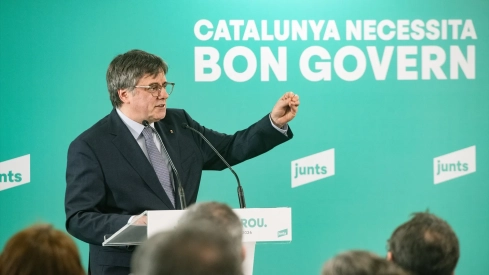
The former president of the Generalitat and leader of Junts, Carles Puigdemont, has defended that his party knew how to take advantage of the willingness of the President of the Government, Pedro Sánchez, to close agreements in this legislature, and has thus summarized his assessment of the pact with the socialists: "We have taken advantage of Sánchez's ambition to defeat Spain".
In an interview granted to El Mundo and collected by Europa Press, Puigdemont explained that it was the PSOE who knocked on Junts' door to negotiate support for Pedro Sánchez's investiture, and that he then wanted to check how far, in his opinion, "their ambition for power and their cynicism" went, after, as he pointed out, they had said "everything" to each other in the previous legislature.
The conditions Junts put on the table
According to the independentist leader's account, Junts made it clear to the socialists that they did not trust them, although they were willing to try to profit from their political momentum to obtain commitments that, he maintains, the PSOE itself had ruled out beforehand. In that package he placed issues such as competencies, financing, decrees and investments, although he stressed that the central point was the conflict between Catalonia and the rest of Spain.
Puigdemont stated that, when the bases of that conflict were addressed, they demanded a dialogue that would take place in a neutral space, "in Switzerland", and that the progress or obstacles of the process could be attested to. "They were going to the supermarket. They were going to say: 'Let's see what you want from the shopping list' and they found that we didn't want that", he said to describe the clash between both parties.
The former Catalan president also assured that the PSOE asked for a legislative agreement and that Junts responded negatively, convinced that the socialists would not accept demands such as international mediation or amnesty, although he maintains that both were finally included in the Brussels agreement.
Amnesty, lawfare and relationship with the State
Regarding the negotiation around the Amnesty Law, Puigdemont defended the wording of the most controversial points and explained that, according to his version, the political conversation developed with a perception of distrust towards the PSOE. In this framework, he described the existence of a "lawfare", which he defined as "an organized political persecution to criminalize and deactivate independentism".
He also reiterated that an emissary from the PSOE offered him a series of pardons that he rejected, and assured that he was willing to stay "all his life" in Belgium if necessary. In the same vein, he said that his party warned them that the Amnesty Law had to be complied with and that any obstacle from the State to its application would be understood as a "breach".
Asked if he takes for granted that the Government has controlled the Constitutional Court (TC) throughout this process, Puigdemont pointed out that his experience with the Estatut makes him cautious with this body and with progressive magistrates, because their majority was the one that ended up "dynamiting" the text. In this sense, he added that, until the ruling of the Court of Justice of the European Union (CJEU), and even a little later, he was convinced that they would not agree with him in his case.
Immigration, financing and absence of contact with Sánchez
In the section dedicated to the negotiation on immigration, the leader of Junts pointed out that contacts with the socialists pushed the discussion to the limit. As he recounted, the concession occurred "at the last minute", when the break with the PSOE was assured at the table, and it materialized in points such as the presence of Mossos d'Esquadra in border controls, that the NIE would be issued by the Catalan administration and "some other point" along those lines.
Regarding financing, Puigdemont explained that they reached the limit because Junts refused to discuss any other model that did not involve the economic agreement. "Although they offered us everything, even narrative blackmail: 'How are you going to give up so much money?'", he said, and indicated that the problem was no longer about proposals, but about compliance.
The former president of the Generalitat also specified that he never spoke directly with Pedro Sánchez, neither by phone nor in person, since he has lived in Belgium, and that he has not revealed who was the socialist interlocutor in the negotiations.
Zapatero, Bolaños and the role of the interlocutors
In the final part of the interview, Carles Puigdemont placed the figure of former Prime Minister José Luis Rodríguez Zapatero at the center of the negotiation of the Brussels agreements, after rejecting that Minister Félix Bolaños exercised that role because they did not trust him.
In his opinion, Zapatero has "a vision of plural Spain that is the most advanced that any Spanish prime minister has been able to formulate", also in his cultural approach to the conflict between Catalonia and the rest of Spain. Puigdemont added that Zapatero's position seemed more flexible than that of the Government, despite the fact that, when he spoke, he believes he did so "on behalf of the PSOE".
Regarding whether he noticed an unsuspected ambition in José Luis Rodríguez Zapatero, he stated that he did not reach that conclusion, because, among other things, "he already had his ambition sublimated, he had done everything".
Contact