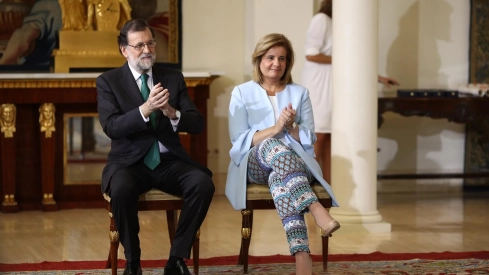
The former President of the Government Mariano Rajoy has bid farewell to Fátima Báñez, his former Minister of Labor and Social Security, who died in the Urda (Toledo) railway accident. In an opinion piece published in El Debate, Rajoy recalled the political and personal trajectory of one of his closest collaborators and highlighted her ability to seek agreements even in moments of strong political confrontation.
"She was never in favor of confrontation. Nor of arguments," wrote the former president, who wanted to emphasize Báñez's way of understanding politics. The former minister, 59, was traveling on one of the trains involved in the accident when she was heading to Seville to participate in a business event.
"Fátima Báñez is no longer with us. But she leaves us many things," Rajoy expressed at the beginning of his tribute. The former president reviewed the years they shared in government and in opposition, as well as the former minister's role in some of the main economic decisions of the Popular Party Executive.
Rajoy highlights Báñez's role in labor and pension reform
Rajoy recalled that Báñez was part of his team even before the 2011 general elections and remained in the Government until the former president left La Moncloa in 2018. During those years, she headed the Ministry of Employment and Social Security and played a prominent role in the economic reforms promoted by the Executive.
"She was competent and very capable," said Rajoy, who attributed to his former minister a significant part of the labor and pension reforms approved in 2012. According to the former president, both measures, along with other government decisions, contributed to facing the economic crisis that Spain was going through. The popular leader also recalled that those reforms provoked strong social opposition and two general strikes. Despite the protests, he defended that the decisions adopted were necessary for the country's economic recovery.
Beyond her ministerial management, Rajoy highlighted Báñez's ability to maintain dialogue with social agents after those confrontations. As he recounted, it was she who convinced him to resume conversations with the unions, despite his own doubts after the strikes. "I confess that, after what we had experienced, I had my doubts. But Fátima was right," the former president acknowledged in his article.
The former president vindicates his commitment to dialogue and recalls her personal side
In his farewell, Rajoy presented Báñez as a politician capable of defending her convictions without renouncing the search for agreements. For the former president, this attitude is essential for those who hold government responsibilities, especially in times of political tension.
"That policy of building and at the same time defending what needs to be done, is the responsibility of those who govern," he wrote. Rajoy also warned that, when politics is limited to trying to defeat the adversary without seeking common ground, "coexistence crumbles and the atmosphere becomes unbreathable." The former president also dedicated a good part of his text to recalling Báñez's personality, whom he described as an intelligent, positive, generous woman with the ability to solve both political and personal problems.
Since 2020, Báñez had presided over the CEOE Foundation, after leaving the front line of politics following Pedro Sánchez's arrival to the Presidency of the Government in 2018. In this new stage, she continued to be linked to the business world and to initiatives related to employment. Rajoy also recalled the friendship they maintained and the meetings they shared with a group of friends. In the final section of the article, he extended his support to the former minister's husband, Jaime Alonso, and their children.
"We will remember Fátima, her kindness, her contagious joy, her generosity," he wrote. The former president closed the tribute with a reflection on memory and the remembrance of those who pass away: "To remember is to ensure that those who have left us and whom we never want to forget live forever among us."
