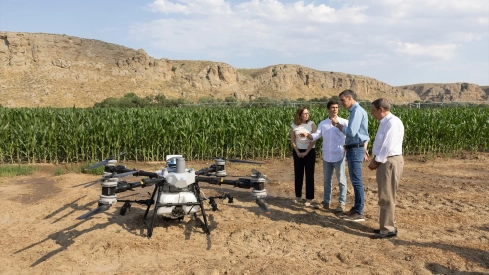
The Government wants fertilizers to stop being one of the weak points of Spanish agriculture. Pedro Sánchez announced this Monday a State Fertilizer Plan to reduce external dependence, improve fertilization efficiency, and prevent an international crisis from once again skyrocketing production costs in the middle of the agricultural campaign.
The announcement comes after the blow caused by the crisis in the Middle East and the blockade of the Strait of Hormuz, a key route for global fertilizer trade.
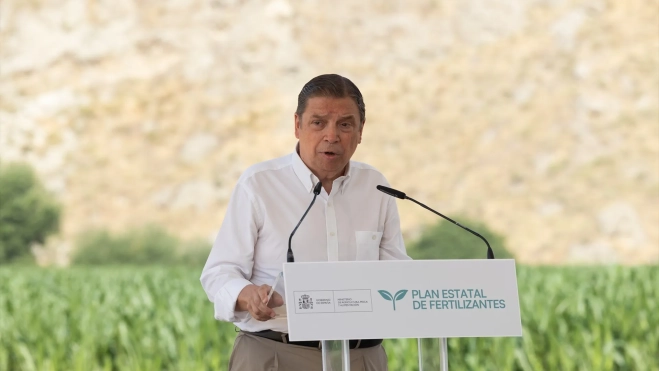
According to the Minister of Agriculture, Luis Planas, prices have risen by more than 30% since February due to tension in the area. This increase is in addition to the accumulated increase since the war in Ukraine, which had left fertilizer prices at very high levels before the new crisis.
Sánchez presented the plan in San Martín de la Vega, accompanied by Planas, with a message closely linked to strategic autonomy. The Executive maintains that fertilizers affect production, farm margins, final prices, and food security. To put it more clearly: when fertilizer becomes more expensive, the blow can end up reaching the fields and also the shopping basket.
Aid for 425,000 farmers
The Government published this Monday the first list of 425,000 beneficiaries of aid for the purchase of fertilizers, for more than 600 million euros. The total allocation of the fund reaches 665 million, after the extension of 165 million approved last week by the Council of Ministers.
Moncloa estimates the aid mobilized for the primary sector due to the Middle East crisis at more than 1.1 billion euros. Sánchez defended that Spain has put more than double the European average on the table and recalled other measures already activated, such as the 20-cent per liter discount for agricultural and fishing diesel, in addition to a financing line of up to 300 million.
The Government tries to combine two approaches. On the one hand, direct aid so that farmers and ranchers can face the immediate price increase. On the other hand, a strategy to change the model of fertilizer use and production before the next supply crisis.
Three axes for the plan
The State Fertilizer Plan should be ready in the first quarter of 2027 and will be supported by three main lines. The first will be precision agriculture, with drones, sensors, soil monitoring, and digital tools to better adjust fertilization doses. The goal is to save costs, reduce excesses, and improve productivity plot by plot.
The second will be strategic autonomy. Spain wants to depend less on imported raw materials and the natural gas used to manufacture fertilizers. This line includes the promotion of green hydrogen, green ammonia, biogas, digestates, and other alternative nutrient sources. Planas has also advocated for recovering controlled organic fertilization and advancing in biostimulants.
The third pillar will be price transparency. The Executive proposes a national information system on the fertilizer market to detect tensions before they fully hit the farmer. It also foresees a monitoring table capable of reacting more quickly to sudden increases.
Spain wants to be ahead of Brussels
The Spanish plan will run parallel to the European Union's Fertilizer Action Plan, which Brussels presented this spring to improve supply, alleviate costs, and strengthen agricultural resilience. Planas has said that the European Commission "has fallen short" and has argued that Spain must move forward with its own strategy.
The Government's reading is simple. The war in Ukraine showed European energy fragility. The Hormuz crisis has now shown agricultural fragility. If fertilizers depend too much on international routes, fossil fuels, and external suppliers, the countryside is exposed to any geopolitical shock.
The interministerial working group is already underway. Agriculture will now open dialogue with autonomous communities, agricultural organizations, cooperatives, and the fertilizer industry. The calendar set by Moncloa places the plan closed in the first quarter of 2027.
Add ElConstitucional.es as a preferred Google source for free.
Stay informed about all the latest breaking news with the best information. Against disinformation, for democracy and social rights.
