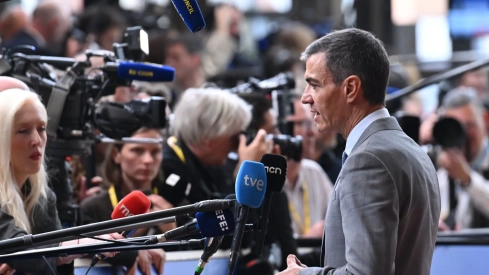
The President of the Government and Secretary General of the PSOE, Pedro Sánchez, has regretted Montse Mínguez's resignation and has revealed that he tried to convince her to continue. "I told her not to do it because I believe she is an extraordinary spokesperson, she is an immense politician," he said this Friday from Brussels, at the end of the European Council summit, shortly after the leader's resignation was announced following the controversy over her partner's real estate businesses.
Sánchez explained that he had exchanged messages with her and that he was aware of the personal suffering she was going through. "I knew that Montse was broken; she was having a very bad time personally," he said. According to him, it was Mínguez herself who asked him to withdraw from the lists for the general elections on November 29, in which she was going to lead the socialist candidacy for Lleida.
The president denounced that "the level of harshness, aggressiveness and hatred" also reaches the loved ones of those dedicated to politics. "On many occasions in our country during these last years, red lines have been crossed that should not have been crossed. And this is the consequence," he said about Mínguez's departure, whom he defined as a great politician and a good person. "We lose a great colleague and a great asset to the party," he added.
DIRECTO | Pedro Sánchez, sobre la dimisión de Montse Mínguez: "La política algunas veces maltrata a algunas personas. El caso de Montse es uno de ellos"
— Radio 5 (@radio5_rne) October 16, 2026
"Lamento mucho que no continúe como diputada"https://t.co/k2S39srj0P pic.twitter.com/rtmIopDdXe
The PSOE defends its trajectory
The federal leadership has expressed its respect for Mínguez's decision to leave the spokesperson position and the Secretary of Studies and Programs of the Executive. In a statement, the PSOE has thanked her for her dedication, her commitment and the passion with which she has defended socialist values in her public interventions, in addition to claiming her "coherence when voting according to her principles" and an "impeccable trajectory as a socialist".
This support links with the defense made this very morning by the socialist spokesperson in Congress, Patxi López, before the resignation was known. López stressed that Mínguez has voted in favor of access to affordable housing, without prioritizing the possible particular interests of her partner. Sánchez himself had expressly supported her this Thursday, also from Brussels, by responding that he "of course" maintained his support.
The controversy has arisen after reports from 'Artículo 14' about her partner's real estate companies, Sergi Vélez, the management of some thirty homes and eviction procedures. The PP has used these businesses to accuse the leader of inconsistency with the socialist discourse on housing. Mínguez has defended the legality of the family activity and has considered the criticisms a personal attack, while her party has focused on the housing measures she has supported.
The leader has announced her withdrawal "with a clear conscience, my head held high and my fidelity to my principles intact". In her message, she explained that she considers her decision the best for the collective project and has appealed to responsibility in the face of the advance of the far-right and the risk of setbacks in social rights. Her resignation forces the PSOE to cover the spokesperson position and to modify the candidacy for Lleida on the eve of the Federal Committee that must ratify the electoral lists.
Brussels and the horizon of 29N
Sánchez's appearance closed a summit marked by differences on migration policy, with criticism from several European governments of the Spanish position. The president has assured that the Twenty-Seven have reached a "compromise solution" on the migration text and has defended the need to maintain a progressive voice in that debate. He also stressed that the conclusions recognize the status of Ceuta and Melilla as European land borders in Africa and include commitments for operational and financial support.
Asked about the presence of Moroccan warships in Ceuta waters during the massive entry in July, he has denied that other European leaders have asked him for explanations about that episode. Faced with Alberto Núñez Feijóo's demand to deploy the Spanish Navy against Morocco, he replied that "communication between the Spanish and Moroccan navies is fluid and total."
Sánchez has also explained that European leaders have agreed to intensify diplomatic efforts to reduce tension around Iran and promote peace and regional stability. In that context, he has highlighted the importance for Spain of accelerating the energy transition and the decarbonization of the economy.
Hemos acordado intensificar nuestros esfuerzos diplomáticos para reducir la tensión, lograr la paz y la estabilidad en la región de Irán.
— PSOE (@PSOE) October 16, 2026
Y algo muy importante para España: acelerar la transición energética y la descarbonización de nuestra economía.@sanchezcastejon pic.twitter.com/DYOz1Izw4W
In national politics, and a few hours before the deadline for coalitions, he has expressed his "absolute respect" for the decisions of the parties to the left of the PSOE. He has declared himself "very encouraged" and "optimistic" for November 29, convinced that Spanish society will support another four years of progressive policies. "If it's not one way, it will be another," he said, before ending the appearance by reminding that this Saturday he has a Federal Committee and still has to prepare his speech.
