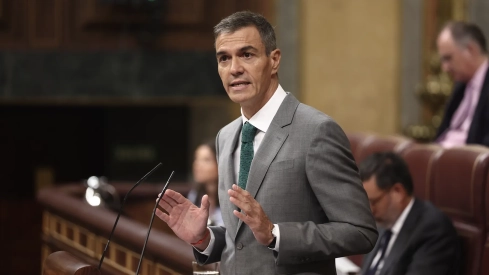
Having reached this point in his appearance, Sánchez has raised the three questions that, in his opinion, concentrate the main doubts about what happened on July 30 and 31: whether the crisis could have been avoided, who or what caused the massive crossing, and what the Government will do from now on.
"I want to address all three with transparency, with rigor, with facts, debunking hoaxes, providing data, so that every citizen can draw their own conclusions," said the president, who dedicated a good part of his intervention to reconstructing the warnings received during the previous weeks and to denying that there were extraordinary warnings that anticipated the magnitude of what happened.
"The Government received alerts, but not about what finally happened"
Sánchez has assured that the Executive reacted to the main change that had occurred in the migratory scenario before the crisis: the Supreme Court ruling of July 8. From then on, he explained, maritime surveillance in Tarajal was reinforced with 70 additional personnel, new vessels were deployed —including an offshore vessel and a high-speed patrol boat— and the design of new physical elements began to adapt border control to the new judicial framework.
Meetings were also held with the Moroccan authorities and the capacity of the CETI was expanded in anticipation of a possible intensification of migratory movements. "That's what we did. We reacted to the only real change that occurred in the migratory scenario last July 8 with the Supreme Court ruling," he defended.
The second question, he added, is whether the Government received extraordinary warnings in the previous days capable of anticipating what ended up happening. His answer was emphatic: "it did not." Sánchez assured that "all reports, all messages, verbal notes from the State security forces and bodies" were reviewed, as well as the CNI documents sent to the political authorities and the Government Delegation in Ceuta.
According to the president, none of those documents went beyond the description of the available data or routine warnings and none anticipated "neither the scale nor the probability of what finally occurred."
Sánchez denies that Frontex warned of the crisis
One of the points on which Sánchez wanted to be especially forceful was the alleged prior warning from Frontex. "It has been said that Frontex, the European border control agency, Frontex warned a month before," he said before rejecting that version. "But it's not true. It's not true, ladies and gentlemen," he affirmed. According to his explanation, the European agency's document was a routine report on greater viability of the migratory route and detections recorded during the quarter, but "it did not foresee anything remotely similar to what happened on July 30 and 31."
The president also denied that there was a warning from the National Police a week before about a "high risk" in Ceuta. Sánchez admitted that such a report existed, but clarified that it referred exclusively to maritime arrivals to the peninsula and the Balearic Islands, not to the border of the autonomous city.
Vivas's call and the warning of crossings by swimming
Sánchez also denied that the Government of Ceuta had alerted Moncloa on July 27 of what was going to happen three days later. According to his account, the president of Ceuta, Juan Vivas, reported that crossings by swimming had increased from 10 to 20 daily and expressed his concern about the possibility that another 200 migrants could reach the city before the end of the week.
"A situation for which he asked us to notify the Ministry of Interior, which is what we did, ladies and gentlemen, immediately, as it could not be otherwise," he explained. That same day, he added, the National Police of Ceuta sent a communication of relevant facts in which it reported the increase in crossings by swimming, but without making "any prospective warning."
The CNI detected the increase, but did not anticipate the magnitude
Regarding the CNI, Sánchez pointed out that during the month prior to the crisis, it prepared two situation reports that were shared with several institutions. Both reflected a phenomenon that, as he indicated, was already known: the increase in crossings by the breakwater, accompanied by a recommendation to exercise extreme caution.
On July 29, a few hours before the crisis, there was also communication between the Government Delegation in Ceuta and the Civil Guard regarding a call disseminated on social media to attempt to cross into the city the next day. Sánchez wanted to clarify one of the elements that has generated the most controversy: the 180,000 people linked to that call.
"That figure was not a prediction of how many people were going to cross, elaborated by the National Intelligence Center," he explained. "It was simply the number of members of a Facebook group in which that call was circulating." The president added that similar calls had appeared in three of the last seven CNI reports and that, therefore, they did not constitute an exceptional phenomenon.
A rebound that, according to Sánchez, followed the usual pattern
The president also defended that the increase in attempted entries by swimming recorded during the previous days did not, by itself, allow anticipating an operation of the dimension that finally took place. Sánchez pointed out that this type of movement presents a seasonal pattern and that attempts usually increase between June and July due to improved weather conditions.
He cited as an example the data from 2024, when attempts went from 400 in June to 3,900 in August, mostly intercepted by Morocco. He also mentioned that in July 2016, higher figures were recorded, but without there being a "linear or exponential" growth pattern that would allow predicting what happened on July 30 and 31.
"Not in vain, and as I mentioned at the beginning, not even the Ceuta authorities themselves considered this possibility," said Sánchez, who extended that lack of foresight to "no think tank, NGO, media outlet" nor to the intelligence services of Spain's allied countries.
The CENIF and the two notes prior to the massive entry
Sánchez focused especially on the two notes prepared by the National Immigration and Borders Center (CENIF), dependent on the National Police, dated July 28 and 29. The president explained that this body prepares non-recurrent informative notes and a weekly report that is sent to the Ministry of Interior every Thursday.
Regarding the note of July 28, Sánchez highlighted that it included a detailed analysis of the situation and concluded that the movement on social media "is not worrying," although conditions predicted "a gradual —and I emphasize— increase, a gradual increase in access attempts."
The note of July 29 spoke, according to the president, of a "potential risk of irregular entries into the autonomous cities of Ceuta and Melilla." The document contemplated different scenarios and attributed a high probability to new attempts of entry by swimming, although with an impact considered "low and medium," while it gave a "medium and low" probability to a coordinated movement through entries by swimming and fence jumping.
"The CENIF note itself, ladies and gentlemen, declares, and I quote again, that it cannot be assured that this will happen," Sánchez emphasized. The document also established that, if relevant new developments appeared, new informative notes would be sent and that the information should be transferred "exclusively to border posts."
"Absolute transparency" and all reports on the table
Sánchez closed this block of his appearance by announcing that the Government will make all documents public so that they can be directly examined and verify what information existed before the crisis. "The Government, therefore, ladies and gentlemen, has nothing to hide in this matter," he affirmed. "So much so that I have given orders to publish a dossier with all the reports, all of them, so that the media and citizens can examine them for themselves."
"Therefore, absolute transparency, publicity of all documents, so that the truth about this matter is known exactly," the president concluded.

This breaking news is being updated. The editorial staff of ElConstitucional.es is working to expand the news and offer you the best information.