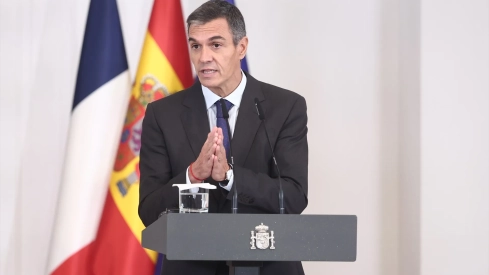
The President of the Government, Pedro Sánchez, has decided to dissolve the Cortes and call general elections after Congress rejected last Friday the two housing decrees promoted by the Executive. The decision comes after a weekend of reflection in Moncloa and amidst full social mobilization for access to housing, with protests and encampments in different parts of Spain.
During his speech, the President of the Government took a jab at the President of the Community of Madrid, Isabel Díaz Ayuso, in response to the criticisms that the regional leader has directed against his management and policies. Sánchez took the opportunity to recall the controversy surrounding the purchase, for 6.3 million euros, of the luxury penthouse acquired by the public company Planifica Madrid. In this context, the head of the Executive defended his management against Ayuso's criticisms and stated: “We have transferred more resources than ever for health and education and they have bought penthouses”.
🔴 Sánchez sentencia a Ayuso en la convocatoria de elecciones: “Hemos transferido más que nunca recursos para sanidad y educación y ellos han comprado áticos” 🔗 Más información en https://t.co/fSqiqe3VWI https://t.co/KatlHnnVsO
— ElConstitucional.es (@elc_es) October 5, 2026
Elections on November 29
Sánchez communicated his decision this Monday in an institutional statement from the Palacio de La Moncloa, after analyzing in recent days the scenario opened after the parliamentary defeat. The rejection of the measures by PP, Vox and Junts left the Government without the necessary support to pass the texts with which it intended to respond to the housing crisis.
The two royal decrees were rejected in the Plenary Session of Congress. The first fell by 178 votes against versus 172 in favor, while the second obtained 184 negative votes and 166 positive votes. PP, Vox and Junts voted against both texts, becoming the three decisive groups to prevent their validation.
The parliamentary defeat occurred after a week marked by political conflict over housing and by increased social pressure. Mobilizations have taken place in different Spanish cities to demand solutions to the difficulties of accessing housing and have coincided with the indignation generated by the case of Maricarmen, the 87-year-old woman evicted from her home in Madrid.
The electoral scenario had opened precisely after Friday's vote. Sánchez spent the weekend studying the different alternatives before making a definitive decision, while in the PSOE and in the Government voices in favor of going to the polls increased. The possibility of calling elections for November 29 was the first available date if the president chose to dissolve the Cortes immediately.
The fall of the decrees has left the Executive facing complicated parliamentary arithmetic. The current composition of Congress makes it difficult for the Government to gather a sufficient majority to approve its main initiatives, especially after Junts joined the PP and Vox's rejection of housing measures.
The election call thus occurs at a time of high political and social tension, with housing as one of the main focuses of conflict. During the weekend, thousands of people participated in mobilizations to demand measures against the housing crisis, while some groups have even proposed new protest actions.
With the dissolution of the Cortes, the Government now opens a new political scenario that will lead Spaniards back to the polls. If the call is made this Monday and the corresponding decree is published on Tuesday in the Official State Gazette (BOE), the first possible date to hold elections would be November 29.
Sánchez's decision puts an end to the uncertainty that had settled in La Moncloa since Friday and turns the rejection of the housing decrees into the trigger for an early election that the president had kept open throughout the weekend.
