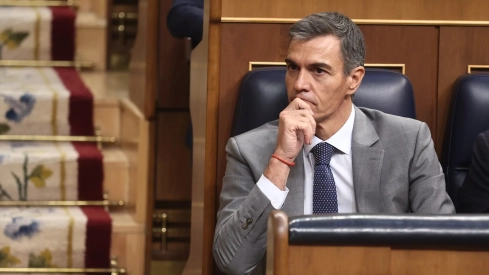
The President of the Government, Pedro Sánchez, faces the parliamentary setback of the two housing decrees without rushing a decision on a possible early election for now. Government sources consulted by 'ElConstitucional.es' reported on Friday, after the defeat in Congress, that the head of the Executive is "calm," that he is opening a "period of reflection" and is willing to negotiate with partners.
The possibility of calling general elections remains on the table, but there is no decision made or a fixed date. The objective of the conversations will be to determine what margin the Government retains to move forward and under what conditions it could face a possible electoral call if Sánchez ultimately opted to anticipate the elections.
The Executive thus seeks to gauge the parliamentary scenario before adopting a major decision. The consulted sources indicate that the president wants to know the disposition of his partners and explore the alternatives that still exist to maintain the legislature. The final word, in any case, rests with Sánchez.
The government's move comes after Congress rejected the two royal housing decrees promoted by the Executive. The vote left the government without its main measures in this area and opened a new political scenario that has placed the future of the legislature at the center of the debate.
Sánchez listens while keeping options open
Faced with opposition requests for him to call elections, Moncloa has chosen to dedicate these days to analyzing the consequences of the parliamentary result and holding conversations with the various actors who may be decisive for the continuity of the Executive.
Meanwhile, some of his partners have begun to comment on the future. The second vice-president, Yolanda Díaz, made it clear this Saturday that the decision rests exclusively with the president, although she assured that the left is prepared to face elections if they are finally called.
"The left is absolutely prepared," she affirmed from Lugo. Díaz insisted that she maintains frequent conversations with Sánchez "for obvious reasons," but stressed that the decision to dissolve the Cortes and call elections is "exclusively" hers.
The vice president has also taken the opportunity to ask progressive citizens not to let themselves be "overwhelmed or disappointed" by the parliamentary defeat of the decrees. "Yesterday they blocked Parliament, but they did not block democracy," she said.
Her words come after a day of housing mobilizations that brought thousands of people to the streets of Madrid. According to the Government Delegation, some 70,000 people participated in the four demonstrations that converged in Cibeles, while the Tenants' Union raised the figure to 500,000 attendees.
Negotiation path open
The Government has not closed the parliamentary path either. The rejection of the decrees does not mean, according to the position conveyed this Saturday by socialist leaders, that the possibility of negotiating new housing measures has been exhausted.
The spokesperson for the PSOE Federal Executive, Montse Mínguez, has assured that her party is "always" willing to negotiate after the fall of the two royal decrees. The socialist leader has claimed that the Executive has kept open dialogue with the different formations and has specifically questioned Junts' vote.
Junts, for its part, has demanded that the Government sit down to negotiate its proposals on housing. The general secretary of the formation, Jordi Turull, has assured that the Executive is still "in time" to "rectify" and negotiate a new decree, while stating that his party is "prepared" for elections if Sánchez decides to call them.
Feijóo calls for elections and places housing as the "symbol of failure"
Against the Government's waiting strategy, the president of the PP, Alberto Núñez Feijóo, has taken advantage of the parliamentary defeat to intensify his request for general elections.
During his speech at the La Toja-Vínculo Atlántico Forum, Feijóo demanded that Sánchez stop raising the possibility of an early election and call citizens to the polls. His position had already been clear even before starting his speech, when he responded with a "I say yes" when asked about the possibility of the president deciding to call elections.
Subsequently, he has turned the electoral call into one of the main axes of his intervention. "There is only one way out, for citizens to speak up as soon as possible. President Sánchez should not bluff anymore about calling Spaniards to the polls. He should do it. Spain has the right to decide now," he stated.
The leader of the PP has defended that his request does not respond to "revenge," but to his diagnosis of the political situation. "I don't ask for elections out of revenge, I ask for them because my country can't take it anymore," he pointed out.
Housing has occupied a good part of his speech. Feijóo has defined this problem as the "symbol of the failure" of the Government and has defended a model based on increasing housing supply.
Sumar prepares its strategy and once again focuses on Bustinduy
The Sumar space is also preparing for the new scenario. Its main representatives will hold a meeting this Sunday to analyze the parliamentary defeat of the housing decrees, study the political situation, and address the possibility of early elections.
The meeting comes after Saturday's mobilizations and while the space still has not defined who would lead a potential candidacy for the general elections. Among the names being considered are the Minister of Health, Mónica García, the Minister of Culture, Ernest Urtasun, and the Minister of Social Rights, Pablo Bustinduy.
As ElConstitucional.es exclusively reported, the Bustinduy option is gaining strength again. Internal sources from Sumar consulted by this media point to a particularly positive assessment of his role during the negotiation of the housing decrees and the interventions he has led in recent days.
The minister has taken on a prominent role in defending the measures and was one of Sumar's main interlocutors during the negotiations. His name thus gains weight again in the internal debate against the option of Urtasun, while other voices propose Mónica García as a possible head of the list for Madrid.
This Sunday's meeting should serve to organize these positions at a time when the possibility of elections has ceased to be a distant hypothesis and has become one of the main issues on the political agenda.
For now, however, Sánchez has not made a decision. The Government keeps parliamentary negotiation open, listens to its partners and studies the available alternatives, while the opposition calls for elections and Sumar begins to prepare its strategy for a possible electoral scenario.
The result of these conversations will be decisive in determining whether the Executive can rebuild sufficient support to continue the legislature or if Sánchez ends up considering that calling elections is the appropriate solution. The decision, according to the consulted sources, will continue to depend exclusively on the president.
