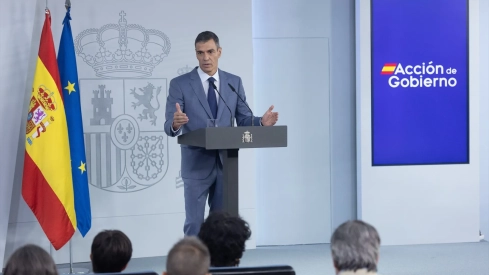
The President of the Government, Pedro Sánchez, defends the intervention of the real estate market, blames the conservative bloc for the parliamentary blockade and promises to maintain protection against evictions. After the death of Maricarmen, he vindicates the decrees approved by the Executive and calls for a progressive majority in the elections on November 29.
Sánchez has placed housing at the center of his strategy for the general elections on November 29. In his first interview after announcing the early election, the President of the Government defended the need to intervene in the real estate market and presented the upcoming election as a choice between two political models: “either rights or cuts”, “either the people or the vulture funds”.
In an interview granted to elDiario.es at the PSOE headquarters in Ferraz, Sánchez blamed the conservative bloc for preventing the measures promoted by the Executive to protect tenants and stop evictions from going forward. The head of the Government believes that the parliamentary blockade makes it necessary to obtain a broader progressive majority to develop his housing policy.
The conversation expanded after the death of Maricarmen, the 87-year-old woman who died in the hospital two weeks after being evicted and who has become the symbol of the struggle for housing in Spain. Sánchez expressed his “sorrow” and “sadness” over her death, while rejecting the partisan use of pain. “I believe that politics is precisely about responding to that pain,” he said, referring to the measures approved by the Council of Ministers to prevent evictions like the one suffered by the elderly woman.
Sánchez blames the parliamentary blockade for the housing crisis
The president defended that his Government has tried to approve measures to protect vulnerable people throughout the legislature, but has denounced the opposition of a conservative majority in Congress. In his opinion, the lack of parliamentary support has prevented a sufficient response to a problem that he considers a priority for citizens.
“We have tried to raise this issue in Congress on repeated occasions throughout these more than three years of legislature,” he explained. Sánchez attributed the lack of progress to the “conservative bloc,” which he accuses of opposing preventing the evictions of vulnerable people.
The head of the Executive has contrasted this situation with the economic results he claims from his mandate. Although he has acknowledged that he has not managed to approve the General State Budgets throughout the legislature, he has defended that the Government has met its budgetary objectives and has highlighted economic growth, job creation, and the reduction of inequality.
He has also quantified at 78 the legislative initiatives approved during the legislature, including two constitutional reforms. However, he considers that the blocking of housing policies represents one of the main differences compared to the previous mandate. "And if Parliament turns its back on citizens, citizens have every right to demand a response to what they are demanding, which is a forceful intervention in the housing market," he stated.
The death of Maricarmen
The death of Maricarmen has once again placed the protection of vulnerable people against evictions at the center of political discussion. Sánchez has defended the decrees approved by the Government and has assured that the Executive responded to social demands with measures aimed at preventing new cases.
Asked about the criticisms of those who demanded greater government involvement after the death of the elderly woman, the president insisted that his Executive has tried to promote these measures on repeated occasions. According to his version, the opposition of conservative forces prevented their earlier approval.
Sánchez has also rejected that the minute of silence for Maricarmen should be interpreted as a partisan initiative. "The minute of silence is always a representation of the pain expressed by society as a whole," he stated. In his opinion, the political debate should focus on preventing similar situations from recurring.
The president has also defended the definition of vulture funds contemplated in the new regulation. He considers that these entities contribute to the commodification of a right recognized in the Constitution and has rejected that measures to protect tenants necessarily harm small landlords. "We have to defend the rights of small landlords, of tenants, and, of course, confront vulture funds," he pointed out.
The PSOE promises new measures and calls for a progressive majority
Sánchez has confirmed that housing will have a prominent place in the socialist electoral program. Among the initiatives he has defended are the regulation of seasonal rentals, protection against evictions, and new measures to intervene in areas of the real estate market where, according to the Government, there are dysfunctions.
The president has also supported opening the debate on indefinite rental and the possibility of establishing compensation for tenants when their contracts end. He has acknowledged that this is an advanced discussion in Spain, although he has assured that the PSOE supports addressing these issues.
In this context, he has reiterated that his objective is to achieve a broader parliamentary majority that allows these policies to be developed. “We need a broader majority to solve the housing problem: a Parliament that looks more like the clamor of the street,” he has defended.
The head of the Executive has estimated around 124,000 homes are under construction or in the process of construction and has assured that more than 500,000 properties have been rehabilitated. Likewise, he has placed above 900,000 the protected and free-market homes that are built or under construction.
Sánchez accuses Junts of moving closer to PP and Vox
The president has also criticized Junts' rejection of the housing decrees, after the Government negotiated with the Catalan party various measures related to owners and vulture funds.
Sánchez has assured that he does not understand Junts' change of position after the conversations held and has regretted that the party did not allow the bill to be processed to continue negotiating.
“But on this issue, it is evident that Junts is closer to the PP and Vox than to the rest of the political forces in the parliamentary arc,” he stated.
Despite parliamentary difficulties, the head of the Executive has defended that the Government will continue to exercise its functions until the elections. Regarding evictions, he has assured: “My commitment is that no eviction will occur in what remains of the legislature.”
The postal vote and possible foreign interferences
Beyond housing, Sánchez has questioned the right's accusations about postal voting. The president believes that the doubts raised by the PP respond to fear of an electoral defeat and has warned that this discourse could call into question a fundamental right.
"The hoax of postal voting, and you can see it on their faces, is fear of losing the elections," he stated.
Sánchez added that those who resort to this voting method are, in many cases, workers who cannot physically go to the polls due to their work obligations. For this reason, he accused the opposition of trying to limit the exercise of the right to vote for millions of people.
The president also expressed concern about possible foreign interference during the election campaign, both from other countries and non-state actors. At this point, he criticized the positions against housing measures expressed by Amazon founder, Jeff Bezos, after he backed chef José Andrés' criticisms of market intervention.
Sánchez questioned large businessmen positioning themselves against these policies and defended the capacity of democratic governments to regulate issues affecting access to housing, energy consumption, and water management.
The president vindicates the amnesty and rules out any option other than governing
During the interview, Sánchez also defended the amnesty law after the favorable pronouncements from the Constitutional Court and European justice. The president believes that the norm has contributed to improving coexistence in Catalonia and refused to assess whether previous decisions by the Supreme Court responded to a strategy to harm the Government.
In relation to the corruption cases affecting the PSOE, he acknowledged that there has been "real corruption" and cited the case of José Luis Ábalos. At the same time, he denounced what he considers a strategy of judicialization of politics promoted by associations linked to the far-right.
Sánchez concluded by defending the continuity of the coalition government and ruled out contemplating any scenario other than revalidating the mandate. In his opinion, the elections on November 29 will decide between the continuity of social policies and a project of involution that he attributes to the right and the far-right.
"I see the atmosphere, the excitement and the ambition that has been generated on the left," he assured, before reiterating his goal of obtaining a broader parliamentary majority.
