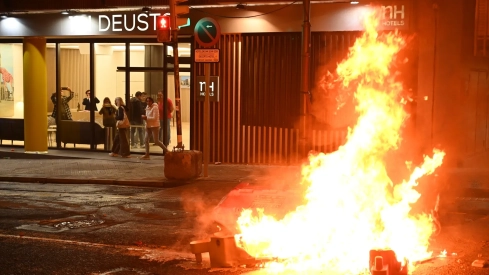
The pre-campaign for the general elections of November 29 has incorporated a new issue into the debate: the disturbances recorded in Barcelona and Bilbao. While the PSOE of Pedro Sánchez maintains housing, education, and public services among its priorities, PP and Vox have placed the altercations among their main arguments of criticism against the Government, with proposals on security and accusations against the Executive.
The three formations have condemned the violence, although their responses stem from different approaches. Sánchez has spoken of vandalism and calls instigated from social networks; Feijóo has blamed the Government for contributing to the tension; and Abascal has linked the incidents to his discourse on immigration and his accusations against the president.
The episodes had different triggers. In Barcelona, the altercations followed a youth call disseminated through social networks. In Bilbao, they began after the mobilizations against the announced visit of Vito Quiles, who finally canceled his event.
Barcelona: a call on social media that ended in looting
On Saturday, October 24, hundreds of young people gathered around Plaça de Catalunya after a call disseminated under the slogan "Instituts Indignats". During the afternoon and night, looting, fires, and clashes with the police occurred.
The first widely disseminated balance was 128 arrests, 72 of them minors, with 23 businesses vandalized and 33 interventions by firefighters to extinguish fires in containers, wastebaskets, and other urban elements.
The Mossos subsequently updated the figures to 130 arrests, of which 76 were minors, and placed the number of establishments affected by damage or looting at around thirty. The Catalan police have set up an investigation team to analyze images and other evidence and identify those responsible.
Bilbao: peaceful marches preceded the altercations
Two days later, Bilbao experienced another day of incidents. Thousands of people had participated in the mobilizations against the presence of Vito Quiles, whose event was scheduled for 7:00 p.m. next to the University of Deusto.
The university suspended its academic activity at 2:00 p.m. and closed the campus at 3:00 p.m., following police instructions. It also clarified that it did not organize or authorize the event. Quiles ended up canceling it after warnings, he stated, from Ertzaintza security.
After the peaceful protests, groups of hooded individuals erected barricades and burned containers and vehicles. Damage to businesses and attacks on police facilities were also reported.
The Ertzaintza set the final balance at 17 arrests —ten minors— and one person under investigation, correcting the provisional figures from the first hours. According to their statement, none of those involved had been previously arrested by that force. The investigation remains open to identify more participants.
The Basque Security Councilor, Bingen Zupiria, maintained that there were people prepared to exercise violence regardless of whether Quiles attended. He also raised the possibility that they had followed instructions from organized groups, an aspect subject to investigation.
Sánchez condemns vandalism and the Government asks to await investigations
Pedro Sánchez described the Barcelona riots as “pure vandalism” and advocated a “zero tolerance” response. The president pointed out that the events did not constitute a democratic exercise and alluded to the role of social media in their instigation.
The Executive's condemnation of the two episodes also came through its spokesperson, Elma Saiz, after Tuesday's Council of Ministers: “In a democracy, violence has no place.”
Saiz rejected accusations that hold the Government responsible and asked political leaders to act responsibly while the Mossos and the Ertzaintza investigate what happened. “Condemn all violence without palliatives or qualifiers,” she demanded.
Feijóo proposes tougher penalties
The PP has linked the incidents to its criticism of the Government's management and its electoral proposals on public order. After what happened in Bilbao, Feijóo denounced a “new attempt at intimidation by the violent left” and promised a Government that guarantees “order and security” after 29N.
In an interview on Onda Cero, the popular president announced that he would reinstate an aggravation of penalties for acts of vandalism committed with a covered face. He also proposed toughening the response when disturbances are organized through social media.
Abascal takes the debate to immigration
Santiago Abascal reacted to the Barcelona videos with the message “Let them be educated in their country.” In a subsequent interview, he defended the deportation of foreigners who commit crimes and again raised what he calls “remigration” of people who receive aid without working.
After the incidents in Bilbao, the Vox leader also blamed Sánchez and called their perpetrators “Pedro Sánchez's militias.”
