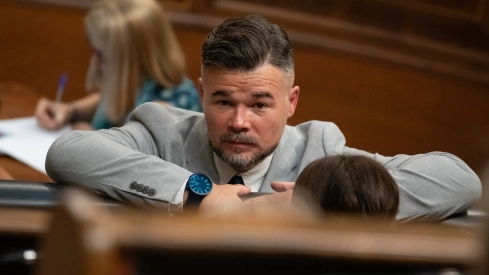
The discomfort with Gabriel Rufián that 'ElConstitucional.es' advanced this Sunday night already has a much more forceful public expression. The Comuns have accused this Monday the spokesperson for Esquerra Republicana de Catalunya (ERC) of favoring the division of the left, after the republicans and Podemos have formalized their agreement for the general elections on November 29.
"Rufián came to unify the lefts and is doing everything possible to divide them," the Catalan formation maintains in a statement. The Comuns attribute a deep disappointment among the progressive electorate to his movements and reaffirm that they will run within the Broad Front, the project they are building with Izquierda Unida, Movimiento Sumar and Más Madrid.
This newspaper reported last night, based on internal sources of the Broad Front, Ada Colau's frustration with conversations between Rufián and Podemos that those interlocutors placed behind her back. It also advanced that the Catalan understanding opened new difficulties to decide with whom Podemos would run in the rest of Spain. The statement makes public that deterioration of trust.
The ERC-Podemos agreement also confirms the path of collaboration that 'ElConstitucional.es' explained during Sunday. The purple formation will contribute to the republican candidacy in Catalonia and Irene Montero and Rufián will campaign together. The scope of that understanding outside Catalonia remains pending and, above all, whether it will help close a shared candidacy with the Broad Front or will end up reinforcing two separate electoral offers.
An agreement in Catalonia that leaves open the state division
Podemos renounces presenting its own candidacy in the four Catalan provinces and will support the one headed by Rufián. Both parties justify the cooperation by the need to stop the extreme right and defend rights. The statement still does not specify how many members of Podemos will enter the ERC lists or in what positions, relevant questions to know the effective weight of the formation in that agreement.
The alliance allows ERC to incorporate support without abandoning its candidacy and offers Montero the collaboration of a leader with significant public projection. But the Comuns maintain their own electoral project. The cooperation between ERC and Podemos concentrates a part of the left-wing support in Catalonia while maintaining competition with the Broad Front, precisely the space to which Colau had invited Rufián.
Outside Catalonia, the situation remains open. A shared event between Montero and Rufián can give visibility and mobilization capacity to Podemos, but the composition of the ballots will depend on agreements between organizations. If Podemos runs separately from the Broad Front, both will compete for a part of the same electorate, even if they share proposals on housing, wages, or public services.
The Catalan pact also does not, by itself, prevent negotiating agreements in other territories. The immediate difficulty is political. Podemos has allied in Catalonia with a competitor of the Comuns while its possible incorporation into a state coalition, of which the latter are a part, is still pending. To close that fit, the leaderships need to agree on where they will collaborate, what leadership they will share, and how they will explain the territorial differences to their voters.
The sources consulted last night by this newspaper still saw possibilities for understanding outside Catalonia, despite the anger. That expectation remains a negotiating possibility. The agreement announced this Monday resolves the electoral relationship between ERC and Podemos in Catalonia, but leaves pending the decision on the rest of the State.
Colau gains support and Madrid continues to concentrate the dispute
The bet on Ada Colau has consolidated among the organizations of the Broad Front. The Comuns defend her as the leadership capable of expanding the candidacy, Izquierda Unida has expressed its support, and Movimiento Sumar endorses her role from Barcelona. It is the name that this newspaper has been advancing in recent weeks, based on sources from the space, while the conditions of her incorporation were being negotiated.
That consensus still coexists with the lack of a joint proclamation and with the political condition that Colau has publicly defended. The former mayor wants a project that includes Podemos and has offered space to Rufián. As we reported on Saturday, sources from the Broad Front explained that she was willing to let him lead if he joined. His decision to continue with ERC has closed that option and forces the candidacy to be concretized on other bases.
The co-coordinator of Movimiento Sumar, Verónica Martínez Barbero, defended this Monday on 'La Hora de La 1', on TVE, Colau for Barcelona and Emilio Delgado for Madrid as consensus figures. She also demanded a decision from Podemos. "Talking about primaries on the one hand and at the same time about agreements with Rufián, does not fit," she said, while maintaining her confidence in reaching a common list.
Madrid continues to be decisive. Más Madrid proposes Delgado as number one and the Minister of Health, Mónica García, as second, with the presence of Izquierda Unida, Movimiento Sumar and Podemos if it joins. Accepting Podemos' participation still requires agreeing on its position in the candidacy, in addition to the procedure for choosing it. Montero maintains her open primaries and is the only aspirant to lead that process.
The negotiations affect the representation that each organization will have in Congress. The top positions determine who has real possibilities of obtaining a seat, especially when polls anticipate a fall in the space. An agreement on leadership can facilitate negotiation, but it needs to be accompanied by guarantees on the lists and the functioning of the future coalition.
The federal coordinator of Izquierda Unida, Antonio Maíllo, has placed that priority above anger. On RNE he defended that "there is no other way out than to reach an agreement" and expressed his confidence that Rufián will contribute to a shared electoral proposal. His position leaves an open task for the republican after sealing the pact with Podemos: to use that interlocution to facilitate a broader understanding.
The electoral cost is played province by province
The most delicate question is how to convert support into deputies. Votes for Congress are distributed by provincial constituencies, so a campaign with a strong national presence needs candidacies capable of competing in each territory. The law excludes from the distribution lists that do not reach 3% of the valid votes in the province; exceeding that percentage does not guarantee a seat.
In provinces that elect few deputies, the percentage needed to gain representation is usually considerably higher. Two small lists can be left without a seat where a joint candidacy would have options to dispute the last seat. The extent of this risk depends on the votes obtained and how they are distributed among provinces and parties.
The latest 40dB. poll, published on Friday, reflects this difference. It projects between five and seven deputies for the Broad Front and two for Podemos if they compete separately. In the joint scenario, the range rises to between 15 and 19 seats. It also estimates greater support for the united candidacy, so the difference combines mobilization expectations and the effects of electoral distribution.
These are poll scenarios prior to the officialization of the ERC-Podemos agreement. They do not yet measure the electorate's response to the Rufián-Montero tandem, nor do they allow anticipating how much support it could attract. Their visibility can broaden Podemos's vote; if this growth comes mainly from former Broad Front voters, it would change the strength of each organization without necessarily increasing the joint support of the left.
There is also the risk that prolonged negotiation will erode the trust of those who expected a broad candidacy. Colau, Montero, and Rufián have defended cooperation as a response to the advance of the right. The credibility of this approach will depend on the agreements that are finally translated into ballots, in addition to public calls for unity.
The deadline to register coalitions ends this Friday, October 16, in four days. Podemos maintains its votes for Wednesday 14 and Thursday 15. Organizations must decide before the deadline which parties will run together and in which territories, while continuing to negotiate leadership and candidacies.
