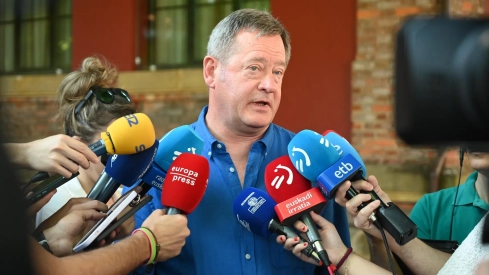
The Basque Security Counselor, Bingen Zupiria, has placed "organized Basque groups" behind the incidents registered yesterday in Bilbao, which resulted in 19 arrests and three investigated for their alleged involvement in the burning of cars and containers, as well as in the assaults on several businesses, after an event by the agitator Vito Quiles that was finally canceled.
In statements to Radio Euskadi, Bingen Zupiria stressed that, of the 19 arrested, 11 are minors, most of them without police records and of Spanish nationality. "The detainees did not know the years of ETA violence or the 'kale borroka'," said the counselor, before adding that, for this reason, "it is reasonable to think that they have external references or may follow instructions from organized Basque groups."
Investigation and profile of those arrested
According to information provided by the Ertzaintza, among those arrested are seven minors, three 18-year-olds and one 19-year-old, while the remaining eight are still under investigation. In addition, there are three people under investigation: a 17-year-old minor and two 22-year-olds.
The counselor expressed his concern about this type of altercation, because its protagonists may come to think that "the use of violence is justified". In this regard, he warned that, in a society like the Basque one, "there is no room for half measures" and "much pedagogy" must be done.
Bingen Zupiria also considered that there is a "climate of agitation" in Euskadi, with "extremist movements that permanently question the legitimacy of institutions" and that promote calls that, on occasion, end in violent acts.
The altercations, after the suspension of the event in Deusto
The incidents occurred after a concentration of several thousand people identified as "anti-fascists", who were protesting in front of the University of Deusto for an event scheduled for seven in the evening in which Vito Quiles was to speak. Quiles himself announced on his social networks the cancellation of the call, approximately half an hour before, for security reasons.
After the concentration dispersed, several hundred radicals moved to the nearby Lehendakari Aguirre avenue, where they set fire to a municipal police motorcycle and dozens of garbage containers, which they had moved to the center of the road, and then threw stones at the agents and the Ertzaintza police station in the Deusto neighborhood.
Shortly before, a construction container had been set on fire by hooded individuals in Francesc Macià street, near Lehendakari Aguirre, and rockets and stones were also thrown at the agents. Later, the disturbances moved to the Plaza de Euskadi, next to the Deusto bridge, and to the city center, where about half a dozen vehicles and numerous containers were set on fire.
Institutional and political reactions
The lehendakari, Imanol Pradales, has expressed his "deep concern" about altercations that he has described as "intolerable" and "unacceptable", carried out by groups of radicals. "Enough is enough. We don't want them in our country," he stated.
For her part, the spokesperson for EH Bildu in the Bilbao City Council, María del Rio Pereda, conveyed, in a message on X distributed by the party's press office, the coalition's "absolute rejection" of the "regrettable events" that occurred in the Biscayan capital, after the popular, peaceful and democratic responses of the day.
The mayor of Bilbao, Juan Mari Aburto, expressed himself forcefully in his condemnation of the events and described the altercations carried out by the radicals as "horrifying", of whom he said that "they are not anti-fascists; they are authentic fascists". Aburto insisted that "those who have drunk from sources of violence act with violence."
In addition, the Bilbao mayor conveyed his solidarity with the merchants "whose stores have been looted, who have seen their vehicles burn and the citizens of Bilbao who have had to endure an absolutely horrible afternoon".