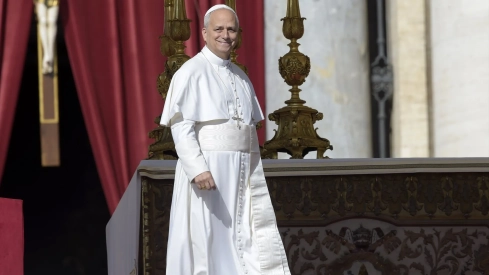
Galician born in Madrid, Yago de la Cierva (1960) is a professor and consultant, an expert in crisis management. In addition, he is the head of the coordination of Pope Leo XIV's visit to Spain (June 6-12), an event of high repercussion. Nothing similar had happened since Joseph Ratzinger traveled to the Spanish capital in 2011 to preside over the XXVI World Youth Day, an event that brought together hundreds of thousands of young people from all over the world, and which precisely had him in the command cabin supervising the operations. Now, De la Cierva sits down with 'ElConstitucional.es' to, indeed, unravel the ins and outs and arabesques to take into account when the arrival of a Holy Father is expected. The magnitude is that of a rock star, an Olympic Games or a World Cup. That and much more, because it has not been easy to pave the way in just four months of management.
- How is a trip of these characteristics organized?
The Pope's trips are organized by the Holy See in coordination with the Dioceses, that is, the local churches. The third leg is the governments of the country in question, since the Holy Father is -at the same time- head of state and spiritual leader of a religious confession, in some countries a majority and in others less so. Even in the latter, there is always a Catholic community.
- What is the praxis to follow? The matrix, the first thing that is done. That is, Spain invites him or, vice versa, it is he who decides.
He receives many invitations. The Pope accepts those backed by the government and bishops of the specific country. In cases where the Catholic Church is not a majority, he usually asks for an invitation from the predominant religious institution. This is why none have gone to Russia. Yes, he was invited by the Russian president years ago, also by the Catholic bishops... Not by the Orthodox Church. These, at a minimum, are the requirements. Then, it is the Pope -depending on priorities and agenda- who decides when and where to go. Also the length of the stay.
- And then?
He asks the bishops to send him a proposal. This is sent to Rome, studied, and a provisional program is approved. Then, a Vatican delegation approaches the country that the Holy Father will later visit... Normally, it does so a couple of times before to check all the sites, talk to the organizers... Then, the agenda of public events is authorized and published. Now official.
- How does the Holy See manage the private meetings of Leo XIV? I imagine there must be many.
Yes, for example, at Nunciatures. They do not require transfers. There are hundreds of letters from people asking to see him, and he - as a human being - can only carry out some of them. You see, the Holy See has a team of travel organizers. Currently, it is led by a Mexican Monsignor (José Salas). He is the coordinator of Apostolic Journeys, appointed during the end of Francis' Pontificate. He has collaborators: people from protocol and travel management, people from the Dicastery for Communication, security (Gendarmerie) and personal security, in this case the Swiss Guards. Afterwards, it is interesting to note that local churches are presided over by a cardinal or bishop. Also a general coordinator, who leads the organization under the direction of the president. Finally, there is an ad hoc committee created with people - also - from security, communication, protocol, liturgy, logistics and content to be discussed.
- This is in generic terms, but let's talk about Spain.
Well, the Holy Father has approved it by Diocese. That is, he first agreed to go to the Canary Islands, then Barcelona and Madrid, in that order. Each of them has a local committee. Then, the Episcopal Conference tries to help them by creating a transversal one for common issues: instructions, accreditation of journalists, State protocol... In short, a streamlining so as not to drive public authorities crazy. It is for support and assistance to the local Dioceses, who actually organize the visits and decide the content in agreement with the Holy See. This is how everything is established.
- What is your role and who calls you first?
It was Cardinal José Cobo, Archbishop of Madrid. I had been the executive director at World Youth Day in 2011. Then, the Cardinal called Fernando Giménez Barriocanal and me. We were financial and executive director, then. He asked us for help to organize everything together with the Diocese, the first committee that is formed. Afterwards, it was necessary to create another one in the Episcopal Conference, located in Madrid. To pave the way, Fernando and I are - also - the general coordinators of the visit to Spain. With this we ensure that everything is transversal and works well.
- In Madrid there will be two important events.
Yes, the Youth Vigil and Sunday Mass, June 7 (Plaza de Cibeles, 10 am). Although celebrated in the capital, they have national relevance as they are on a weekend. José Cobo has invited all Spaniards who wish to come, taking advantage of Madrid's centrality on the peninsula. That's why Fernando and I are in both places: national coordinators and, additionally, we are part of Madrid's planning committee. All of this is to make things easier.
- In recent weeks, several Italian media outlets have described this papal visit as one of the most costly in recent times. He was compared, not in terms of impact but economically, to a rock star. I don't know what you can tell me about this, and if in any way this compensates Spain in the medium to long term.
Let's talk about the Genesis of the trip. Leo XIV accepted the inheritance of Francis, who had announced his desire to go to the Canary Islands. In fact, preparations began in his day to make visible the drama of immigration, of the Atlantic migratory route. His first trip, in case you don't remember, was to Lampedusa (Sicily). He put the European and global spotlight there. Yes, on the Mediterranean route.
- The Atlantic one is more numerous.
Much more dramatic. It has more victims. Pope Francis emphatically said that his idea was to go there. Then, unfortunately, he fell ill and passed away. He could not fulfill his wish. Prevost picked up the baton to carry it out. The same happened with the trip to Nicaea to celebrate the anniversary of the Council. The second stage is Barcelona, specifically for the inauguration of the Tower of Jesus Christ and the culmination with a beautiful cross. Cardinal Omeya reminded him of the matter, inviting him to the blessing. In addition, June 10 is the centenary of Gaudi, an architect who is in the process of beatification.
- How did the Madrid thing come about?
The Pope confessed to Cardinal Cobo his desire to go to Madrid before Barcelona. When the bishops asked him if he wanted to go to other Dioceses, he replied: "I will go later, because this is my first trip to Spain." Well, he will visit four in total, because in the Islands there are Las Palmas and Tenerife. He will visit both, yes.
- Did Sánchez's visit to Rome days ago to meet with Robert Prevost have anything to do with this trip?
No, not at all. On June 1, the president of the Community of Madrid (Isabel Díaz Ayuso) was there, but those appointments were scheduled in advance.
- The expenses.
Yes, true. He will visit five cities, and I can assure you that they will be much more sober than previous trips. I'll give you an important fact: on the trip to Africa (Algeria, Cameroon, Angola, Equatorial Guinea), journalists had to pay almost fifteen thousand euros per person. Here, it will not reach three thousand. That's six flights plus as many hotel nights. These are public data, mind you. On this trip, the public authorities of the Canary Islands and Catalonia help with subsidies. It is important to emphasize this.
- Not in Madrid?
They provide venues, but they do not finance the visit. In this case, the Diocese of Madrid has created a committee to find benefactors. It will be the longest and most crowded there... A visit of almost half a million young people is expected... A mass with more than a million people. Those are the main expenses, because we are talking about stages, security, bathrooms, fences, water, electronic systems, screens...
- It is estimated, barring last-minute unforeseen events, a total expenditure of 25 million euros with a return of approximately 150. Then, once the event is over, the external audit will be more precise with the definitive impact. Also on issues of monetizing sponsorships and sponsors.
I deny that it is more expensive than other trips.
- Also that meeting with the Pope has a fee of half a million?
Anyone who knows the Vatican reality knows that every time the Pope receives an important gift - a work of art, a fire truck, a car or the Christmas tree for St. Peter's Square - the Supreme Pontiff has the good habit of thanking them. Add that in this case, the Holy See said that all those who had consistently contributed to the visit, would have a moment of encounter with him. It was always like that. The only difference is that the transparency criteria of this visit are total. The organization publishes everything it does.
Add ElConstitucional.es as a preferred Google source for free.
Stay informed about all the latest breaking news with the best information. Against disinformation, for democracy and social rights.