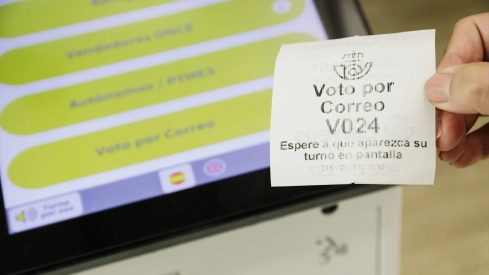
The Central Electoral Board (JEC) will study this Thursday several claims related to the vote of Spanish residents abroad and the application of the so-called 'grandchildren's law', the provision of the Democratic Memory Law that allows descendants of exiles to access Spanish nationality.
Among the documents that the body will analyze is the one presented by Vox, which requests that citizens registered in the Electoral Census of Absent Residents (CERA) stop voting by mail and can only do so in person at consulates and embassies. The party of Santiago Abascal maintains that the current voting system from abroad does not offer the same guarantees as the procedure applied within Spain. In its opinion, the process of incorporating new voters into the census is being carried out in an "enormously opaque" manner, which is why it also demands a temporary halt to new registrations in the Electoral Census of Absent Residents (CERA) while the procedure is reviewed.
The party links this request to the application of the so-called 'grandchildren's law', considering that the mechanism for accessing nationality promoted by the Government since 2022 responds to a "slow-motion coup d'état". With this argument, it asks the Electoral Board to review the system for registering new Spanish citizens residing outside the country.
But this Thursday's meeting will not only revolve around the initiative registered by Vox. There will also be various consultations submitted by organizations and individuals that question some aspects of the application of the norm. Among them is the one presented by the Independent Trade Union and Civil Servants Central (CSIF), which demands more precise instructions for consulates and a common criterion when incorporating new nationals into the electoral census.
The "rigging", the axis of the opposition's discourse
The decision that the Central Electoral Board must adopt this Thursday occurs in a context marked by the opposition's criticism of the naturalization system provided for in the so-called 'grandchildren's law' and its possible repercussions on the electoral census of Spanish residents abroad.
The president of Vox, Santiago Abascal, has been one of the most forceful voices. The leader of the party has accused the Executive of promoting a procedure without guarantees and has stated that "Pedro Sánchez and his mafia are radically changing the way in which Spanish nationality is obtained. They are also radically changing the way in which the postal vote from abroad is exercised. And today none of these procedures are transparent in any way".
The president of the Community of Madrid, Isabel Díaz Ayuso, has also joined these criticisms, questioning the government's actions by publicly asking if the Executive intends to "nationalize socialists" and demanding "observers now" to supervise the process before the next general elections.
Along the same lines, the president of the Popular Party, Alberto Núñez Feijóo, has accused Pedro Sánchez of promoting alleged "electoral engineering" through the "manufacturing" of new voters, statements that the Government has rejected while the Central Electoral Board is now preparing to analyze the claims presented regarding the external vote and the application of the so-called 'grandchildren's law'.
