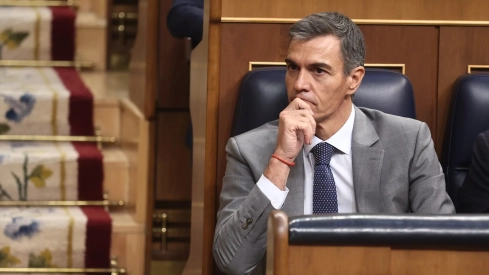
The Government and the PSOE take for granted that the president will announce early elections this Monday, although Sánchez has not yet communicated his decision to the entire Council of Ministers
The decision is in the hands of one person and, at this hour, everything points in the same direction. Pedro Sánchez has spent the weekend secluded in a process of analysis and reflection, surrounded by his closest and most trusted collaborators, while in the Government and in the PSOE the conviction is spreading that the president will finally opt to dissolve the Cortes and call early general elections.
It will be this Monday when Sánchez communicates his decision.
At La Moncloa, a calculated expectation has been maintained throughout the weekend. The president has not yet conveyed his decision to his entire Council of Ministers, which remains awaiting to know what the head of the Executive's next move will be. However, government and PSOE sources consulted this weekend by ElConstitucional.es practically take for granted that Sánchez will lean towards calling elections.
The hypothesis has gained strength after an especially complicated week for the Executive in Congress. Last Friday, the housing decrees fell after the no vote from PP, Vox, and Junts. The parliamentary rejection has ended up fueling a feeling that was already growing in La Moncloa: that of a blocked legislature with serious difficulties in moving forward with new initiatives in the Lower House.
The scenario drawn by the socialists is that of a government conditioned by an adverse parliamentary majority capable of stopping its main initiatives. And in that context, the possibility arises of turning parliamentary blockage into the central argument of a potential election campaign.
A "window of opportunity" for the PSOE and Sánchez
The strategy, according to the sources consulted, has been on the table for days. From the PSOE, Sánchez has been asked to call elections, considering that there is a window of opportunity for the socialists.
The reasoning involves transferring to the citizenry the confrontation around housing, one of the issues that the Government considers most sensitive and transversal. The intention would be to present the campaign around the rejection by PP, Vox, and Junts of the two housing decrees, arguing that these formations have prevented the implementation of measures aimed at addressing a problem that affects millions of Spaniards.
The Government intends, in this way, to turn the parliamentary blockade into the axis of an electoral narrative: an Executive that tries to approve measures on housing against an opposition that, united in the vote, prevents their validation.
But before reaching the polls, there is still one piece to fit.
Housing, at the center of the campaign
At La Moncloa, they are also working with the possibility of bringing the housing decrees back to the Cortes. The intention is to find formulas that allow them to be approved again and try to validate them in the Permanent Deputation of the Congress.
This is a path that would allow the Government to maintain the initiative on one of the issues it intends to place at the center of public debate, even while Sánchez finishes deciding whether to end the legislature early.
The paradox is evident: while mechanisms are being prepared to try to recover the decrees rejected on Friday, in circles closest to the Government it is practically taken for granted that the president could choose to go directly to the polls.
The final decision rests with Sánchez
Despite the political atmosphere in La Moncloa strongly pointing towards an early election, the last word remains exclusively with Pedro Sánchez.
During these days, the president has kept the decision-making circle reduced to his most trusted collaborators. The weekend has served him to maintain contacts and assess the different scenarios before making a decision that would affect the immediate future of the legislature and the Government itself.
The Council of Ministers remains expectant. So does the PSOE.
The political photograph late on Sunday is, therefore, that of an Executive preparing its next moves while awaiting its president's decision. At La Moncloa, there is talk of analysis and reflection; in the socialist ranks, of an electoral opportunity; and among the government sources consulted, of a call that they practically take for granted.
Everything remains pending an announcement.
It will be this Monday when Sánchez clears up the unknown and determines whether the legislature continues despite the parliamentary blockade or if, on the contrary, Spain is heading towards early general elections.
