The work of an actor will no longer begin when the camera starts recording, nor that of a musician when the stage lights turn on. The Government has approved this Tuesday the new labor regulation for artists, technicians, and assistants, a reform that will recognize rehearsals, the preparation of a production, and part of the tasks that until now remained hidden behind the finished work as effective working hours.
The royal decree replaces the framework approved in 1985 and completes one of the most anticipated pieces of the so-called Artist's Statute. The norm will reach some 771,000 people, 3.6% of employment in Spain, and will cover performing arts, audiovisual, and music, in addition to new forms of creation and dissemination through the internet, 'streaming' platforms, and social networks.
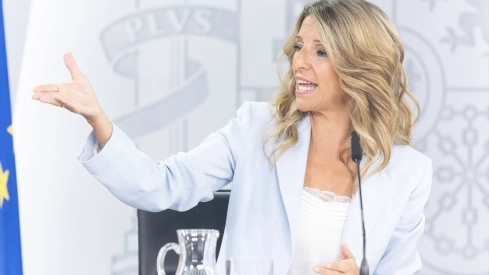
Yolanda Díaz has presented the change as "the labor reform for culture workers" after more than a year of negotiation with unions, companies, and around 80 professional organizations. The text leaves behind a regulation that still referred to labor ordinances approved during Franco's regime for activities such as cinema, theater, circus, or music.
"Culture is not a hobby, it is a job," the second vice president has claimed. Her department intends to convey this idea to labor relations marked by intermittency, short-term contracts, and a considerable part of the work that is done away from the public.
Hoy aprobamos el Estatuto del Artista, la reforma laboral de los trabajadores y trabajadoras de la cultura.
— Yolanda Díaz (@yolandadiaz.bsky.social) 21 de julio de 2026 a las 14:49
[image or embed]
Work begins long before the applause
One of the main novelties affects the calculation of the working day. Rehearsals, script preparation, pre-production, post-production, and promotional activities must be considered working time when carried out under the organization and instructions of the company.
The reform thus addresses one of the most common conflicts in the sector. Artists and technicians could dedicate days or weeks to preparing a work, learning a role, rehearsing a choreography, or promoting a premiere, while the contract and remuneration were concentrated on the performance, the show, or the recording period.
The new framework also obliges companies to communicate work plans, rehearsals, and other planned activities in writing and in advance. The measure seeks to provide more stability to professionals who often string together brief projects and variable schedules, often with little room to organize their personal lives or accept other assignments.
Breaks are also brought closer to the general rules of the labor market, and it is allowed that unused vacations be paid proportionally in short-term contracts. The intention is to adapt common rights to a sector where an employment relationship can cover an entire film, a theater season, a tour, or a single performance.
Technicians definitively enter the scene
Protection is no longer concentrated solely on performers, musicians, dancers, or directors. The technical and auxiliary personnel essential to set up a production are incorporated into the same labor framework, from those who assemble a set to sound, lighting, costume, hairdressing, makeup, or on-set assistance professionals.
The change completes the expansion initiated in 2022 and recognizes that a cultural work depends on a chain of jobs that rarely appears before the public. Artistic contracts may also be used for this personnel when their activity is directly linked to a specific production and does not form part of the permanent structure of the company.
The regulation also covers dubbing professionals, screenwriters, specialists, extras, choreographers, circus artists and other profiles linked to the different phases of creation. Internet, YouTube and digital platforms now appear within the scope of application, after decades in which the norm continued to speak mainly of public shows.
Díaz has summarized this advance by recalling that "without technicians and assistants, there is no show." The goal is that there are also no productions sustained on invisible workers, informal contracts or essential tasks that fall outside the workday.
Minors will need a contract, company and authorization
The decree regulates in detail and commonly for all of Spain the artistic work of minors under 16 years of age. The exception that allows them to participate in films, series, advertisements, theatrical works or musical productions will continue to exist, but it can only be exercised through an employment relationship as an employee and with prior administrative authorization.
Minors will no longer be able to appear as self-employed workers or carry out a commercial activity outside of a responsible company. The measure also reaches new realities such as children who star in advertising campaigns, generate paid content on social networks or regularly participate in channels managed by their families.
"Self-employment with minors is over in Spain," Díaz assured. The vice president has compared the situation with that of any other sector and has warned that working without a contract, regulated salary or hourly limits would still be exploitation even if the activity is carried out in front of a camera or from a family room.
The text establishes maximum working hours according to age, rest periods and limits on night work for adolescents aged 16 and 17. The activity must be compatible with the education, social life and personal development of the minor, who will also retain the right to be heard during the procedure.
The authorization will be valid throughout the territory when a production is carried out in several autonomous communities. Until now, differences between administrations could force the repetition of procedures and generate different levels of protection for the same filming or the same tour.
Intimacy coordinators by obligation
Companies must have an intimacy coordinator when sexual or intimate scenes are filmed or performed. Their function will be to ensure that consent exists throughout the process, agree on the limits of interpretation, and prevent situations of abuse or harassment.
This figure was already used in some productions, especially audiovisual ones, but it depended on the will of each company. From the entry into force of the norm, it will be mandatory and must reinforce its intervention when a minor participates in the scene.
The decree also adapts the protocols against violence and harassment to the reality of artistic contracts. A performer may remain only a few days on a set or join a company for a few weeks, so the procedures must act quickly enough to protect the victim before the employment relationship ends.
Díaz has linked this measure to historical cases in which actresses reported years later having been deceived or subjected to practices they had never consented to. Intimacy coordination aims to establish from the beginning what actions will be performed, how they will be filmed, and what use can be made of the images afterward.
Clearer pay slips and rights separated from salary
The reform requires differentiating all salary and non-salary concepts on pay slips. Payments for the assignment of intellectual property rights must appear separately, provided that these rights are not collectively managed by a specialized entity.
The measure will allow distinguishing how much a person earns for their work and what amount corresponds to the subsequent exploitation of their interpretation, their voice, or their image. This separation is especially important when a film, a recording, or a campaign continues to generate income after the contract has ended.
Collective agreements may add guarantees on data protection and digital rights. They must also continue to develop issues specific to each activity, from tours and travel to availability times between one performance and another.
Remuneration transparency seeks to correct contracts in which different payments appeared grouped under a single amount. The worker will be able to know with greater precision what rights they are ceding, for how long, and what remuneration they receive in return, although the real capacity to negotiate will continue to depend largely on the collective agreement and their position vis-à-vis the company.
Artificial intelligence is left out
The main pending point is generative artificial intelligence. The first drafts included specific limits to prevent a company from cloning an artist's voice, face, or interpretation without consent and without clearly agreed compensation.
That section has disappeared from the final text after the Council of State considered that it affects fundamental rights and requires a norm with the rank of organic law. The royal decree improves information on the assignment of image, voice, and intellectual property, but does not create a specific regime against replicas made using AI.
The difference is relevant. A payroll may separately reflect the amount agreed for the use of certain rights, although the new regulation does not by itself resolve when a synthetic voice can be generated, for how long it must be authorized, or what happens with future uses that were not foreseen when signing the contract.
CCOO, UGT, the Union of Actors and Actresses, and CONARTE have celebrated the bulk of the decree and describe the level of agreement reached as "very high." At the same time, they consider that an opportunity has been lost to protect professionals against a technology that especially threatens dubbing, interpretation, and music.
"This leaves any question about the uses of generative artificial intelligence in the hands of individual negotiation," the organizations have warned, adding that they will continue to demand specific regulation. "The law of the jungle is not an option," they summarized.
A Statute built over eight years
The Artist's Statute is usually presented as a single norm, although in reality it is made up of different labor, fiscal, and Social Security reforms. Its origin lies in the 75 recommendations unanimously approved in Congress in 2018 to adapt laws to the intermittency of cultural work.
Since then, the temporary artistic employment contract, a special unemployment benefit, improvements in the compatibility between pension and creative activity, and tax changes aimed at softening the impact of very irregular income have been incorporated. The decree approved this Tuesday completes the renewal of the special employment relationship that had been in force since 1985.
The process still has several open fronts. Professional associations demand a more adequate system for the self-employed, better coverage during periods without work, the recognition of occupational diseases specific to the sector, and new tax measures for incomes that can be concentrated in a few months.
The Government will create two technical commissions to study the requalification of those who must abandon an artistic profession and union representativeness in a sector fragmented among thousands of projects and short contracts. The royal decree will begin to apply after its publication in the Official State Gazette, while protection against artificial intelligence will have to return through a different legislative channel.
Add ElConstitucional.es as a preferred Google source for free.
Stay informed about all the latest breaking news with the best information. Against disinformation, for democracy and social rights.
