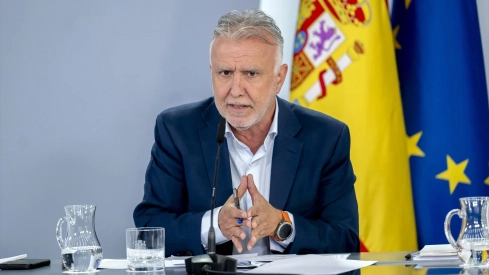
The Government has this Wednesday put the Popular Party before a question that will mark the future of migrant minors who arrived in Ceuta. What does it propose to do with those children who cannot return with their families to Morocco? The Minister of Territorial Policy and Democratic Memory, Ángel Víctor Torres, maintains that the answer lies in transferring them to the Peninsula and alleviating an overwhelmed reception system.
"If a high number cannot be reunited, what is the solution? That they stay in Ceuta?" Torres asked after presiding over a new meeting of the Situation Committee in the autonomous city. The minister has urged the President of Ceuta, Juan Jesús Vivas, to publicly support the relocation of these minors to other communities.
The Executive differentiates between the competencies of the two administrations. Ceuta maintains the guardianship and the obligation to care for the children, while the State deals with immigration procedures, international protection applications, and negotiations with Morocco for a possible family reunification. Each case must be studied individually and have legal assistance.
The care pressure remains enormous. The Autonomous City has under its protection 2,140 already identified minors, while Torres estimates that between 700 and 1,000 are still on the streets awaiting affiliation. The state system also accommodates 4,160 adults in its facilities.
Two ways to get them out of Ceuta
The Ministry of Youth and Childhood has reminded that there are two immediate formulas to begin transfers without waiting for all the files to be concluded. The first would allow to take 500 girls considered especially vulnerable to the Peninsula. Ceuta would retain guardianship and specialized entities would assume their custody and daily care.
This option has been on the table for more than a month and also does not require the consent of the receiving communities. The Autonomous City must formalize agreements with the organizations responsible for reception. The department led by Sira Rego assures that places are available and that the processing of each minor can continue from anywhere in Spain.
The second alternative is bilateral agreements between Ceuta and other autonomous communities. Navarre is the only one that has so far closed a reception agreement, a response that the Ministry considers insufficient given the magnitude of the emergency.
Both formulas are added to the mandatory mechanism introduced through the reform of article 35 of the Immigration Law, whose deadlines are longer. Youth and Childhood accuses the responsible administrations of lack of political will and recalls that the PP voted against the mandatory distribution despite Vivas having demanded greater territorial solidarity for years.
Torres has directly reproached Alberto Núñez Feijóo for turning "his back" on Ceuta with that vote. He has also called on the Ceuta PP to clarify whether it maintains its defense of the distribution or assumes the position of the popular communities that resist receiving minors, some of them conditioned by their agreements with the far-right Vox.
Ceuta claims to have complied
Vivas's Government admits that guardianship corresponds to it, although it considers that its ordinary capacity is insufficient to assume an arrival of these dimensions. Its spokesperson, Alejandro Ramírez, has assured that Ceuta has already completed the necessary procedure to transfer the 500 girls and has denied that the local administration is blocking their departures.
The discrepancy was focused on the appointment of a legal representative to accompany the minors during the procedure. The State has provided two million euros to finance that legal assistance and Ceuta has formalized this week the collaboration with the Bar Association. "The moment it was said that the City should appoint a representative, it was done," Ramírez defended.
The Ceuta Executive maintains that all identified minors are being referred to the emergency resources enabled in Piniers and Tarajal. It also recalls that its contingency capacity was set at barely 29 places before the crisis. The central Government replies that this saturation precisely reinforces the need to activate the offered transfers as soon as possible.
The first files began to be processed on Monday through face-to-face interviews and with the assistance of legal representatives. The Situation Committee will analyze the first advanced cases on Wednesday, September 23, to determine which minors can be reunited with their families in Morocco and which ones should continue within the Spanish protection system.
Add ElConstitucional.es as a preferred Google source for free.
Stay informed about all the latest breaking news with the best information. Against disinformation, for democracy and social rights.
