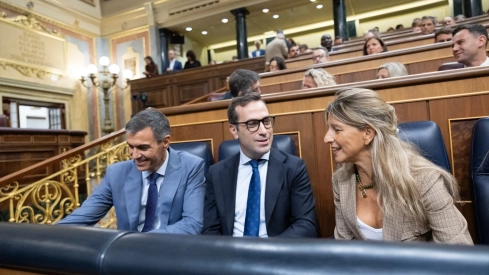
The Government closed this Wednesday an especially difficult day in Congress with a resounding endorsement of its main economic, social, and humanitarian response for Ceuta. The Plenary validated by 304 votes in favor and 33 against the decree that mobilizes 309 million euros to face the consequences of the massive entry of migrants registered at the end of July.
The Popular Party ended up voting in favor despite the harsh criticisms it had launched against the package during the debate. Junts abstained and the far-right Vox remained as the only rejection of measures that include aid for companies and workers, security reinforcements, funding for reception, and resources allocated to the city's public services.
The vote allowed the Executive to save the legal instrument with which it intends to accelerate Ceuta's recovery. The decree was already in force since its publication, but it needed the endorsement of Congress to remain so. Now it will also be processed as a bill under the urgency procedure, which will allow groups to introduce changes.
The parliamentary balance of the day also left a political setback for the Minister of Interior. A motion by the PP managed to censure Fernando Grande-Marlaska for his management of the crisis and asked Pedro Sánchez to dismiss him. The initiative has no legal effects and the Government maintains its support for the minister.
The Chamber rejected, on the other hand, the proposals presented by Vox to hold the Executive responsible for crimes that migrants may commit and to suspend cooperation agreements with Morocco. Its initiative to prevent the transfer to the Peninsula of minors arriving in Ceuta, which did receive the support of the PP, also failed.
309 million to restore normality
The First Vice President and Minister of Economy, Carlos Cuerpo, defended the decree as a response to the concerns expressed in recent weeks by social agents, businesses, workers, and Ceuta authorities. The objective, he maintained, is to help the city "return to normality as soon as possible."
The package reserves 118 million for humanitarian reception, of which 63.6 million will be allocated to the care of migrant minors. Another 90 million will strengthen security, 80 million will sustain economic activity and employment, and 21 million will finance essential services. The response is completed with a line of guarantees of up to 50 million.
Among the measures are direct subsidies for SMEs and self-employed workers, bonuses, incentives for tourism and consumption, labor mechanisms to protect employment, and resources to expand accommodation facilities. The investment is approximately equivalent to 16% of Ceuta's annual gross domestic product.
The PP described the plan as insufficient and accused the Executive of trying to compensate with money for the errors made during the crisis. Finally, it chose to support it, preventing the political debate from leaving Ceuta without one of the main instruments designed to alleviate the economic and social impact of the last seven weeks.
That support came after another tough confrontation between Pedro Sánchez and Alberto Núñez Feijóo during the control session. Both accused each other of wanting to "chronify" the situation. Feijóo demanded explanations from the president about his contacts with Morocco and Sánchez reproached the PP for "putting spokes in the wheels" of the measures promoted by the Executive.
Torres accelerates adult and minor files
The Minister of Territorial Policy and head of the single command, Ángel Víctor Torres, met this Wednesday with the committee in charge of coordinating the state response and presented a new balance. Currently there are 4,160 adults in resources enabled by the State, while 2,140 minors have already been identified and remain under the guardianship of the autonomous city.
The Government estimates that there are still between 700 and 1,000 minors pending identification on the streets. After several weeks of differences between administrations over legal assistance, individualized interviews have already begun with the presence of the legal representative required for each child or adolescent.
Torres expects to have the first complete files next Wednesday. The priority will be reunification with their families in Morocco, provided that the necessary guarantees are in place, the minor is heard, and the Prosecutor's Office endorses each case. Those who are entitled to international protection or lack a safe family environment must remain in Ceuta or be transferred to other Spanish territories.
The minister has insisted that the guardianship of minors corresponds to the Ceuta government, although the State is providing funding, personnel, and possible reception places on the Peninsula. Sánchez escalated tension with Juan Jesús Vivas's Executive when asked about the minors who remain on the streets. "Ask Vivas," the president replied.
The jurisdictional clash continues to be the most delicate point between both administrations. Torres defends that Ceuta must complete the files and collaborate in the reallocations, while Vivas's Government demands more speed and an indicative date to alleviate the pressure on its resources.
In the case of adults, 1,917 triage files have already been initiated to determine who has the right to remain in Spain and who can be returned. Voluntary returns to Morocco amount to 5,603, and another 180 people have renounced requesting international protection.
The process faced a new obstacle this Wednesday after the National Court provisionally halted the installation of the planned camp in the port of Ceuta. The space was going to occupy 16,000 square meters and would have capacity for about a thousand people. The suspension will remain until the court resolves the precautionary measure requested by the Unified Police Union.
Torres highlighted, among the advances towards normality, the recovery of attendance at educational centers. 90% of students attended class during the last three days, compared to 75% recorded at the beginning of the school year.
Melilla takes the dispute to the border this Thursday
The debate will move this Thursday to Melilla, where the agendas of the Government and the main opposition party will coincide on the occasion of the city's 529th anniversary. The Minister of Inclusion, Social Security and Migrations and spokesperson for the Executive, Elma Saiz, will participate in the institutional acts as a sign of the Government's support for the people of Melilla.
Feijóo will also travel to the city and accompany the regional president, Juan José Imbroda. Before that, he will hold a meeting in Madrid with the European Commissioner for Home Affairs and Migration, Magnus Brunner, focused on the situation in Ceuta, border protection, and return procedures.
The European agenda has gained weight after Ursula von der Leyen defended before the European Parliament that “Ceuta is Spain” and “Ceuta is Europe”. The President of the Commission announced a new response mechanism for migratory emergencies, more support from Frontex, and procedures to accelerate returns without abandoning legal guarantees.
Feijóo will extend his offensive next Monday with another visit to Ceuta accompanied by the president of the European People's Party, Manfred Weber, and the general secretary of the party, Dolors Montserrat. The Government will arrive at this new challenge with the 309 million decree approved and with the immediate challenge of transforming that broad parliamentary support into a visible improvement of the situation on the ground.
Add ElConstitucional.es as a preferred Google source for free.
Stay informed about all the latest breaking news with the best information. Against disinformation, for democracy and social rights.
