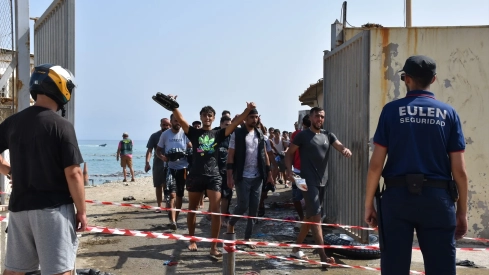
The Government has mobilized the Army this Thursday to reinforce the Civil Guard in the face of the massive entry of thousands of people from Morocco into Ceuta. The military units deployed in the autonomous city will support the agents in the necessary tasks to maintain security after a day in which the Tarajal border has been completely overwhelmed.
The decision represents a last-minute turn in the Executive's response and comes just hours after Alberto Núñez Feijóo expressly demanded the intervention of the Army. The president of the PP also asked to close the border, deploy a diplomatic offensive against Morocco and the European Union, and declare the situation of interest for National Security.
The military request did not come solely from Génova. All groups in the Ceuta Assembly, including the PSOE of Ceuta, had demanded during the afternoon the deployment of the Armed Forces, the urgent closure of the border, and the assumption of a single command by the State. The president of Ceuta, Juan Jesús Vivas, had been demanding an exceptional response all day in the face of the collapse of security and reception resources.
Moncloa has acceded to the demand for military deployment, although it maintains its rejection of declaring a national emergency. The Government argues that state civil protection regulations do not include migratory flows among the assumptions that allow activating this mechanism. Ceuta invokes a different route, the National Security Law, but the Executive has not applied it for the moment either.
The Army will directly support the Civil Guard
"The Armed Forces will reinforce the Civil Guard in the exercise of its powers and those that may be necessary to maintain security in the city of Ceuta," the Government has communicated. The military will be coordinated by the Operations Command and will act in support of the agents deployed on the ground.
The Executive has not yet specified the number of soldiers mobilized or the exact distribution of their tasks. The order affects the Army units already stationed in Ceuta, as occurred during the border crisis of May 2021. The military mobilization is part of a much broader operation. To the 60 agents of the Reserve and Security Group permanently assigned to border surveillance, a platoon of 20 personnel has been added. Two other platoons, with 40 more civil guards, will arrive in the coming hours.
The Citizen Security Unit of Ceuta will also receive 30 agents from different units in Andalusia. The Special Group for Underwater Activities will send two teams of divers, made up of eight personnel, to reinforce maritime surveillance and attend to entries by swimming through the Tarajal breakwater.
The maritime device currently has two medium vessels and four Zodiac boats. The oceanic vessel 'Duque de Ahumada' will arrive in Ceuta during the early hours of this Friday and in the coming days, five boat captains, three mechanic-sailors, and several drone pilots will join. The Air Service will also send a helicopter.
The National Police has deployed an Immigration team composed of six people to support identification and documentation tasks. Three teams from the Police Intervention Unit have arrived from Seville and subsequently, personnel from the Central UIP and Malaga will join.
The objective of the Interior Ministry is to reach a contingent of 200 UIP and UPR police officers specifically dedicated to citizen security in Ceuta. The personnel usually stationed in the city will double shifts through extraordinary working days while the crisis continues.
Feijóo asked to act in a "desperate" situation
Alberto Núñez Feijóo had called for military intervention during the afternoon through a message disseminated on his social networks. "The situation in Ceuta is desperate. The Government cannot look the other way regarding its obligations because we are facing a national security crisis," affirmed the leader of the PP.
The situation in Ceuta is desperate. The Government cannot look the other way regarding its obligations because we are facing a national security crisis.
— Alberto Núñez Feijóo (@NunezFeijoo) July 30, 2026
All support to @JuanVivasLara and the autonomous city, which unanimously and rightly asks for the recognition of the… pic.twitter.com/33a9HMjPas
Feijóo supported the request made by Juan Jesús Vivas and demanded the immediate recovery of border control. His proposal included the closure of border crossings, the deployment of the Army, diplomatic actions before Rabat and Brussels, and the declaration of a situation of interest for National Security.
The mobilization announced by Moncloa addresses one of these demands, although the Government continues to reject the declaration of emergency and keeps the border open in the midst of Operation Crossing the Strait. The Executive has also opted to negotiate directly with Morocco the urgent handover of people who have entered irregularly.
The far-right Vox had also asked to send the Army and close the border. Santiago Abascal's party has again described the arrival of migrants as an "invasion" and has demanded the urgent appearance in Congress of ministers Fernando Grande-Marlaska and Margarita Robles and the director of the Department of National Security.
Thousands of people enter and the CETI becomes saturated
The massive entry began during the morning and reactivated strongly from 3:30 p.m. Thousands of people have skirted the Tarajal breakwater, crossed by swimming, or accessed through one of the side doors of the border, while agents tried to assist those who arrived injured or exhausted.
There is still no official closed figure on the number of entries registered this Thursday. Authorities speak of several thousand and the figure of between 1,500 and 2,000 people corresponds only to the ten days prior to this last wave, so the real balance will be considerably higher.
The pressure also continues on the other side of the border. A five-kilometer human column stretches from the center of Fnideq, the Moroccan town of Castillejos, to the vicinity of Ceuta. Thousands of young people continue to arrive on foot, by motorcycle, or by car from different parts of Morocco with the intention of reaching the Spanish enclave.
The Moroccan police are overwhelmed in the area, according to information gathered on the ground. Rabat has not provided figures on arrests, rescues, or possible deaths, and the flow towards the border has not stopped despite the announced agreement between both governments.
In Ceuta, the Temporary Immigrant Stay Center has 512 places but already houses about 800 people. More than a thousand remain in its vicinity without being able to access the facility, while many other people are spread across different streets or have gone to relatives' homes. The situation of minors has also exceeded the city's capacity. The facilities set up accommodate about 700 children and adolescents, and the Ceuta government has had to reopen two warehouses to provisionally expand the available places.
The collapse has ended up affecting daily activity. Bars, restaurants, supermarkets, shops, and several shopping centers have closed their doors during the afternoon, while the Confederation of Entrepreneurs and the Chamber of Commerce have called for calm, unity, and confidence in public services.
Morocco accepts returns and Brussels offers Frontex
Spain and Morocco have agreed to strengthen coordination and apply measures for the return, "as soon as possible," of those who have entered Ceuta irregularly. Rabat has publicly confirmed the agreement after several hours of official silence about what was happening at the border.
The Interior Ministry accuses human trafficking networks of using the recent Supreme Court ruling that prevents the application of immediate rejection to those intercepted at sea. Morocco also blames criminal organizations for the mobilization and assures that its security forces have prevented thousands of attempts in recent days.
Returns must be carried out through the corresponding legal procedures. The identification of each person, the protection of minors, and access to the asylum procedure remain subject to the guarantees provided by Spanish and international legislation.
Fernando Grande-Marlaska has maintained permanent contact with his Moroccan counterpart, Abdelouafi Laftit. José Manuel Albares has also spoken several times during the day with Morocco's Minister of Foreign Affairs, Nasser Bourita, to try to "channel and resolve" the crisis.
The European Union has offered Spain to increase its support through Frontex. The European Commissioner for Home Affairs and Migration, Magnus Brunner, has conveyed to Marlaska Brussels' availability to collaborate in controlling the external border and has confirmed that the Commission maintains contacts with the Moroccan authorities.
I conveyed to Minister Grande-Marlaska the EU’s readiness to increase support to Spain, including through Frontex, to control the situation. We are also following up with the Moroccan authorities to ensure all necessary efforts are made to prevent these dangerous journeys.
— Magnus Brunner (@magnusbrunner) July 30, 2026
Pedro Sánchez has assured that the Government is "fully committed" to offering an immediate response and that it will mobilize all necessary resources. The president has spoken with Juan Jesús Vivas and has defended cooperation with Morocco and European authorities to restore normality.
Marlaska will travel this Friday first thing in the morning to Ceuta to personally evaluate the operation and meet with local authorities. When he arrives, the Army units will already be under operational command and the 'Duque de Ahumada' will have reinforced maritime surveillance in front of Tarajal.
Add ElConstitucional.es as a preferred Google source for free.
Stay informed about all the latest breaking news with the best information. Against disinformation, for democracy and social rights.
