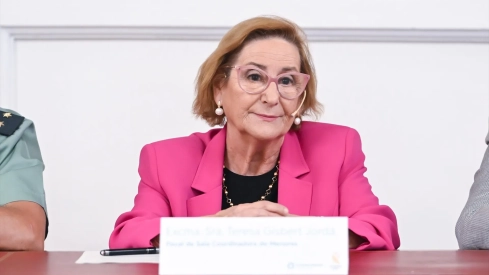
The massive entry of people into Ceuta has completed three weeks. The Government is carrying out transfers in the autonomous city to reception centers, procedures for the distribution of migrants are being initiated, and the situation of unaccompanied minors in the territory is being managed. In this regard, the prosecutor of the Coordinating Chamber for Minors at the State Attorney General's Office, Teresa Gisbert, granted an interview this Thursday to journalist Pablo Tallón on the ‘Cadena SER’ program Hora 25, where she emphasized that the European Pact on Migration and Asylum (PEMA), in force since last June 12, clearly establishes how these procedures should be carried out.
Gisbert thus responded to the statements of the leader of the PP, Alberto Núñez Feijóo, who has argued that the massive entry into Ceuta would allow the immediate return of migrants. Against this position, the prosecutor recalled that the Supreme Court already established that the return of minors cannot be done directly and that it is necessary to study the circumstances of each case. "Therefore, it makes no sense," she affirmed.
🗣️ Teresa Gisbert, Fiscal de Menores: "Como trata una sociedad a los niños y niñas, la define. Los fiscales estamos para proteger a los vulnerables y personas con discapacidad, pero que no nos vengan con historias de legislación porque está clarísima" pic.twitter.com/ViWD1xqwT9
— Hora 25 (@Hora25) August 20, 2026
The prosecutor also referred to the autonomous communities that are putting obstacles to the reception of minors and pointed out that "the only thing they do is try to hinder." Specifically, she pointed to those where a pact has been made between PP and Vox, although she stressed that none can refuse to comply with legally established obligations.
As she explained, the Juvenile Prosecutor's Office intervenes when a community raises difficulties in receiving children referred from Ceuta. "When the juvenile prosecutor addresses the autonomous community to tell them that they cannot refuse to take in the minors that the royal decrees say, despite the objections, in the end they give in because they have no choice because it is compliance with the law," she said.
Gisbert assured that this situation is not new and that for approximately a year and a half the same procedure has been repeated. The Prosecutor's Office contacts the juvenile prosecutor of the destination territory, sends a letter and reminds the corresponding administration of the obligations it must fulfill.
Gisbert pointed out, however, that one of the main problems is the lack of interpreters. The procedure requires conducting personal interviews and being able to communicate with minors in any language, in addition to analyzing their family and personal situation. "The best interest of the child prevails," she explained, and specified that this principle can lead both to considering a return to their family and to ruling it out if there is a risk that the child will be in a situation of unprotectedness.
Regarding the number of minors who remain in the city, Gisbert acknowledged that they still do not have an exact figure. Estimates come from minors identified by the Police and subsequently transferred to centers, but there is uncertainty about how many may still remain on the streets.
Gisbert defended that the Spanish protection system must apply the same guarantees to all minors, regardless of their nationality or administrative situation. "We do not distinguish, they are not irregular foreigners, before being irregular foreigners they are minors, which is the most important thing," she affirmed.
Add ElConstitucional.es as a preferred Google source for free.
Stay informed about all the latest breaking news with the best information. Against disinformation, for democracy and social rights.
