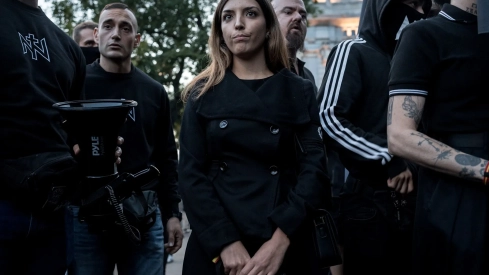
Isabel Peralta kept four long guns in her house and the judge released her this Sunday on bail, with her passport withdrawn due to flight risk, in one of the most sensitive derivatives of the operation against National Nucleus.
The leader of the neo-Nazi group, arrested last Friday, was linked to a police investigation that, according to the information known so far, would have been opened for the recruitment of minors. The case remains open and, for the moment, the crimes initially attributed to those arrested are incitement to hatred, illicit association, and possession of weapons.
A coordinated raid in seven provinces and a search of the central headquarters
The National Police carried out a simultaneous operation in seven Spanish provinces —Asturias, Madrid, Guadalajara, Burgos, Alicante, Pontevedra, and Valladolid— which ended with 14 arrests. The intervention was coordinated by the General Information Commissioner and allowed several searches to be carried out, including that of the central headquarters of National Nucleus in Madrid.
Of the ten detainees who appeared before the judge this Sunday, one was arrested in Gijón and two in Avilés. The remaining seven had been identified in the investigation as possible members of the organization's leadership and were transferred to the court centralizing the case.
The Asturian focus and the dispute over the Simancas monument
The operation comes after National Nucleus staged an act of fascism exaltation in Gijón last February, around the monument to the Heroes of Simancas, on the facade of the Colegio de la Inmaculada, of the Society of Jesus. Following that episode, the Asturian Government urged the Ministry of Interior to dissolve far-right formations like this one.
The monument has also been at the center of political and judicial controversy. The Government of the Principality issued a resolution to remove it, the Society of Jesus appealed it before the Superior Court of Justice of Asturias, and the high court agreed to a precautionary measure to suspend the suppression of the sculptural ensemble.
In a recent visit to Gijón, the Secretary of State for Democratic Memory, Fernando Martínez, assured that the Government will force the removal of the monument due to its connection with the Franco dictatorship, despite the precautionary halt agreed by the Asturian court.
Contact