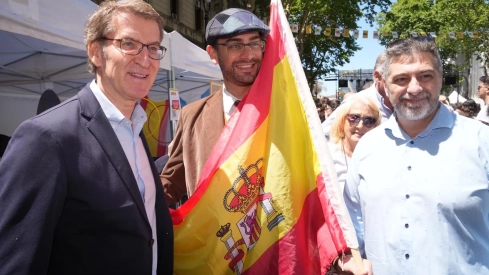
Alberto Núñez Feijóo has found in the Grandchildren's Law a new front against Pedro Sánchez, but the archives have quickly returned the ball to him. The leader of the PP now accuses the Government of practicing "electoral engineering" and trying to "manufacture" voters through the granting of nationality to descendants of Spaniards abroad. The problem for Génova is that Feijóo very recently defended a similar formula, promised it in Argentina, and even included it in the Popular Party's electoral program.
The phrase that now haunts him came from his own X account in November 2022, during a trip to Buenos Aires. There he assured that he had conveyed to the Spanish community his commitment to promote "a nationality law for the grandchildren of Spaniards abroad". That message was accompanied by another political promise: to repeal the Democratic Memory Law. That is to say, Feijóo did not then reject that descendants of Spaniards could recover their nationality. What he disputed was the framework chosen by the Government.
Hoy en Buenos Aires he podido estar con la colectividad española y trasladarles mi compromiso de impulsar una ley de nacionalidad para los nietos de españoles en el exterior, y a derogar la mal llamada Ley de memoria democrática. pic.twitter.com/UISRuy1yTe
— Alberto Núñez Feijóo (@NunezFeijoo) November 6, 2022
The shift now comes with a much harsher tone. Feijóo maintains that Sánchez wants to expand the census to compensate for a possible electoral loss and has mixed the Grandchildren's Law, overseas voting, and the regularization of immigrants into the debate. These are distinct issues. Nationality by descent is processed under the Democratic Memory Law, CERA voting corresponds to Spaniards residing outside Spain, and the administrative regularization of foreign persons does not in itself grant the right to vote in general elections.
The data also do not support the image of an automatic pool of votes for the PSOE. As of March, there were 2.4 million appointments or applications linked to the Democratic Memory Law, 1.2 million formalized files, 544,722 approved, and about 306,000 people registered in the consular Civil Registry. Applying for nationality does not equate to having it granted. Having it granted does not imply voting. And voting from abroad does not guarantee supporting a specific party.
The closest precedent also makes the PP uncomfortable. In the 2023 general elections, the external vote ended up benefiting the popular party in Madrid, where they snatched a seat from the PSOE after the CERA recount. The emigrant vote itself, which Feijóo now places under suspicion, has for years been a field worked by the Galician PP in Argentina, Uruguay, and other countries with a strong presence of descendants of emigrants.
The contradiction does not stop in 2022. The PP's program for the 2023 general elections included the commitment to guarantee the community of descendants of Spaniards the right to opt for nationality through a reformed access law for grandchildren. Also in Galicia, during his regional stage, Feijóo had defended nationality for children and grandchildren of Spanish emigrants. In 2006, he even said in Uruguay that it made no sense for a grandchild of Spaniards to have fewer rights than an immigrant.
Díaz and Puente return the newspaper archive to him
The Government and its partners have taken advantage of the change in discourse to attack Feijóo. Yolanda Díaz has accused the PP leader of embracing “Trumpist theses” by sowing doubts about the electoral system and has reproached him for his own trajectory in Galicia with the external vote. The vice president has gone further by recalling that Feijóo presided over a community in which, according to her words, “the living and the dead voted”.
Óscar Puente has also entered the controversy. The Minister of Transport has recovered old messages from Feijóo and the point of the PP's electoral program on the nationality of descendants of Spaniards. His thesis is simple: altering an election with the Grandchildren's Law, as suggested by PP and Vox, is “science fiction”.
Y cumplió. Lo llevó en su programa electoral en las generales de 2023. https://t.co/4YTT8MreEi pic.twitter.com/4zv80LxWXN
— Óscar Puente (@oscar_puente_) June 30, 2026
The Government spokesperson, Elma Saiz, had already described Feijóo's words as a “major irresponsibility” and linked them to the “desperation” of someone who, in her opinion, is beginning to smell an electoral defeat. In Moncloa, they maintain that the procedure is regulated, that consulates do not assign provinces at the convenience of the Government, and that access to nationality responds to a measure of reparation for descendants of Spaniards affected by exile and the loss of nationality.
The controversy leaves the PP trapped between its current discourse and its own recent commitments. Feijóo has gone from promising a nationality law for the grandchildren of Spaniards abroad to denouncing as “electoral engineering” a procedure that extends rights to that same group.
