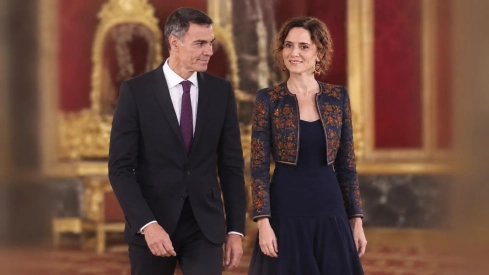
Pedro Sánchez and Isabel Díaz Ayuso have moved the Spanish political fight to the international arena, just a few weeks before the general elections on November 29, and this struggle opens up a fundamental question: who manages to better project Spain's image abroad and convert that visibility into political capital within the country.
The President of the Government has hosted the XXX Ibero-American Summit in Madrid, an event that the Government has sought to present as a lever to reinforce Spain's role as an interlocutor between Latin America and the European Union. In parallel, the regional president of Madrid has continued to cultivate her own foreign agenda, with contacts and meetings that bring her closer to leaders of the Latin American right.
Diplomacy as a showcase, but without proof of electoral effect
Sánchez defends within this framework multilateralism, dialogue, and international cooperation, and with this, he seeks to reinforce Spain's image as an interlocutor with Latin America and Europe. Even so, the electoral impact of these summits cannot be taken for granted.
The summit also brings to the table the new Latin American political map: the presence of leaders such as Javier Milei and José Antonio Kast reflects the shift towards conservative positions in several countries in the region. This reality requires maintaining institutional relations with governments with very different ideological approaches from those of the Executive.
The case of Milei summarizes this tension: Sánchez and the Argentine president have engaged in public confrontations and maintain fundamental ideological differences, but their coincidence in Madrid forces a separation of political dispute from diplomatic relations.
Ayuso and the Latin American right, an alternative agenda to project influence
Ayuso has also sought international prominence through her meetings with leaders like Kast, a strategy that allows her to project herself to the Latin American right-wing sphere. The comparison with the Government's line serves to measure two different ways of projecting foreign influence from Spain.
The difference is political: while Sánchez prioritizes international cooperation and dialogue in a multilateral key, Ayuso cultivates relations with leaders of the regional right. Both paths seek visibility and capacity for influence, but it still remains to be seen which narrative translates into political capital within the country.
In this logic, Kast's meetings with Ayuso and Santiago Abascal are also framed, meetings that reinforce the image of political harmony between the Spanish right and its Latin American allies. For the next step, the key will be to see which narrative carries more weight and how it translates —or not— into the race towards November 29.
Contact