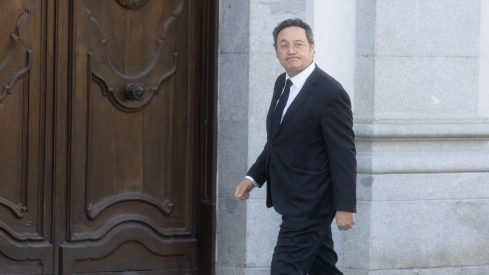
The President of the Government, Pedro Sánchez, leaves open the possibility of pardoning former Attorney General Álvaro García Ortiz before the November 29 elections. "I don't rule it out," he replied in an interview published this Friday in 'elDiario.es', when asked specifically about that option. The statement has provoked a new offensive from the PP, which attributes to Sánchez the intention of paying favors to the person who headed the Public Prosecutor's Office, while Justice keeps the file under study and a decision from the Council of Ministers has not yet been announced.
The Minister of the Presidency, Justice and Relations with the Cortes, Félix Bolaños, confirms in an interview on RAC1 that the request is on his desk, but avoids anticipating the result. "We will see if it is appropriate to make a decision these days or if it is appropriate to leave it for later," he explains. The possibility of resolving the pardon before 29N remains open, although the Government has not set a date or communicated the scope of a possible measure of grace.
The debate affects a conviction issued by the Supreme Court for revealing secrets related to Alberto González Amador, partner of the president of the Community of Madrid, Isabel Díaz Ayuso, in the context of his case for alleged tax fraud. The ruling imposed on García Ortiz two years of special disqualification from the position of attorney general, a fine of 7,200 euros and compensation of 10,000 euros. The decision divided the court, with five magistrates in favor of convicting him and two, Ana Ferrer and Susana Polo, in favor of acquitting him.
The Public Prosecutor's Office supports the partial pardon
The file began to be processed in January, after pardon requests were submitted, months before the election call. Sánchez places his response within the examination of the measures that the Executive can carry out in this period. The dissolution of the Cortes does not turn the Government into an acting Executive, a situation that occurs after the elections. In addition, the pardon is agreed upon in the Council of Ministers and formalized by means of a royal decree published in the BOE, without needing a parliamentary vote.
The current Attorney General of the State, Teresa Peramato, recalled this Friday in Salamanca that the institution has already made a statement. "We have already issued the report regarding the pardon, which is in favor," she said. The Prosecutor's Office's endorsement refers to a partial pardon, focused on the disqualification that remains to be served. Peramato avoided assessing what the Government, which is responsible for the decision, will do, and recalled that the conviction has also been appealed for protection before the Constitutional Court.
That report, signed in May by the Deputy Prosecutor of the Supreme Court, María Ángeles Sánchez Conde, maintains that the procedure has caused "intense and disproportionate extra-penal consequences". The Prosecutor's Office argues that García Ortiz acted to preserve the prestige of the institution, without obtaining personal economic benefit, and highlights his lack of a criminal record, his resignation from office, and his compliance with the payments required by the court. The petition is based on the impact on his reputation and professional career and questions the usefulness of maintaining the disqualification in its entirety.
From the Government, the Minister of Social Rights, Consumer Affairs and Agenda 2030, Pablo Bustinduy, maintains his criticism of the process, although he avoids commenting on the granting of the pardon. He considers that the case will be studied in law schools as "a symbol of the breach" of fundamental principles of the rule of law. The defense of the former prosecutor is also raised in terms of judicial guarantees, while Bolaños remains cautious about the resolution of the file.
The PP takes the pardon to the campaign
The general secretary of the PP and campaign director for 29N, Miguel Tellado, has turned Sánchez's response into an accusation of exchange of favors. In a message published this Friday on X, he maintains that the president "has to quickly pay pending favors" and suggests that García Ortiz could be "tempted to sing." Tellado does not provide in that message evidence of the alleged exchange he denounces and takes for granted an electoral defeat of the Government. His reply includes a call to decisively defeat the PSOE at the polls, thus linking the eventual measure of grace to the campaign strategy.
The Madrid PP reproduces that same accusation. Its spokesperson in the Assembly, Carlos Díaz-Pache, maintains that Sánchez fears possible revelations from the former prosecutor and calls him an "aspiring autocrat". He also attributes to him the intention to "pervert the action of Justice". Díaz-Pache links the conviction to an attack on Ayuso, although the crime judged affects the revelation of reserved data of her partner. The spokesperson takes for granted that the president will grant the pardon, despite the fact that Justice keeps its decision open.
The Supreme Court, for its part, reported in June against the pardon because it did not appreciate reasons of justice, equity or public utility that would justify it. The magistrates underlined the seriousness of the conduct and its consequences for confidence in the Public Prosecutor's Office. This opposing criterion must be incorporated into the file, although it does not prevent the Government from granting a partial pardon. The law requires the support of the court for a total pardon and allows for the evaluation of a partial measure even when the judicial report is unfavorable.
The partial pardon defended by the Public Prosecutor's Office would act on the pending disqualification, since García Ortiz has already paid the fine and compensation. The conviction would remain and the measure would not imply his automatic return to the position, which is held by Peramato. The appeal for protection before the Constitutional Court follows a different path, aimed at examining the possible violations of fundamental rights alleged against the sentence.
