The PP and the far-right Vox have once again placed the mail-in vote at the center of the debate less than a month before the general elections on November 29. Both parties are demanding that the Central Electoral Board (JEC) access the daily information that Correos sends to the Ministry of Interior regarding the evolution of this procedure.
The request comes after weeks in which leaders of the far-right Vox and the PP have fueled doubts about postal voting. On this occasion, the two parties are requesting that the process data be shared with all candidacies. They have not provided evidence that sending this information to the Interior Ministry has led to vote manipulation.
The PP maintains that the reports include the number of applications, the delivery of documentation to voters, shipments addressed to polling stations, and a comparison with previous processes. The popular party demands that these data be provided to the JEC and to the parties running in the 29N "at the same time, with the same level of detail and under the same conditions."
"In an election, there cannot be candidacies with more information than others," argues Alberto Núñez Feijóo's party, which believes that the ministry's access could give the PSOE an "advantage." The PP does not question that the Interior Ministry receives these reports, but demands that they also be available to the rest.
On behalf of the far-right Vox, MEP Jorge Buxadé has demanded that the information reach both parties and citizens, and that the Electoral Board order its publication on the Correos website. "Transparency and objectivity," he wrote on the social network X.
The Ministry of Interior, led by Fernando Grande-Marlaska, defends that it receives the data in its capacity as responsible for coordinating electoral processes. As explained, the objective is to verify Correos' compliance with its obligations and the proper functioning of the service.
The communication is provided for in an order published in the Official State Gazette in December 2025 for elections called during 2026. The rule establishes that Correos must provide daily information to the Interior Ministry on applications, documentation delivery, and shipments destined for polling stations, along with comparative data from previous elections.
That same provision establishes that Correos must inform both the JEC and the Interior Ministry about the custody measures for electoral documentation. The request submitted now refers to access to daily reports on the evolution of postal voting. For the moment, the Electoral Board's decision on that request remains pending.
Suspicions and guarantees of postal voting
The new claim comes in a climate of distrust fueled by right-wing and far-right leaders since the elections were called. The leader of Vox, Santiago Abascal, encouraged in-person voting and hinted at the possibility that Pedro Sánchez might try to manipulate the process. The president of the Community of Madrid, Isabel Díaz Ayuso, also asked citizens not to vote by mail.
Those statements were made without providing evidence of widespread fraud. Feijóo, who presided over Correos between 2000 and 2003, for his part expressed his distrust of the company's current executives and announced that he would request additional measures from the Electoral Board.
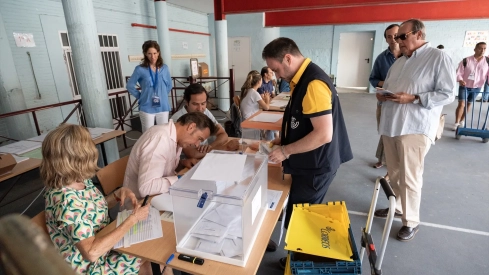
Postal voting has identification and custody controls. To request it at an office, the voter must identify themselves; if they do so online, they need an accepted electronic signature system. The Electoral Census Office verifies the registration and sends the necessary documentation to vote. When depositing the envelope at Correos, the voter's identification is also required, a guarantee applied in the 2023 general elections. The shipments are kept in custody until they are delivered to the polling stations, where they are placed in the ballot box at the end of election day.
The statistical reports requested by the PP and Vox record the evolution of the process, but do not allow knowing which candidate each voter has voted for. The ballots travel inside the voting envelope and are mixed in the ballot box with the rest before the count.
The procedure is particularly important for those who cannot go to their polling station. In the general elections of July 23, 2023, held in summer, Correos registered 2,622,808 requests for postal votes, the vast majority of which became cast votes.
For 29N, voters residing in Spain can request it until November 19 and have until November 25 to deposit the envelope at a Correos office. Once the request is accepted, the voter will no longer be able to vote in person at their polling station on election day.
