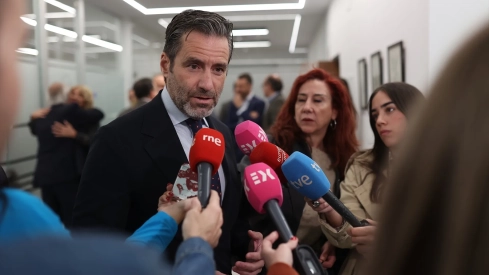
The PP sees an "electoral" and "political" strike two weeks before the general elections
The Popular Party (PP) denounced this Wednesday that Pedro Sánchez's Government "encourages" a strike that it considers "electoral" and "political", just over two weeks before the general elections, and has assured that the call is an "absurdity" that goes against "common sense".
The party has also warned that the mobilization could damage the "credibility" of the trade union movement.
In an informative meeting organized by Artículo 14, Sémper warned that the "elite" of the unions is doing "irreparable" and "very deep damage" to the trade union movement today, a tool that, he stressed, "is necessary in a democracy." "And this seems to me one of the very relevant consequences of today," he pointed out.
The national spokesman for the PP insisted that this "absurd political" strike will "harm" the Spanish economy, but also "will harm the credibility of the trade union movement." In his opinion, the call reflects current times, in which "criteria and responsibility have been inverted."
Furthermore, Sémper pointed out that "perhaps" in "some Peronist country" or from "other latitudes" they could find "some reference in which the Government encourages a general strike."
He also criticized that the unions announced the strike once the elections were called, recalling that, in theory, general strikes are usually called "to provoke political change" or "to go against a Government."
"It seems absurd to us": criticisms of the political climate and trade unions
Sémper has assured that he is "concerned" about the "deterioration of the credibility of one of the fundamental pillars" of democracy, referring to trade unions. "There is no public debate about the role of trade unions, which have not evolved at all," he said.
After the president of the Community of Madrid, Isabel Díaz Ayuso, called for an end to "union garbage," Sémper did not want to delve into the meaning of those words and stated that, in politics, as in life, "everyone expresses themselves as they see fit."
"I believe that what we are seeing seems absurd to us. An unacceptable absurdity, but one that is a reflection of the times we have had to live through," he added, before assuring that they are in the "death throes" of the legislature presided over by Pedro Sánchez, in which, he said, "extravagant things," "continuous theater," and an "inversion of responsibility" have been seen.
In this context, he maintained that, if Alberto Núñez Feijóo reaches Moncloa, he will bring "rationality" because he is the "adult in the room" with a "managerial" profile who seeks to "calm Spanish politics."
Sémper also predicted that the general elections on November 29 will be a "political defeat" for the left and also a social one, because, in his opinion, "it has abandoned the defense of the material conditions of citizens."
Subsidies to unions and return to "normality" in negotiation
Asked if a PP Government would maintain subsidies to unions and the current model, Sémper indicated that they will have to be "reasonable", "logical" and, above all, "adjusted to the role they actually play". In that vein, he pointed out that unions should also assess "what role they want to play in society" in a "also changing" labor market.
"And the proposal that the PP with Feijóo at the helm will make, if Spaniards give us their opportunity, is to return to normality, to a conversation between employers, unions and the Government," he said, adding that it is "almost returning to the world of yesterday" and recovering "the normality that they should never have lost."
Tellado speaks of a "crisis of representativeness" in unions
For his part, the general secretary of the PP, Miguel Tellado, stated that it will be necessary to wait until the end of the day to check the degree of follow-up of the strike. He said that he wishes that whoever wants to strike, does so, but also that whoever wants to go to their workplace, can do so.
"Respecting a constitutional right, it is evident that we are not facing a general strike, we are facing an electoral strike. María Jesús Montero has recognized it and I believe that the organizers themselves had difficulties expressing against whom it was, what was being demanded, what was wanted," Tellado said in an interview on Telecinco.
In this sense, the popular leader stressed that it is "a preventive strike against the next Government of Spain" and "the payment of the unions, CCOO (Comisiones Obreras) and UGT (Unión General de Trabajadores), to their respective parties in a pre-campaign where it seems that the left is very much in need of support."
Announces a crisis in unions
Asked about Ayuso's statements about the withdrawal of subsidies to unions, Tellado pointed out that it is a "regulated matter" and added that the PP "respects the action of unions", which are "indispensable in a democratic society". "I believe that today there is a crisis of representativeness that also affects the unions in our country, as well as other types of organizations," he said.
Tellado also highlighted that unions such as CSIF (Central Sindical Independiente y de Funcionarios) or USO (Unión Sindical Obrera) have distanced themselves from this general strike. "I would not like to put everyone in the same bag because it would be an unfair reflection," he noted, while recalling that in the face of Tuesday's incidents in Oviedo they worked with the unions of the National Police, with whom they "exchanged information" about what happened.
Finally, the general secretary of the PP assured that, if the strike is for housing, CCOO and UGT "are demonstrating against Pedro Sánchez", but that, if it is "simply and plainly to influence the electoral campaign", they are working "in favor of Pedro Sánchez". "I very much fear that it is an electoral strike and not to defend the rights of workers," he concluded.
Contact
We are listening. Get in touch.
