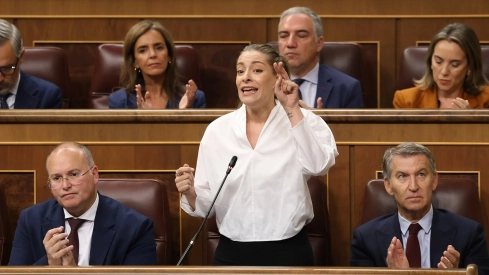
The PP interprets the union mobilization as part of the electoral campaign
The spokesperson for the Popular Party (PP) in Congress, Ester Muñoz, assured this Tuesday that the demonstration and general strike called by General Union of Workers (UGT) and Workers' Commissions (CCOO) for this autumn “will not be the last” if their party comes to power after the general elections on 29N.
In an interview on Telecinco, Muñoz criticized that the call takes place “in the middle of the campaign” and suggested that it responds to a strategy of the left to instrumentalize the unions, a dynamic that, in her opinion, is based on “winning elections through tension”.
The popular leader also recalled that four months after Mariano Rajoy's arrival in Moncloa, in 2011, the PP's headquarters were already “surrounded”, and took for granted that the left would mobilize the streets again if Alberto Núñez Feijóo assumed the Presidency of the Government.
“Fear” versus “hope” in the discourse of the Government and the opposition
Muñoz accused the President of the Government, Pedro Sánchez, and the left of fueling “fear” among the population with warnings about alleged cuts in pensions or social rights. In her opinion, the head of the Executive promotes confrontation in the streets because he is “cornered” by judicial processes and lacks a project capable of generating hope.
“The PP has governed this country for many years and we have not ended public services, on the contrary, we have improved them, we have expanded social rights and no one here has stopped receiving their pension”, affirmed the popular spokesperson, who compared this strategy with the one that, she said, Alfonso Guerra defended in the 90s.
Against this approach, Muñoz placed the PP's proposal, focused, as she explained, on recovering independent public institutions, restoring opportunities to young people and rebuilding the well-being of the middle classes, a message that she summarized in the idea of generating “hope”.
Sémper ironizes about the unions and speaks of “trompe l'oeil”
For his part, the spokesperson for the Popular Party, Borja Sémper, ironized in an interview on Onda Cero, about the moment chosen by the union leaders, whom he reproached for having “fallen out of bed” precisely now, after eight years of Pedro Sánchez's mandate.
Sémper maintained that all this is part of a “trompe l'oeil” and a narrative that, in his opinion, “no longer surprises anyone”.
The PP attacks the housing decrees and the Permanent Deputation
In the parliamentary sphere, Ester Muñoz described as a “shell game trick” the Executive's intention to approve again the Royal Decrees on Housing, which Parliament overturned last Friday and which this Tuesday the Council of Ministers will validate again through the Permanent Deputation*, given that the Cortes are dissolved.
“We frame it within their own campaign for November 29. It is an act of propaganda”, affirmed the PP spokesperson, who also recalled that Pedro Sánchez “never had a majority to govern”. Muñoz also criticized that the president resorts to a parliamentary path that, in her opinion, he rejected when he was in opposition, and pointed out that he is the head of the Executive whose decrees have been rejected the most by Congress.
In the same vein, Borja Sémper considered that the Government wants to “cover up eight years of inaction in housing” through the “tortuous use of Congress” and accused Pedro Sánchez of “manipulating” procedures by taking the decrees to the Permanent Deputation of Congress to “circumvent the will of the majority of Congress”. “It's serious”, he exclaimed.
Housing, at the center of the political dispute
The popular spokesperson defended that the Ministry of Housing has turned access to housing into “the main problem for Spaniards”, despite the fact that, as he stressed, when Pedro Sánchez arrived in Moncloa it occupied the 16th position among the main concerns of citizens.
From there, Sémper asked to address this problem with “proposals” and with an “alternative model”, and wondered how it can be argued that a matter of such magnitude will be resolved “with two royal decrees when it is much more complex”.
