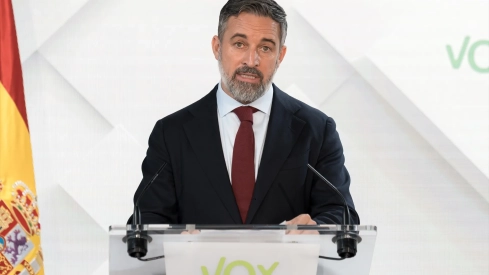
The leader of the far-right Vox, Santiago Abascal, is already presenting his demands for a possible government with the Popular Party (PP). Just hours after the President of the Government, Pedro Sánchez, announced early elections for November 29, he has placed three priorities on the table that he intends to transfer to La Moncloa with Alberto Núñez Feijóo. "National priority", "deregulation" and "remigration" are the conditions with which the pre-campaign begins, while polls point to a strengthened Vox and a PP that might need it to govern.
In a statement without questions at his party's headquarters, Abascal has called for "remigration" to reverse what he calls "the migratory invasion" and has linked immigration with problems of housing, healthcare, security, and purchasing power. His "national priority" proposal consists of giving preference to Spaniards over foreigners in access to public resources. Deregulation completes his economic offer, presented as an offensive against regulations, taxes, and policies he considers ideological.
The scope of the expulsions that Vox defends is explained by its economic spokesperson, José María Figaredo, in an interview published this Sunday in 'El Debate'. The deputy includes irregular immigrants, those who commit crimes, those he considers to refuse to integrate "by imposing their culture," and those who live on public subsidies. Receiving aid or submitting to the party's criteria on integration thus enters his catalog of reasons for expelling people from the country.
The "national priority" also has a concrete application in that interview. Figaredo demands that social housing be primarily allocated to Spaniards. At a time of soaring rents and protests for the right to housing, the far-right proposes that nationality determine who has preference for receiving public protection. Abascal now turns this exclusion agenda into a demand for the future Executive he aspires to share with the PP.
Feijóo opens the door to having Abascal as vice president
The PP president has been leaving that possibility open for months, although he maintains his preference for governing alone. In June, during his interview on 'El Hormiguero', he expressly admitted a coalition with Vox if the electoral result made it necessary. He also listed limits on the Constitution, autonomies, equality, and an orderly migratory policy. The entry of the far-right into the Government was then already incorporated into the scenarios that Feijóo accepts to negotiate.
In July, he again defended this understanding. "I have to come to an understanding with Mr. Abascal," he assured in an interview with 'The Objective', reported by Europa Press, explaining his options if the PP does not achieve a sufficient majority. He acknowledged differences on the autonomous model and Europe, but also an approximation between both parties. Abascal sets his conditions to an interlocutor who has already publicly accepted the possibility of reaching an agreement with him.
The regional agreements offer concrete precedents. PP and Vox govern together in Extremadura, Aragon, Castilla y León, and Andalusia, where they have included "national priority" in their pacts. According to the analysis of the documents published by Servimedia, their application is linked to criteria of roots, residence, contribution, or schooling, which can also benefit foreigners established in those territories. This formulation differs from the preference for nationality that Vox claims and leaves open a decisive question for any state negotiation.
These same agreements contain restrictions for people in an irregular situation, with a proposal to limit their access to structural social benefits and services to cases of vital urgency. They also include opposition to the distribution of unaccompanied foreign minors and the replacement of memory laws with "concord" laws. Concessions to the far-right agenda already have precedents in governments shared with the PP, beyond pre-campaign statements.
The average of polls published on October 3 by 'El País' places the PP around 33% and Vox at 18%. The central projection of their model gives 137 deputies to the popular party and 62 to the far-right, 199 in total compared to the 176 needed for an absolute majority. Compared to 2023, Vox gains about six points while the PP remains approximately at the same level. This distribution would give Abascal more capacity to demand measures and positions.
The 40dB barometer, published this Monday by SER and 'El País', reflects the same trend. Vox rises six tenths to 18.4% and the PP loses eight to 31.6%, with vote transfers towards the ultra-right formation. The interviews were conducted between September 25 and 28, before the parliamentary defeat of the housing decrees and the election announcement. They measure the situation prior to these events, without yet reflecting their impact.
Pensions and housing, other points of demand
The economic offensive also reaches retirees. Figaredo has called the pension system "zombie" and has advocated replacing its current operation with a mixed model of distribution and individual capitalization. The proposal introduces individual savings in retirement financing, without the interview detailing how much each part would weigh or how the transition would be assumed. These are decisions that especially affect those with low wages and little capacity to save.
In housing, the Vox spokesperson demands the immediate recovery of the property in the event of non-payment, breach of contract, or expiration of the rental agreement. He groups these situations under his response to "okupación" (squatting), extending that framework to conflicts between landlords and tenants. The proposal comes as Maricarmen's eviction has provoked mobilizations and after Vox voted, along with PP, Junts, and UPN, against the two decrees with residential protection measures.
Abascal has accompanied his demands with attacks on the electoral process. Although he celebrates the call as an "excellent piece of news", he warns of alleged manipulation by Sánchez and demands "free, clean, and non-violent" elections. He also attributes to the left alleged "militias" that would prevent Vox from campaigning. In his statement, he provides no evidence of this alleged manipulation.
Esta es la última oportunidad para una inmensa mayoría de españoles.
— Santiago Abascal 🇪🇸 (@Santi_ABASCAL) October 5, 2026
No la vamos a desaprovechar. pic.twitter.com/aZZDLQ7vaL
In his speech on Antena 3 this Monday, the far-right leader has recognized, however, that the elections will be "very uncertain". He recalled that in 2023 a PP and Vox majority was also predicted that ultimately did not materialize and has stated that he maintains a "cordial" relationship with Feijóo. "I have already learned that we cannot sell the bear's skin before hunting it," he warned.
