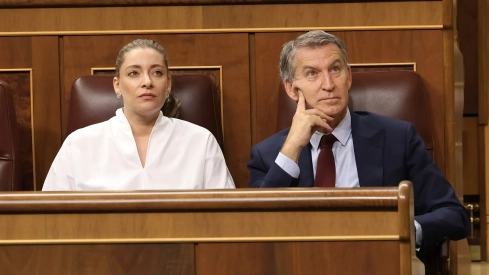
The spokesperson for the Popular Group in Congress, Ester Muñoz, demanded this Friday that the President of the Government, Pedro Sánchez, call elections if the two housing decrees fall in the Plenary Session of the Congress of Deputies, considering that today's vote is equivalent to a "covert vote of confidence".
In an interview on Telecinco, reported by Europa Press, Muñoz maintained that the head of the Executive should go to the polls if he does not get parliamentary support. "It is evident that the social majority of this country is not with Pedro Sánchez. Therefore, what he has to do is be responsible and call elections," she stated.
The PP leader insisted that this Friday's vote resembles a political test for the President of the Government, and added that, if the decrees do not go ahead, Sánchez should "stop bothering Spaniards," to whom she attributed growing weariness with the Executive's decisions.
The PP's doubts about Junts' support
Asked about the possibility of Junts supporting the decrees, the popular spokesperson assured that she would not be surprised if the group votes against, after having criticized, according to her version, the "tricks" of the text. "I am not surprised that Junts now votes against this, because otherwise they would go against their voters," she pointed out.
Muñoz remarked that she is "astonished" that the Government is surprised by that position, and recalled that last September 10 Parliament approved "with a broad absolute majority a series of structural measures for there to be housing in this country" which, in her opinion, Sánchez's Executive did not address.
Criticism of legal certainty and litigation
The spokesperson for the Popular Group defended that there is a parliamentary majority to legislate on housing, but that this majority, she denounced, is "constrained" by the Government. In that context, she defended that it is not strange that two decrees now fall that, in her opinion, say the opposite of what was approved just a month ago by the Lower House.
In addition, she warned that the norms under discussion do not provide legal certainty and could generate "a lot of litigation" in the courts. According to her criteria, these texts "should not even be called housing" and, at the very least, would be "rental" decrees, because they do not incorporate "a single structural measure for there to be more housing in the stock and for people to be able to rent."
Muñoz also ruled out that the Popular Party would propose a motion of no confidence, assuring that it does not have the necessary votes for it to prosper in Congress. "To add frustration to the situation could even be counterproductive," she noted.
The hypothesis of elections at the end of November
Regarding the information that points to a possible call for general elections at the end of November, the popular spokesperson recalled that this type of message "are sometimes leaks from the Government itself to try to generate frameworks" and orient the public debate towards the possibility of early elections.
"What I believe is that Spaniards are astonished at all this circus that the President of the Government has set up in a week," she stressed, while denouncing that the Executive submits to a vote two decrees that, in her opinion, contradict each other and do not solve the underlying problem.
Housing, salaries, supply and bureaucracy
The PP leader defended that the housing problem is "much more structural" and is related to salaries, the lack of supply and the bureaucratization that makes it difficult to build housing, whether public or private. In that sense, she accused the President of the Government of practicing a "frivolous and simplistic" policy.
Finally, Muñoz assured that the Popular Party will not take "a step back" despite the Executive's "threats" and will continue to present measures on housing. "People are fed up and what they want is a new opportunity, a change of course, they want serious policies, fewer presidents engrossed in TikTok, in Spotify and who really treat problems with seriousness," she concluded.
