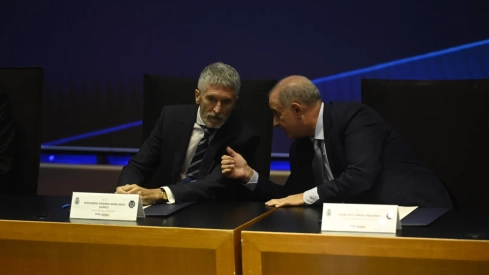
The director general of the Police, Francisco Pardo, informed the Minister of Interior, Fernando Grande-Marlaska, this Wednesday that "there is no police report whatsoever" attributing to the Moroccan security forces the planning or execution of the massive entry registered in Ceuta on July 30 and 31.
The response from the head of the Police gives the Government a boost after several hours of enormous political pressure. The document prepared by the National Immigration and Borders Center (CENIF) exists and was sent to the Audiencia Nacional, although Interior rejects the interpretation published in recent hours, according to which investigators held Moroccan gendarmes responsible for leading migrants to the border to cause its collapse.
Pardo also downplayed the scope of the warning sent by CENIF to border posts on July 29. According to the explanation given to Marlaska, it was "a frequent risk alert" that also did not refer to a possible massive entry the following day.
Marlaska had demanded urgent explanations from the police leadership early this morning after learning from the press about the existence of the document. The minister asked to verify its veracity, to know since when it had been in the hands of the force and to clarify why information of such importance had not reached the Government or the bodies responsible for coordinating the response to the crisis.
Pardo met with the general commissioner of Immigration and Borders, Juan Ávila, and with the head of Information, Javier Antonio Susín. After gathering their explanations, he communicated to Marlaska the response that Interior subsequently disseminated.
Two conflicting versions about the report
The judge of the Audiencia Nacional María Tardón had ordered the agents not to provide their superiors with information about the preparation and content of the document. Pardo maintains that this judicial instruction prevented him from knowing about it previously. The magistrate authorized this Wednesday that the investigative team allow its commanders access to the report.
Interior's explanation clashes with information published by various media. According to them, the agents described the presence of uniformed and plainclothes gendarmes who would have guided several waves of migrants towards Ceuta with the intention of overwhelming the Spanish response capacity.
The account attributed to the report details a first entry led by young people equipped with wetsuits, fins, and flotation devices, followed later by families, women, minors, and people from sub-Saharan Africa. The publications maintain that the movements were directed from Moroccan territory and responded to an organized action.
The other discrepancy affects the July 29 warning. The disseminated information indicates that this communication warned of maritime entries planned for the 30th and set a level of "extreme risk." The version communicated by Pardo presents it as a usual alert that lacked references to an arrival of the dimensions that the border finally reached. The full content of the document will allow establishing the true scope of both statements.
Torres demands rigor from Feijóo
The Minister of Territorial Policy and the Government's sole command in Ceuta, Ángel Víctor Torres, has referred to Francisco Pardo's explanations and has asked Alberto Núñez Feijóo for "rigor". Both coincided this Wednesday in the institutional act for Ceuta Day, marked by the controversy over Morocco's possible involvement.
Torres explained that the Government learned of the report's existence on Tuesday night and that Marlaska immediately summoned the director of the Police for explanations. "There is no report whatsoever" that blames Morocco, the minister reiterated based on the information Pardo has conveyed to the Executive.
Hours earlier, Félix Bolaños had denied that the Government was hiding information and had called for "maximum caution" until the document was known. The Executive had maintained until now that no police or intelligence service anticipated the arrival of more than 70,000 people and that there was also no evidence to attribute its organization to Morocco.
Feijóo has accused the Government of hiding information and has asked to summon the Moroccan ambassador in Spain, in addition to recalling the Spanish representative in Rabat for consultations. The police union Jupol has also increased pressure by demanding the resignations of Marlaska, Pardo, and the Government delegate in Ceuta.
Torres has also updated the balance of voluntary returns. A total of 3,648 migrants have returned to Morocco since July 31, 129 more than those counted this Tuesday. The minister insisted on the need to have reception spaces as soon as possible and defended that the chosen centers have the agreement of the central government and the Ceuta Executive.
The investigation continues under the direction of María Tardón, who requested the report last August 3 to determine if the entry responded to a concerted action with criminal relevance. The controversy will reach Congress this Thursday, the 3rd, during Pedro Sánchez's appearance, where the opposition will place the content of the document and the prior warnings at the center of the debate.
