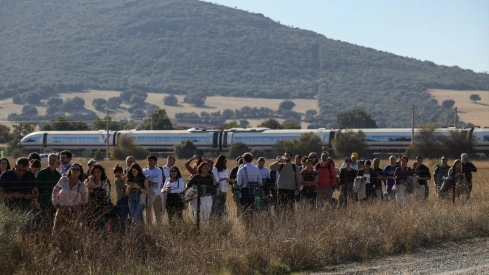
The early hours of this Monday are being used in the vicinity of the old Urda station to intensify the work of removing the train cars that, almost 24 hours ago, collided by rear-end at that point, an accident that, for the moment and according to official figures, has resulted in 68 deaths and more than a hundred injured distributed in hospitals in Albacete, Toledo, Ciudad Real, and Madrid.
Throughout the night, more than 500 people remained in the area, including firefighters, members of the Military Emergency Unit (UME), health personnel, and members of the State Security Forces and Corps, in an operation that continued working throughout the early morning to secure the area and facilitate technical work on the convoys.
Identification of victims at the Institute of Legal Medicine of Toledo
On the other hand, the Institute of Legal Medicine of Toledo is preparing to begin the identification work of 52 of the 68 bodies resulting from the accident, a task that will involve the work of up to 25 forensic doctors, according to forecasts released in recent hours.
The forensic process will be carried out in stages, while operations continue at the scene of the accident and attention to the victims' families, in a device that remains open and coordinated among the various services involved.
Hospitals receive the injured and Madrid maintains its device
The spokesperson for SUMA of the Community of Madrid, Pilar Rodríguez, has indicated that the victim care device established yesterday at Atocha station, with personnel from SUMA, SAMUR, and Cruz Roja, will be maintained throughout the day.
Regarding the collaboration work of Madrid's emergency services in the accident area, Pilar Rodríguez specified that they were working until 4:30 AM, helping to lift the convoys to check if there were victims trapped inside.
The number of travelers attended by SUMA amounts to a total of 83 and, subsequently, they were transferred to the hospital network of Castilla-La Mancha, within a health operation that remains active for the follow-up of those affected.
Blood donation centers work at maximum capacity
The blood donation centers of the autonomous community have also woken up at full capacity, while Dr. Elena Madrigal, coordinator of the Blood Donation, Hemotherapy and Hemovigilance Network (RHHH) of Castilla-La Mancha, has encouraged in statements to Radio Castilla-La Mancha, to approach all reception points.
Dr. Elena Madrigal has also reminded that donation "has to be every day", in a call that occurs while hospitals maintain attention to the injured and health resources remain mobilized to respond to the needs derived from the accident.