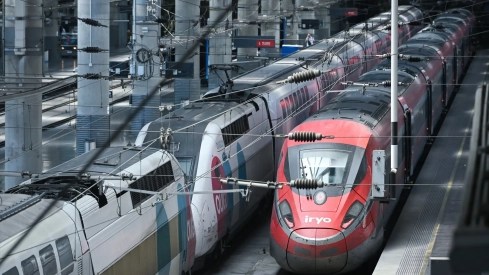
Spain begins three days of mourning this Thursday for the victims of the Urda train accident, in Toledo, with a train drivers' strike called before the tragedy to demand safety improvements. The Minister of Transport, Óscar Puente, faces the investigation into the collision between an AVE and an Iryo and the demands of a group that denounces pending commitments for months. Renfe, for its part, maintains that it has fulfilled its obligations.
The confirmed balance remains provisional and includes at least 68 fatalities. The latest update from 112 Castilla-La Mancha, published at 9:56 p.m. on Wednesday, placed 53 people still hospitalized in the region, after discharges recorded during the day. The search and recovery operation for victims has continued throughout the night, while many families are still awaiting the identification of their loved ones.
The Spanish Union of Railway Engineers (Semaf) has ratified the 24-hour strike in all Renfe group companies, until 11:59 p.m. this Thursday. The call affects driving personnel and is maintained with the established minimum services. The union has extended its condolences, asked for extreme caution, and announced that it is studying new measures to reinforce railway safety.
A strike called before the tragedy
The strike had been announced since October 16, twelve days before the accident. Semaf called it after a meeting with Transport, Adif, the State Railway Safety Agency, and Renfe, in which it considered the committed advances blocked. The organization denounces that coordination between agencies has become an obstacle to applying agreements it considers necessary to work with guarantees.
Its demands include protocols for meteorological emergencies, clear communications when there is a risk on the track, the incorporation of train drivers, and solutions to the reliability problems of trains. They also include breaks during driving and attention to professionals who suffer a run-over. The objective expressed in the call was that "the urgency to circulate should never take precedence over safety".
Desde el Sindicato de Circulación Ferroviario califican de "lamentable" que se hable de error humano cuando todavía no ha terminado la investigación. CSIF pide que se respete la presunción de inocencia y SEMAF pide prudencia.
— RTVE Noticias (@rtvenoticias) October 28, 2026
🎙️@EstherMorMor pic.twitter.com/7GNrO3Xgqc
After the Urda crash, Semaf has maintained these demands and called for a structural change, but has avoided attributing specific causes to the accident. Its statement calls for waiting to know what happened and prioritizes attending to the victims and supporting their families. The original call also asked to investigate the failures with a broader perspective than the automatic search for a culprit in the cabin.
Renfe denies having failed to meet its commitments. In its response to the strike, published before the accident, it assures that it has fully executed the obligations assumed after the Adamuz tragedy and that it has reported this in the follow-up meetings in April, May, and October. The company also defends the hiring of more than 1,200 workers, the reinforcement of maintenance, and actions to improve service reliability.
The operator considers the strike "unjustified" and maintains that part of the claims depends on decisions that exceed its competencies, such as the regulation of driving times or certain actions by the Labor Inspectorate. The disagreement therefore affects both the fulfillment of what was agreed and who should resolve each demand.
The union response to the tragedy is also not uniform. While Semaf maintains the strike and calls for caution regarding its causes, Comisiones Obreras de Castilla-La Mancha calls for a rigorous investigation and corrective measures. The Unión General de Trabajadoras y Trabajadores has called for respect for the victims and to avoid speculation. The Central Sindical Independiente y de Funcionarios, on the other hand, has called for Puente's resignation and has reproached him for pointing to a worker as responsible before clarifying the whole of what happened.
The audios focus on the Atocha Control Center
The investigation must reconstruct how an AVE traveling from Madrid to Seville ended up hitting an Iryo stopped on the same track from behind. According to the preliminary explanation from Transportes, a breakdown of the LZB, the system that continuously supervises the movement of trains, caused several convoys to stop. From that moment on, Adif's control center in Atocha took over traffic management during the incident.
The communications known on Wednesday document decisive moments. At 8:36, the AVE was authorized to resume circulation with "normal speed." The Iryo driver later received a similar indication, but at 8:48, she reported that she could not restart her equipment and remained stopped before the Urda entrance signal. Shortly after, the impact occurred.
Puente has described this authorization as "inexplicable." According to him, the existing conditions required driving with sight speed and a maximum of 40 kilometers per hour, adapting the speed to be able to stop the train before an obstacle. Investigators will have to contrast the orders, signaling, circulation records, and equipment operation to establish the complete sequence.
The judge of plaza number 2 of the Civil and Instruction Section of the Orgaz Court of First Instance has decreed the secrecy of the proceedings. She has also ordered the seizure and custody of any black boxes found, the collection of data from the control center, and obtaining from Adif the protocols and actions before, during, and after the crash. Access to the area and the removal of elements have been restricted to preserve evidence.
In parallel, the Independent Administrative Authority for Technical Accident Investigation (AITAT) is working. Its president has warned that it is too early to advance hypotheses. The temporal coincidence between the strike and the accident once again puts safety at the center of the debate, but labor claims and the causes of the accident must be examined with their corresponding evidence and responsibilities.
Urda has hit the same high-speed corridor where the Adamuz accident left 46 dead last January. Then an Iryo derailed and invaded the track on which an Alvia was traveling. In Toledo, the two trains were traveling in the same direction and the AVE hit the convoy in front. The circumstances of both accidents are different and their investigations remain open.
The strike adds to the closure with Andalusia
The strike is taking place with the high-speed connection between Madrid and Andalusia interrupted by the accident. The closure affects the corridor regardless of the Renfe strike and does not have a confirmed reopening date. The company has enabled free changes and cancellations for travelers affected by the suspension and has announced road alternatives to connect Madrid with Ciudad Real and Puertollano.
In the rest of the network, Transportes has set minimum services of 73% for High Speed and Long Distance and 65% for Medium Distance. In Cercanías Madrid, 75% is established during peak hours and 50% during the rest of the day. Rodalies and Regionales de Catalunya have specific regulations, with 66% during peak hours and 33% during other periods. These percentages correspond to the strike and do not allow for the reestablishment of routes suspended due to the accident.
This Thursday is also the first of three days of official mourning, which will last until 24:00 on Saturday, October 31. The President of the Government, Pedro Sánchez, has pledged an investigation that will go to the end and has assured that, if there were negligences, they will be known. Puente has placed his priority on clarifying the incident and has stated that he will offer the necessary explanations.
Sánchez is scheduled to participate this Thursday in Toledo in the meeting of the Integrated Operational Coordination Center, responsible for monitoring the emergency. The leader of the PP, Alberto Núñez Feijóo, will visit the advanced command post of Urda together with the president of his party in Castilla-La Mancha, Paco Núñez, after demanding a complete and independent review of the railway network.
