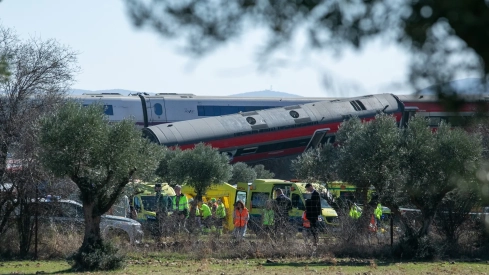
The LZB continuously monitors train speed and can activate the emergency brake if safety limits are exceeded. This protection, installed on the Madrid-Seville high-speed line since its inauguration in 1992, has come under scrutiny after the collision between a Renfe AVE and an Iryo this Wednesday in Urda, Toledo.
As explained by the Ministry of Transport, a system failure caused the trains to stop before the accident. The department maintains that resuming the journey normally was then authorized, when it should have been done with restrictions. The investigation will have to reconstruct that sequence, determine the extent of the failure, and verify how backup procedures were applied.
The track and the cabin communicate continuously
LZB stands for the German term Linienzugbeeinflussung. Its operation is based on the constant exchange of information between the infrastructure equipment and that installed on board the train, through a cable laid along the track and the vehicle antennas.
This connection allows traffic indications to be transmitted directly to the driver in the cabin. The system takes into account data such as the train's position, its maximum speed, its length, and its braking capacity. With this information, it establishes the limits that must be respected during the journey.
The driver can know the permitted speed at that moment, the speed to be reached later, and the available distance to do so. The supervision accompanies the approach to a speed reduction or a stopping point. If the train exceeds the established values, the LZB intervenes on the brake, as stated in the Railway Traffic Regulations.
The director of the Degree in Mechanical Engineering at Francisco de Vitoria University, Jordi Viñolas Prat, explained it to Europa Press with a daily comparison. "It's as if, so to speak, when I'm in my car, the road acts on my vehicle." Under normal conditions, this protection can act automatically in the face of a restriction that the driver has not complied with.
One of its functions is to prevent a train from catching up to the one in front. Alejandro Bustos Caballero, professor of Railways at UNED, explained to Newtral that, if the first convoy stops, the LZB transmits the necessary instructions to the next one so that it can also stop before reaching it. The expert emphasizes that this separation is guaranteed under normal operating conditions of the system.
Information about track occupancy is essential. Traffic is organized through sections called cantons, whose status allows regulating train access and maintaining their separation. Protection systems use signaling information to supervise movement and braking.
Although it is especially associated with the Madrid-Seville corridor, the LZB is also used on Madrid's Cercanías C5 line, as Bustos pointed out. It is a technology of German origin that is also used in Germany and Austria.
A breakdown changes the conditions for circulation
The regulation contemplates transmission failures and breakdowns of LZB equipment, with specific procedures for each situation. In certain cases, the protection causes the train to stop, and resumption requires authorization from the traffic manager, under the conditions provided for continuing.
The Institute of Engineering of Spain recalled this Wednesday that there are procedures for operating with backup systems, a situation technically called degraded operation. In these circumstances, signals located next to the track, instructions from the control center, and communications with the driver become especially important.
On the Madrid-Seville line, the LZB is backed up by ASFA, Automatic Signal Announcement and Braking. Both offer different features. The LZB receives information continuously; the ASFA obtains it at specific points through beacons installed on the track and also has automatic braking functions.
Adif's documentation explains that the ASFA can stop the vehicle in certain situations, such as passing a stop signal or the driver's lack of response to certain warnings. Its operation depends on the equipment, its operating mode, and the information received. To clarify what happened in Urda, it will be necessary to check the status of these protections during the journey.
Transportes maintains that, after Wednesday's breakdown, circulation should have resumed with sight-running and a maximum of 40 kilometers per hour. According to its preliminary explanation, Adif's control center in Atocha authorized the AVE to continue normally and the train reached 200 kilometers per hour before the collision.
Sight-running requires the driver to adapt the speed to the length of track visible from the cabin, so that they can stop before an obstacle or a stop signal. The regulation links this way of circulating to visibility and the circumstances of the journey. The authorizations and specific limits depend on the applicable assumption.
The Institute of Engineering of Spain has called for caution in attributing the causes of the accident. To reconstruct it, it points out the need to examine the train records, communications, and control post itineraries, in addition to the state of the infrastructure. This analysis will allow knowing what happened after the breakdown and what orders were transmitted.
Óscar Puente has defended that the LZB is a "highly proven" system, although it can suffer failures, and has recalled that it is in the process of being replaced. The renovation of the Madrid-Seville line contemplates incorporating the ERTMS, the European rail traffic management system, with train protection level 2.
Adif Alta Velocidad awarded Thales a contract of 93.8 million euros in 2021 to renovate the corridor's safety installations, with an initial term of 52 months. The project included the implementation of ERTMS, the integration of LZB with the new equipment, and the testing and commissioning of the installations, maintaining the commercial operation of the line.
