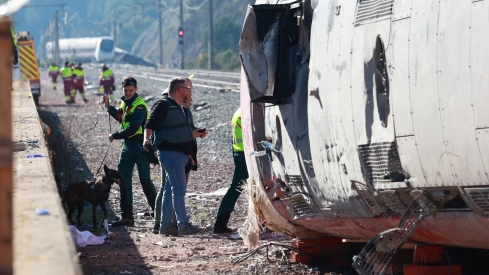
At least 64 people have died, and dozens have been injured after the collision of a Renfe AVE and an Iryo train in Urda (Toledo), on the Madrid–Seville high-speed line, according to the latest data from the Government of Castilla-La Mancha. The crash occurred at 8:54 AM when the AVE hit an Iryo convoy stopped on the track from behind; two Iryo wagons and one AVE wagon fell down an embankment.
For now, although the investigation is early, according to sources consulted by ‘ElMundo’, the Iryo and the AVE would have received different indications: the first remained stopped while the second advanced on the same track at more than 100 kilometers per hour. The sources consulted by the aforementioned media reiterate that it is still too early to determine the causes.
The latest death toll has been confirmed by sources from the Government of Castilla-La Mancha. The number increased after emergency teams were able to access the Iryo wagons affected by the collision.
The Iryo driver would have reported a breakdown
The information published by 'El Mundo' places one of the investigation points on the warning that the Iryo driver would have issued. According to that account, the driver reported that the LZB protection system was failing and the train had stopped.
From there, the investigations must reconstruct what information the different traffic managers received and what instructions reached each cabin. The question is to clarify how the AVE could advance through a section that was still occupied. The sources cited by the newspaper suggest that the protections would not have worked on more than one level.
Communications with control centers
Railway safety combines onboard equipment, track installations, and traffic management procedures. It does not depend, therefore, on a single warning or a single person.
According to information from El Mundo, the incident warning should have been transferred to operators with trains on the section to adopt the necessary restrictions, including speed reduction or stopping. The newspaper points in that chain of communications to the Renfe Operations Management Center and the Adif Regulation and Control Center, located in Madrid.
The reconstruction of those communications will be necessary to know what happened between the Iryo warning and the collision. Pointing out the centers involved in the management does not equate to establishing responsibilities for the accident.
What is LZB and how does it protect the train
LZB is a protection system that continuously monitors speed and transmits driving indications to the cabin. To do this, it connects the equipment installed on the ground with that of the train via a track cable and the vehicle's antennas. This is how the Railway Traffic Regulations describe it.
The train communicates its position and data such as its length, maximum speed, and braking capacity. The control center uses this information, along with the line situation, to send the indications that should guide its progress.
Its function goes beyond informing the driver: if the speed exceeds the established supervision threshold, the LZB can activate an automatic emergency brake. The regulations also contemplate specific procedures for breakdowns and loss of data transmission.
Understanding this operation helps to understand what investigators should examine, but it does not by itself demonstrate what protection failed in Urda. Determining this will require checking the status of the equipment, the indications received, and the decisions made before the impact.
