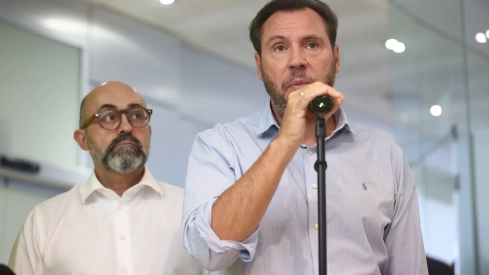
The Minister of Transport and Sustainable Mobility, Óscar Puente, explained from the Adif control center the sequence prior to the Toledo railway accident: a breakdown left the LZB protection system out of service, the trains stopped and, subsequently, the control center authorized them to resume their journey. The Renfe AVE ended up hitting the Iryo that was still stopped on the track.
Puente expressed his "consternation for the victims and families" of the accident, which leaves at least 64 dead and dozens injured. "We are absolutely devastated," he said, before conveying "all my solidarity and empathy" to those affected.
The minister indicated that he met with those responsible, attended a reproduction of the accident, and listened to communications between the control center and the trains.
The LZB failure paralyzed six trains
According to the updated sequence, the LZB system stopped working at 8:32 a.m., causing six trains to stop on a stretch of about 90 kilometers. From that moment on, the movements of the convoys were subject to the instructions of the Adif control center.
Eight minutes later, the operator allowed circulation to resume. The authorization would have been to advance under normal operating conditions, instead of doing so by sight, a procedure that requires driving with special caution and being able to stop the train in front of an obstacle.
The question that must be clarified is why the AVE was authorized to advance when the Iryo remained stopped, what information each of those responsible had, and what procedures were applied after the LZB protection was lost.
The AVE would have reached 200 kilometers per hour
According to that initial reconstruction, the AVE would have reached 200 kilometers per hour after receiving authorization to continue. This data alone does not allow establishing the exact speed at which the impact occurred.
The collision occurred at 8:53 a.m., near Urda (Toledo), on the Madrid-Seville high-speed line. AVE 2080 hit Iryo 6076 from behind. Two Iryo wagons and one AVE wagon fell down an embankment.
The investigation is still in an early stage. The exposed sequence must be contrasted with circulation records, communications, and train data before determining whether there were human errors, technical failures, or a combination of both.
Puente focuses on accident response
The head of Transport has offered his collaboration to clarify what happened: "I am at your disposal to clarify," he said.
Asked about a possible resignation, he replied that his concern at this moment is to resolve the situation. His appearance occurred while emergency services continue to attend to those affected and the circumstances of the crash are being reconstructed.
