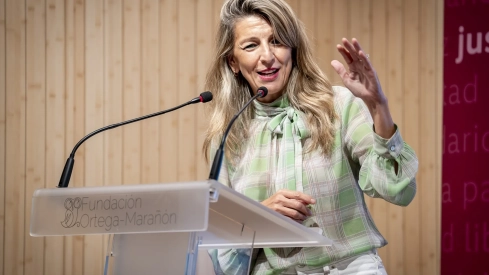
The second vice-president and Minister of Labor, Yolanda Díaz, intends to raise the interprofessional minimum wage (SMI) for 2027 before the general elections on November 29. Sources from Yolanda Díaz's team have indicated that the intention is for the measure to go ahead before that date, although they have stressed that all deadlines provided for in the procedure must be met. In this vein, the Ministry of Labor has this week initiated the processing to try to approve the increase before the minister leaves the Executive.
The salary policy measure is long-term, nothing to do with the electoral elections on November 29, given that this initiative has been carried out every year since Yolanda Díaz became minister. The procedure will be the same. As a first step, the department headed by Yolanda Díaz has convened the Advisory Commission of experts this Thursday, the body that in recent years has advised the Government on minimum wage increases. Before, the evolution of wages and inflation must be analyzed and a proposal formulated on what the new threshold should be. Based on that report, the definitive amount of the next increase will be decided.
The meeting is part of the roadmap to study the new SMI increase and advance its eventual approval within the established deadlines. "We will try to make it before November 29," indicate sources close to the minister, who insist that the process must respect all administrative and political procedures before reaching the final decision.
A minimum wage that affects 2.5 million people
The interprofessional minimum wage is now at 1,221 gross euros per month and remains a central reference for around 2.5 million workers under its direct coverage, in a context of high inflation like the current one. Yolanda Díaz vindicates the evolution of the interprofessional minimum wage (SMI) in recent years as one of the main policies promoted by the Ministry of Labor. The SMI has gone from 735 euros per month in 2017 to the current 1,221 euros, an increase that has significantly raised the wage floor for workers who receive this remuneration. Currently, around 2.5 million people earn the SMI.
Sources consulted by this newspaper explain that successive increases have met their objective, the Ministry's argument is that the evolution of the figures allows measuring the scope of salary policy: in less than a decade, the SMI has increased by 486 euros per month compared to 2017. Díaz defends that these increases have allowed improving the income of workers with lower wages and reducing the distance with respect to the objective of placing the minimum wage around 60% of the average wage, while the PP has on different occasions questioned the impact that high increases can have on companies and employment.
Definitely, two different political models are observed. The Government advocates a policy of continuous increases in the minimum wage, while the PP has historically maintained a negative position regarding these increases. During the last Government of Mariano Rajoy, the SMI reached 735.90 euros per month in 2018, after having remained for years at considerably lower levels. The subsequent evolution contrasts with the increase registered since then, especially after Yolanda Díaz's arrival at the Ministry of Labor.
