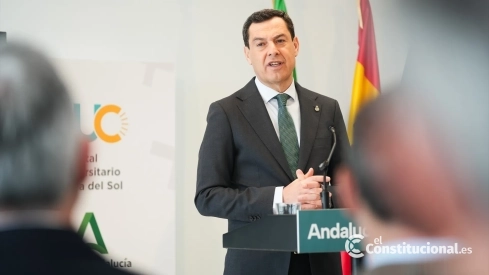
The early election in Andalusia for May 17 is not just an early call; it's really two weeks. It is a high-impact political move that has shaken the entire national political board, starting because it was done in such a way that Pedro Sánchez found himself unable —had he wanted to— to call general elections for an electoral “super Sunday”.
Look, this is not just about Andalusia; it is also a matter of strategy, of power, of opposing political models, as is the case with Moreno. It has surprised everyone, especially the government of Pedro Sánchez, which now has to reorganize in a hurry.
The reason? María Jesús Montero, until now number two of the Executive, will be the Socialist Party's candidate in Andalusia. Undoubtedly, her departure leaves an important political void, but, above all, it evidences an uncomfortable reality: she leaves without having managed to approve a budget in this legislature. And it is not a minor detail, far from it. Furthermore, she faces a major challenge: trying to reverse polls that anticipate a strong decline of the Socialist Party in Andalusia. That is the reality.
Facing her, a Juanma Moreno who has been building for some time, let's say, something different: a profile of his own. Because while the Popular Party at a national level opts for confrontation and political noise, Moreno has done just the opposite: moderation, management, and distance from the extremes, to the point that these elections seem more like a personal candidacy than a matter of acronyms. Almost as if on the ballot it said “Juanma Moreno Bonilla” instead of “Popular Party” in its heading.
And that is no coincidence; it is something perfectly studied. It is strategy. Because Juanma Moreno has decided to mark clear distances with Vox, something we have seen since he arrived at the presidency of the Junta de Andalucía. Not in a strident way, but in a constant way. While other leaders of the Popular Party negotiate governments with Vox in several autonomous communities —such as Extremadura, Aragon or Castilla y León— he tries to build his majority without depending on those pacts. This introduces an evident contradiction within the Spanish right: one can govern with Vox and, at the same time, campaign by moving away from Vox. Moreno believes so, or at least considers that in Andalusia that formula works.
And it does so, moreover, at a delicate moment for the far-right party, with internal crises, tensions, and controversies that, without a doubt, weaken its image. All this turns these elections into something more than a regional event, because what is at stake is not only who governs in Andalusia. A political model is put to the test: moderation versus polarization, management versus noise and, in a certain way, the future of the right itself in our country.
If Moreno manages to maintain the absolute majority, his formula will undoubtedly emerge strengthened. And if he needs Vox, it is obvious that the narrative will have to change. And if the PSOE manages to resist, the scenario will be completely different.
In any case, there is something that is already certain: Juanma Moreno has decided to play his own political game, without asking anyone for permission, not even Feijóo, who found out barely two hours before the call for elections. And that, in politics, is never innocent, like Moreno.