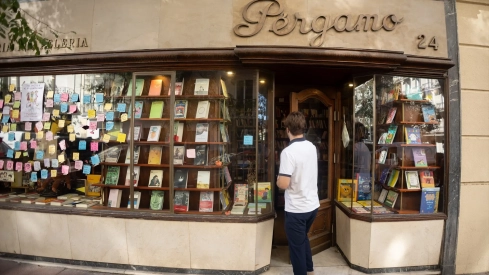
There are places that hold much more than books. They preserve memories, conversations, and a part of a city's history. The Pérgamo bookstore, one of the oldest cultural establishments in Madrid, will close its doors on November 17 at its premises on General Oráa street, where it has remained for 80 years. The farewell comes after the owners of the property decided not to renew the rental contract with its current managers.
"Now what we want is to celebrate ourselves. Sell everything and start somewhere else, we still don't know where or when," explained Pablo Cerezo and María Treviño, who have been at the helm of the bookstore since 2022. Their words summarize a mix of sadness and uncertainty, but also the will not to give up on a project that has managed to build a community of readers around it.
The closure is not due to a lack of public. On the contrary, its managers assure that they sell books and that their reading clubs are full. The problem is that this activity is not enough to face economic difficulties and guarantee the continuity of the business in the same premises. "It's unsustainable," Cerezo summarized in statements to Europa Press.
Eight decades of stories and a second chance
Pérgamo opened its doors in 1946 at the hands of Raúl Serrano, a Language and Literature professor repressed after the Civil War. The bookstore was born in a Spain marked by Francoist censorship and, throughout its trajectory, became a space linked to the dissemination of books and the cultural life of Madrid. Its shelves have witnessed the changes in the city and the different generations that have passed through them.
The history of Pérgamo was already on the verge of ending in 2022, when the founder's daughters retired and the business announced its closure. An investor who had been a customer since childhood decided to rescue it and allowed a new stage to begin with Pablo Cerezo and María Treviño at the helm. Since then, the bookstore has promoted reading clubs, workshops, and literary gatherings that have reinforced its role as a meeting place for book lovers.
Therefore, for its managers, keeping Pérgamo open does not only mean preserving a business. "Keeping Madrid's oldest bookstore was important," said Cerezo, who explained that the value of the establishment goes beyond its age: in local commerce "our collective memory is anchored." The bookseller also raised a question that transcends the future of his own establishment: "Are we making a city for the people who live in it, for the people who work in it, or is it for other people?"
Rents put the future of independent bookstores at risk
Pérgamo's situation reflects the difficulties faced by small cultural businesses in the face of Madrid's real estate pressure. Its managers have explained that, despite the good response from readers, income is not enough to sustain the activity when rent and other expenses consume a good part of what the business generates.
"The pressure of rents is enormous," warned Cerezo, who described the situation as a paradox: the bookstore maintains its activities and its reading clubs are full, but that does not guarantee its survival. The manager also criticized that a large part of families' money ends up being used to pay for housing and rooms at high prices, instead of being invested in culture, leisure or restoration. "It's a drain and it's unsustainable," he stated.
Despite the blow of abandoning the historic premises, its managers want to keep the bookstore alive. "I don't know if in the same neighborhood, in another, in another place, whatever, but Pérgamo will persevere," Cerezo assured. Until November 17, the establishment will maintain its planned activities while looking for a new space. There is still no confirmed location, but there is a clear intention: that the farewell to General Oráa is not the definitive disappearance of a place that for eight decades has been part of Madrid's cultural memory.
