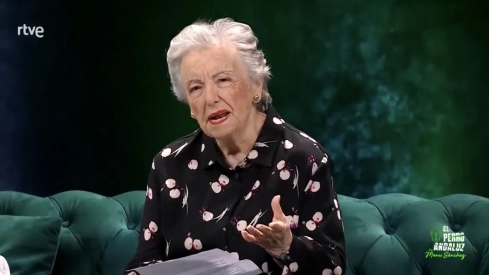
María Galiana has starred in one of the most emotional moments of El Perro Andaluz. The actress, unforgettable for the general public for her role as Herminia in Cuéntame cómo pasó, wanted to pay tribute to Maricarmen with a reading of Desahucio, a poem by Rafael Alberti that, almost a century after its publication, resonates again amidst the debate on access to housing.
The performer participated in her usual section in the program presented by Manu Sánchez on La 1, where she shared the set with singer India Martínez. Before starting the reading, Galiana explained the origin of the verses and clarified that the eviction the poet alludes to is not material, like the one suffered by Maricarmen, but a literary image. A clarification that did not prevent the poem from acquiring a special emotional force in the context of the tribute.
María Galiana recites Desahucio, Alberti's poem that regains meaning
"I have brought this little paper, which is a cheat sheet, because I don't know it by heart," explained the actress, who placed the text in 1929 and linked it to Rafael Alberti's book Sobre los ángeles. With the naturalness that characterizes her interventions, Galiana introduced verses that speak of an uninhabited house, of loss, and of a presence that seems expelled from its own space.
"Alone, without furniture and without bedrooms, uninhabited," writes Alberti in one of the most evocative passages of the poem. The reading progresses through images of wounded walls, humidity, chains, and shouts, culminating in a question that acquires a special resonance in light of Maricarmen's story: "When do you leave the house, tell me, what bad, cruel angels want to rent it again?".
At the end, the actress received a standing ovation from the audience, accompanied by applause from Manu Sánchez and India Martínez. The presenter summarized the emotion of the moment with an expression as brief as it was eloquent: "María Galiana, serious words."
The tribute to Maricarmen that unites culture against the housing crisis
Galiana's intervention comes after the death of Maricarmen, 87, has provoked numerous expressions of solidarity and reactions from different cultural spheres. The woman had been evicted from the home where she resided for decades, a case that has reignited demands for the right to decent housing and criticism of the social consequences of evictions.
Artists like Ana Belén and Eva Amaral have also publicly expressed their sorrow, while actor Liam Cunningham has denounced the situation. Citizen mobilizations have kept Maricarmen's memory alive and have turned her story into a symbol of the difficulties many people face in keeping their homes.
Alberti's poem is also not a new choice within these demands. Ana Belén had already resorted to his verses in a previous mobilization before Maricarmen's eviction, accompanying her reading with an adaptation of La puerta de Alcalá. The recovery of Desahucio demonstrates how literature can transcend its time and find new ways to address the present.
In El Perro Andaluz, María Galiana has done precisely that: rescue verses written almost a hundred years ago to recall a current story. A gesture that has transformed her usual television collaboration into a tribute to Maricarmen and a reflection on the loss of home, dignity, and the meaning of having a place to return to.
Hay desahucios que van más allá de perder una casa. María Galiana da voz a Rafael Alberti en “Sobre los ángeles”.#ElPerroAndaluzTVE pic.twitter.com/Le90GAexbk
— El Perro Andaluz (@PerroAndaluzTVE) October 8, 2026
Eviction, About the Angels. Rafael Alberti, 1929
"Bad or good angels
I don't know,
they threw you into my soul.
Alone,
without furniture and without bedrooms,
uninhabited.
Suddenly, the wind wounds
the walls,
the finest, glassy sheets.
Humidity. Chains. Screams.
Gusts.
I ask you:
when do you leave the house,
tell me,
what bad, cruel angels,
want to rent it again?
Tell me"